
Los fabricantes y proveedores de herrajes para barandillas de vidrio se dividen en tres grupos amplios: marcas europeas de sistemas de barandillas que venden sistemas de barandillas completos y basados en especificaciones; distribuidores norteamericanos de herrajes de vidrio arquitectónico con catálogos profundos de poyos, canales de zapata base, separadores y abrazaderas; y fabricantes asiáticos directos que producen herrajes para barandillas de vidrio sin marco según dibujo para compradores de OEM, marca blanca y proyectos. Los diez proveedores que siguen son los que los compradores profesionales suelen comparar con mayor frecuencia en 2026, con notas sobre lo que cada uno hace realmente y qué modelo de compra se ajusta.
Qué comparar antes de elegir un proveedor de herrajes para barandillas de vidrio
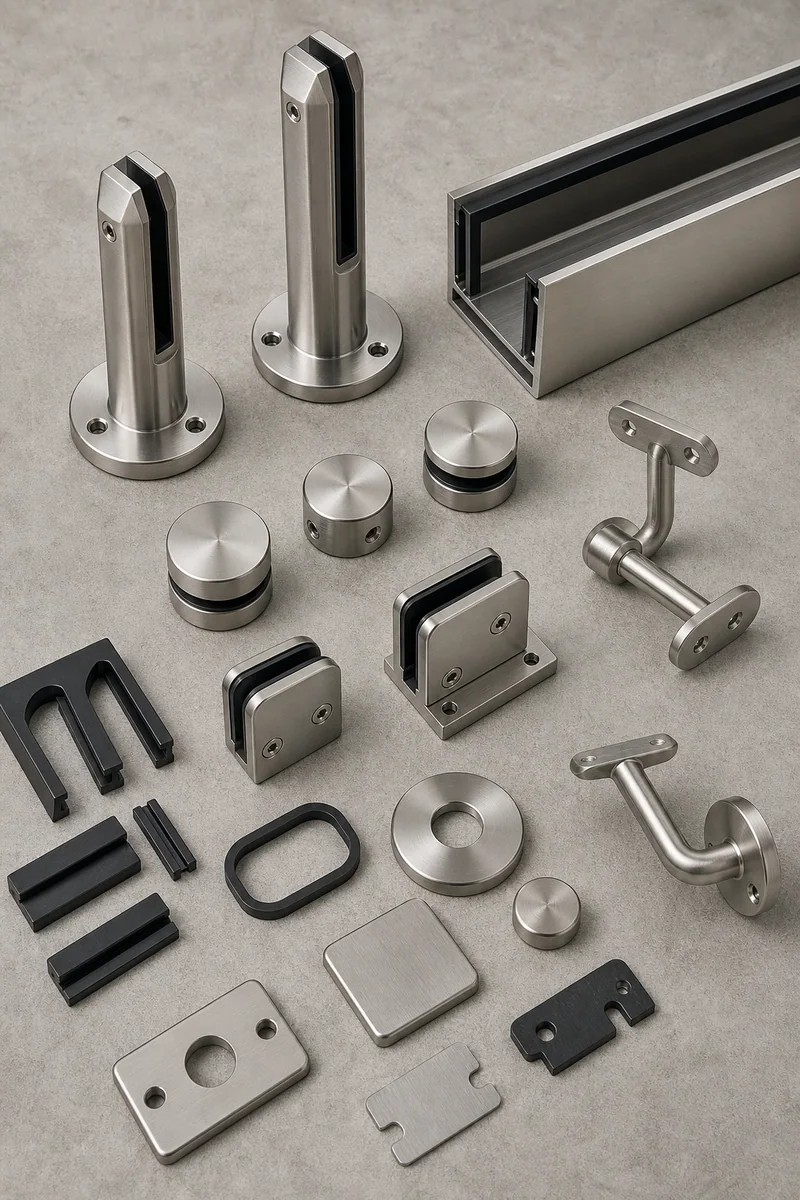
Una ensamblaje de barandilla de vidrio suele construirse a partir de un pequeño conjunto de componentes: poyos (fijos, ajustables, cuadrados o redondos), sistemas de zapata base o canal en U, separadores y accesorios de fijación puntual, abrazaderas de vidrio, soportes y conectores de pasamanos, además de las juntas, chapas de cubierta y tornillería que completan el detalle. Un catálogo puede parecer extenso mientras cubre solo parte de ese rango, por lo que ayuda a verificar la cobertura de componentes frente a los planos del proyecto antes de comparar precios.
- Cobertura de componentes: ¿Ofrece el proveedor poyos, sistemas de zapata base, separadores, abrazaderas, soportes de pasamanos y las pequeñas piezas de acabado en dimensiones compatibles?
- Material y acabado: Acero inoxidable 304 o 316, más opciones de latón, aluminio o recubrimientos donde sea relevante, y acabados como satinado, espejo, negro mate o recubrimientos PVD de color.
- Requisitos de código local y carga: Las normas de barandillas y balaustradas difieren según el país y el tipo de proyecto. Los proveedores deberían poder proporcionar la información del producto que requiere su proceso de aprobación local.
- Personalización: Si los accesorios se pueden producir según su propio dibujo, ajustados en dimensión, grabados con un logotipo, adaptados a un acabado específico, o envasados bajo su propia marca.
- Soporte de ingeniería: Dibujos CAD y 3D, comentarios de diseño para fabricación, prototipos y muestras de aprobación antes de la producción en masa.
- Modelo comercial: Marca de sistema, distribuidor de catálogo o fabricante directo. Esto define la estructura de precios, las cantidades mínimas de pedido, los plazos de entrega y la cantidad de flexibilidad que obtiene en artículos no estándar.
- Documentación y repetibilidad: Información de material, trazabilidad por lote y la capacidad de repetir el mismo acabado y dimensiones a través de fases del proyecto o repeticiones de pedido.
Cómo se ordenó esta lista
El orden refleja en qué medida cada proveedor coincide con los criterios anteriores para herrajes de barandillas de vidrio y balaustradas: cobertura del producto, capacidad de fabricación o aprovisionamiento, profundidad de personalización, apoyo de ingeniería y de proyecto, y la claridad con la que el proveedor se posiciona para compradores de comercio. Es una comparación editorial para este conjunto de criterios, no una clasificación oficial o permanente de la industria.
Aquí es importante tener en cuenta un matiz. Una empresa con un sitio web amplio en inglés y una gran producción de marketing no es automáticamente un fabricante más fuerte que una con una presencia en línea más reducida. Varios capaces fabricantes venden principalmente a través de canales comerciales y rara vez aparecen en los resultados de búsqueda, mientras que algunos nombres muy visibles son distribuidores en lugar de productores. Cuando la información pública sobre un proveedor es limitada, este artículo describe solo lo que es razonablemente claro y evita llenar vacíos con suposiciones. Los rangos de productos, materiales y servicios cambian con frecuencia, por lo que las especificaciones, las cantidades mínimas de pedido y los requisitos de documentación deben confirmarse siempre directamente con el proveedor.
Comparación de un vistazo
| Proveedor | Con sede en | Enfoque principal | Más adecuado para | Capacidad de personalización / OEM |
|---|---|---|---|---|
| Herramientas Zimmor | China (Foshan) | Hardware para duchas sin marco y hardware arquitectónico para vidrio, incluido el hardware para barandillas y pasamanos | OEM, marca privada, distribuidores y compradores de proyectos que desean un suministro coordinado | OEM/ODM, acabados personalizados, troquelado, marca privada |
| Barandilla Q | Alemania | Sistemas de barandillas modulares en vidrio, acero inoxidable y aluminio | Proyectos de balcones, escaleras y espacios públicos guiados por especificaciones | Basado en sistemas; trabajo limitado para componentes únicos |
| C.R. Laurence (CRL) | EE. UU. | Catálogo amplio de hardware para vidrieras arquitectónicas | Contratistas de vidrieras que necesitan muchos elementos del catálogo de una sola fuente | Guiado por catálogo; el trabajo personalizado se gestiona como proyectos especiales |
| Bohle | Alemania | Accesorios, herramientas y consumibles para el comercio de procesamiento del vidrio | Fabricantes y procesadores de vidrio | Guiado por catálogo; los rangos regionales difieren |
| Sadev | Francia | Hardware arquitectónico de acero inoxidable y accesorios para vidrio | Proyectos guiados por el diseño que necesitan accesorios de ingeniería | Ingeniería personalizada en acero inoxidable |
| FHC (Frameless Hardware Company) | EE. UU. | Hardware para aplicaciones de vidrio sin marco | Tiendas de vidrio y vidriadores que compran a través de cuentas comerciales | Enfoque en distribución |
| Häfele | Alemania | Distribución global de mobiliario y accesorios arquitectónicos | Compradores que consolidan accesorios de un solo distribuidor | Enfoque en distribución; el surtido varía según el país |
| Ferretería Richelieu | Canadá | Distribución de herrajes especializados para América del Norte | Distribuidores y fabricantes que buscan un suministro consolidado | Enfoque en distribución |
| Kinlong | China | Fabricación de herrajes arquitectónicos y de construcción a gran escala | Compradores a volumen que necesitan un surtido amplio de herrajes de construcción | Liderado por fabricación; los requisitos del programa varían |
| Viewrail | EE. UU. | Sistemas de barandillas de cable y vidrio | Proyectos de barandillas residenciales y comerciales ligeras | Suministro de sistemas en lugar de OEM de componentes |
Zimmor Hardware (China)
Ideal para: Compradores que necesitan herrajes de barandillas de vidrio fabricados según especificaciones, programas de marca privada, o suministro coordinado de accesorios de barandillas junto con herrajes de vidrio arquitectónico para duchas y otros de una sola fábrica.
Qué hace: Zimmor es un fabricante B2B con sede en Foshan, Guangdong, establecido en 1999, que produce herrajes para cerramientos de duchas sin marco y aplicaciones de vidrio arquitectónico. Su surtido incluye herrajes para barandillas y balaustradas de vidrio, abrazaderas de vidrio, accesorios para puertas de vidrio, sistemas deslizantes y componentes relacionados. Puede leer más sobre la empresa y su instalaciones de fabricación en su sitio web.
Principales fortalezas: Producción directa en fábrica en lugar de comercio; materiales que incluyen latón macizo, acero inoxidable 304/316, aluminio y aleación de zinc; acabados que incluyen cromo pulido, negro mate, níquel cepillado, oro cepillado, latón satinado, color cañón y bronce antique, además de correspondencia de color personalizada; electrodeposición y terminaciones in situ para resultados de superficie consistentes; mecanizado CNC, fundición a presión y producción y trazabilidad de calidad basadas en ERP.
Para compradores que desarrollan sus propios diseños de barandillas o herrajes, Zimmor realiza producción OEM y de marca privada cubriendo dimensiones, estructura, función, grabado de logotipo y embalaje, y desarrollo ODM desde el concepto a través de diseño 3D, revisión de diseño para fabricación, prototipado, troquelado y producción piloto. La empresa también gestiona suministro de proyectos de varias fases donde los acabados coincidentes, las dimensiones consistentes y los pedidos repetidos importan.
Considere: Zimmor está preparado para compradores comerciales, de OEM y de proyectos, en lugar de consumidores de venta minorista, por lo que las compras pequeñas de un solo uso no son el objetivo. Como con cualquier proveedor, la documentación de carga y los requisitos de aprobación específicos del mercado deben confirmarse para la aplicación específica de barandilla.
Q-railing (Alemania)
Ideal para: arquitectos y contratistas que especifican un sistema de barandilla modular completo, donde los componentes están diseñados para funcionar juntos.
Qué hace: Un fabricante alemán de sistemas de barandillas conocido por sus soluciones modulares en configuraciones de vidrio, acero inoxidable y aluminio para balcones, escaleras y espacios públicos.
Principales fortalezas: Enfoque a nivel de sistema, apoyo en planificación y especificación, y una amplia gama de accesorios que se mantienen dentro de un mismo lenguaje de diseño, práctico cuando un proyecto debe documentarse y replicarse en muchas unidades.
Considere: Las marcas de sistemas orientan naturalmente a los compradores hacia su propio conjunto de componentes. Si sus planos requieren accesorios a medida o acabajes no estándar en volúmenes más altos, un fabricante directo puede ofrecer mayor flexibilidad.
C.R. Laurence / CRL (EE. UU.)
Ideal para: instaladores de vidrios en América del Norte que necesitan un catálogo muy amplio de herrajes para barandillas de vidrio de una sola fuente.
Qué hace: Suministra y distribuye herrajes arquitectónicos de vidrio, incluidos artículos relacionados con barandillas como piones, soportes, sistemas de zócalo y abridores, dentro de un rango mucho más amplio de productos de vidriado.
Principales fortalezas: profundidad de catálogo, distribución establecida en América del Norte y documentación técnica de productos que ayuda a los instaladores a especificar correctamente.
Considere: Un modelo centrado en el catálogo significa que los artículos no estándar se tratan típicamente como proyectos especiales. Los compradores fuera de la región principal de distribución deben confirmar la disponibilidad, los términos de envío y el soporte para su mercado.
Bohle (Alemania)
Ideal para: procesadores de vidrio, fabricantes y talleres que desean accesorios para barandillas junto con herramientas, consumibles y equipos de manipulación de vidrio.
Qué hace: Suministra al sector de procesamiento de vidrio con accesorios, herramientas, maquinaria y consumibles en muchos mercados, con los accesorios de barandillas y pasamanos que forman parte de un rango más amplio de la industria del vidrio.
Principales fortalezas: un enfoque profundo en el sector del vidrio, distribución local en muchos países y la capacidad de combinar la compra de herrajes con herramientas y consumibles en un solo pedido.
Considere: Los catálogos y el inventario varían según el país, por lo que los artículos específicos de barandillas disponibles para usted dependen de su mercado local. Los compradores que ejecutan grandes programas de barandillas a medida a menudo comparan también con los fabricantes directos.
Sadev (Francia)
Ideal para: proyectos arquitectónicos que requieren accesorios de acero inoxidable de ingeniería en lugar de piezas estándar de catálogo.
Qué hace: Un fabricante francés de herrajes arquitectónicos de acero inoxidable y accesorios de vidrio, incluidos componentes de enmarcado estructural y de fijación puntual.
Principales fortalezas: fabricación a medida en acero inoxidable y un enfoque orientado a la ingeniería, adecuado para detalles arquitectónicos exigentes.
Considere: los herrajes de ingeniería a medida suelen adaptarse a proyectos de mayor envergadura o liderados por el diseño. Para requisitos estándar de catálogo, un proveedor de herrajes estándar suele ser más simple y rápido con el que trabajar.
FHC — Frameless Hardware Company (EE. UU.)
Ideal para: talleres de vidrio y vidrieros que compran a través de cuentas comerciales y desean un catálogo enfocado en herrajes para vidrio sin marco.
Qué hace: Un proveedor con base en EE. UU. de herrajes para aplicaciones de vidrio sin marco, incluidos accesorios relacionados con barandillas, que atiende al sector del envidriado.
Principales fortalezas: especialización en vidrio sin marco en lugar de herrajes de construcción en general, y un modelo de compra orientado a profesionales que se adapta a las empresas de instalación.
Considere: como negocio de catálogo y distribución, la fabricación personalizada y la producción de marca blanca generalmente se encuentran fuera de su ámbito central.
Häfele (Alemania)
Ideal para: compradores que ya compran accesorios de mobiliario y arquitectónicos a un distribuidor y desean consolidar pedidos, siempre que el catálogo local cubra los elementos de barandilla requeridos.
Qué hace: Un distribuidor global de mobiliario, herrajes arquitectónicos y de construcción, con catálogos específicos por país, stock local y sistemas de pedido establecidos.
Principales fortalezas: alcance logístico, disponibilidad local y una gama muy amplia de accesorios que puede simplificar la administración de compras.
Considere: Häfele no está posicionado como especialista en sistemas de barandillas de vidrio, y los elementos relacionados con barandillas varían según el mercado. Confirme la cobertura del catálogo local antes de especificarlo en un proyecto.
Richelieu Hardware (Canadá)
Ideal para: Fabricantes y distribuidores de Norteamérica que desean herrajes especializados a través de una red de distribución consolidada.
Qué hace: Un distribuidor de herrajes especializados que atiende a los mercados de Norteamérica, con herrajes arquitectónicos y relacionados con el vidrio junto con líneas de herrajes para armarios y decorativos.
Principales fortalezas: cobertura de distribución regional, inventario amplio y conveniencia de pedidos para las empresas que compran en varias categorías de herrajes.
Considere: este es un rol de distribuidor, por lo que la personalización, las herramientas de producción y la fabricación de marca privada corresponden al productor original, no a Richelieu en sí.
Kinlong (China)
Ideal para: compradores por volumen que buscan un gran fabricante chino de herrajes para construcción con una amplia gama arquitectónica.
Qué hace: Un gran fabricante chino cotizado en bolsa de herrajes arquitectónicos que suministra herrajes para edificios, puertas, ventanas y fachadas, con accesorios relacionados con el vidrio como parte de esa gama.
Principales fortalezas: escala de fabricación, un amplio programa de productos y experiencia en proyectos de construcción nacionales.
Considere: los componentes de barandillas de vidrio son una parte de un catálogo mucho más grande. Confirme los elementos específicos de barandilla, las opciones de acabado y la documentación necesaria para su mercado antes de comprometerse con un programa.
Viewrail (EE. UU.)
Ideal para: proyectos residenciales y comerciales ligeros que buscan un paquete de barandillas completo con apoyo en diseño, en lugar de componentes individuales.
Qué hace: Un fabricante estadounidense de barandillas que ofrece sistemas de barandillas de cables y vidrio para hogares y espacios comerciales, vendidos a través de un modelo directo con recursos de diseño.
Principales fortalezas: suministro a nivel de sistema que abarca paneles y herrajes, junto con herramientas de planificación que ayudan a propietarios y constructores a seleccionar un ensamble completo.
Considere: el enfoque está en sistemas de barandillas completos en lugar del suministro OEM a nivel de componente, por lo que las marcas de herrajes y distribuidores que buscan accesorios para sus propios planos pueden necesitar un tipo diferente de socio.
Correspondencia entre el tipo de proveedor y su situación de compra
Fabricantes de vidrio y contratistas de envidado
Las prioridades son la disponibilidad de componentes, dimensiones consistentes y reposición rápida. Los distribuidores de catálogos como CRL, FHC o Bohle se adaptan bien a este modelo, y combinar herrajes de barandillas con herramientas y consumibles puede reducir el trabajo administrativo.
Distribuidores, importadores y mayoristas
Los márgenes dependen del costo de llegada, la calidad del embalaje y especificaciones repetibles, lo que favorece a los fabricantes directos que pueden mantener tolerancias entre lotes y apoyar la marca de propiedad privada. El modelo basado en fábrica de Zimmor, que incluye acabado en casa y embalaje personalizado, está diseñado en torno a este tipo de relación de suministro a largo plazo.
Marcas OEM y de propiedad privada
Si vende bajo su propia marca, el factor decisivo suele ser la profundidad de la ingeniería y la personalización: planos, prototipos, moldes, coincidencia de acabados y trabajo en logotipos o embalajes. Los fabricantes directos con programas OEM y ODM suelen encajar mejor, mientras que los distribuidores de catálogos rara vez ofrecen este nivel de flexibilidad.
Arquitectos y equipos de especificación
La documentación, la consistencia del sistema y la disponibilidad a largo plazo de los mismos componentes suelen importar más que el precio unitario. Las marcas de sistemas modulares son fuertes aquí, y los fabricantes de componentes pueden apoyar detalles personalizados cuando los sistemas estándar no resuelven una condición de diseño.
Suministro para proyectos de hoteles y comerciales
Los proyectos con muchas unidades idénticas o varias fases de construcción necesitan acabados coincidentes, dimensiones estables y reordenamientos confiables con el tiempo. Los proveedores que puedan confirmar especificaciones entre fases deben priorizarse por encima de la cotización inicial más baja.
Preguntas frecuentes
¿Cuál es la diferencia entre un fabricante de herrajes para barandillas de vidrio y un proveedor?
Un fabricante produce los accesorios, típicamente con sus propias operaciones de mecanizado, fundición y acabado, y suele poder personalizar dimensiones, materiales y acabados. Un proveedor o distribuidor revende productos fabricados por otros, lo que favorece la disponibilidad de catálogo y la entrega rápida en lugar de la personalización. Muchas marcas conocidas ocupan ambos roles dependiendo de la línea de producto y el mercado.
¿El acero inoxidable 304 y 316 son ambos adecuados para herrajes de barandillas de vidrio al aire libre?
Ambas gradaciones se utilizan ampliamente en el hardware exterior de barandillas. La grado 316 ofrece generalmente una mejor resistencia en entornos ricos en cloruros, como zonas costeras, áreas alrededor de piscinas y exposición a sales de deshielo, mientras que la 304 es común en aplicaciones en el interior de tierra y protegidas. La elección adecuada de la grado depende del entorno, el régimen de mantenimiento y la especificación del proyecto, por lo que debe confirmarse con el proveedor y el equipo del proyecto en lugar de asumirse.
¿Se pueden personalizar o marcar con etiqueta propia los accesorios de barandillas de vidrio?
Sí. Los fabricantes que ofrecen programas OEM y ODM pueden generalmente ajustar dimensiones, estructura y función, hacer coincidir acabados y colores, grabar logotipos y producir embalajes personalizados o marcas propias. Esto normalmente requiere planos, muestras o requisitos funcionales detallados y generalmente involucra herramientas, muestras y cantidades mínimas de pedido.
¿Cómo puedo verificar la capacidad de fabricación de un proveedor antes de realizar un pedido?
Solicite información de la fábrica y descripciones de los procesos, pida por escrito los detalles de los materiales y acabados, pida muestras de producción para verificar tolerancias y calidad de la superficie, y confirme cómo se gestiona el control de calidad desde la materia prima entrante hasta los productos terminados. Los compradores con programas más grandes suelen combinar esto con una auditoría o un pedido de prueba. Las preguntas generales de adquisición y especificación también se abordan en la FAQ del sitio.
¿Qué afecta la cantidad mínima de pedido y el plazo de entrega del hardware de barandillas de vidrio?
El pedido mínimo (MOQ) y el plazo de entrega dependen de si el elemento es un producto estándar del catálogo o un componente personalizado, el proceso de acabado involucrado, los requisitos de herramientas y el volumen del pedido. Los acabados personalizados, los recubrimientos PVD y el embalaje de marca propia generalmente añaden tanto trabajo de configuración como plazo de entrega en comparación con los acabados estándar.
Resumen
No existe un único proveedor óptimo de herrajes para barandillas de vidrio para todos los compradores. Los proyectos arquitectónicos con especificaciones detalladas suelen preferir marcas de sistemas modulares; los contratistas de vidrieras valoran catálogos amplios y distribución local; y los distribuidores, importadores, marcas OEM y contratistas de proyectos generalmente obtienen la mayor flexibilidad de los fabricantes directos que pueden producir según dibujo, igualar los acabados entre lotes y apoyar programas de marca privada. Haga una lista preliminar de dos o tres proveedores que coincidan con su modelo de compra, compárelos en función de la cobertura de componentes, materiales, profundidad de personalización y documentación, y confirme las especificaciones actuales directamente antes de comprometerse con un proyecto.