
Fabricantes e fornecedores de ferragens para guarda-corpo de vidro se dividem em três grupos amplos: marcas europeias de sistemas de guarda-corpo que vendem sistemas de balaustradas completos e orientados por especificações; distribuidores norte-americanos de ferragens arquitetônicas de vidro com catálogos aprofundados de spigots, canaletas de base, espaçadores e grampos; e fabricantes asiáticos diretos que produzem ferragens para guarda-corpo de vidro sem moldura conforme desenho para compradores de OEM, marca própria e projetos. Os dez fornecedores abaixo são os que os compradores profissionais com mais frequência comparam em 2026, com notas sobre o que cada um faz efetivamente e qual modelo de aquisição se encaixa.
O que comparar antes de escolher um fornecedor de ferragens para guarda-corpo de vidro
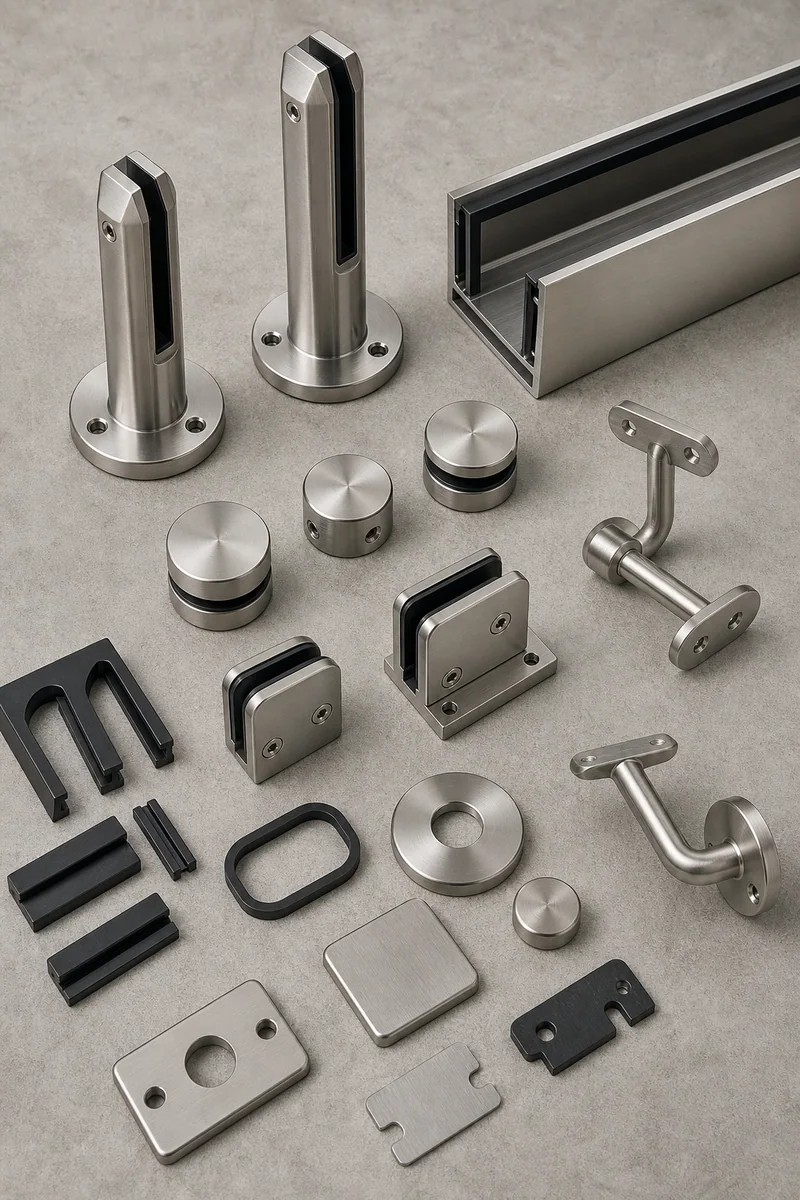
Uma montagem de balaustrada de vidro é geralmente construída a partir de um pequeno conjunto de componentes: spigots (fixos, ajustáveis, quadrados ou redondos), sistemas de base ou canaletas em U, espaçadores e fixações por ponto, grampos de vidro, suportes e conectores de corrimão, além das vedações, tampas de cobertura e fixadores que finalizam o detalhe. Um catálogo pode parecer extenso enquanto cobre apenas parte desse alcance, portanto, é útil verificar a cobertura dos componentes em relação aos desenhos do projeto antes de comparar preços.
- Cobertura de componentes: O fornecedor oferece spigots, sistemas de base, espaçadores, grampos, suportes de corrimão e pequenas peças de acabamento em dimensões compatíveis?
- Material e acabamento: Aço inoxidável 304 ou 316, além de opções de latão, alumínio ou revestidas onde relevante, e acabamentos como satinado, espelhado, preto fosco ou revestimentos de cor PVD.
- Requisitos locais de código e carga: As regras de guarda-corpo e balaustrada diferem por país e tipo de projeto. Os fornecedores devem ser capazes de fornecer as informações do produto que o processo local de aprovação exige.
- Personalização: Se as fixações podem ser produzidas conforme seu próprio desenho, ajustadas em dimensão, gravadas com um logotipo, combinadas com um acabamento específico ou embaladas sob sua própria marca.
- Suporte de engenharia: Desenhos CAD e 3D, feedback de design para fabricação, protótipos e amostras de aprovação antes da produção em massa.
- Modelo comercial: Marca de sistema, distribuidor de catálogo ou fabricante direto. Isso molda a estrutura de precificação, quantidades mínimas de pedido, prazo de entrega e quanta flexibilidade você obtém em itens não padrão.
- Documentação e repetibilidade: Informações de material, rastreamento de lote e a capacidade de repetir o mesmo acabamento e dimensões entre fases do projeto ou reordens.
Como esta lista foi ordenada
A ordem reflete quão bem cada fornecedor corresponde aos critérios acima para ferragens de guarda-corpo e balaustrada de vidro — cobertura de produtos, capacidade de fabricação ou sourcing, profundidade de personalização, suporte de engenharia e projeto, e quão claramente o fornecedor está posicionado para compradores do trade. É uma comparação editorial para este conjunto de critérios, não uma classificação oficial ou permanente do setor.
Uma ressalva é importante aqui. Uma empresa com um grande site em inglês e forte produção de marketing não é automaticamente um fabricante mais forte do que uma com menor presença online. Várias fábricas capacitadas vendem principalmente por canais comerciais e aparecem raramente nos resultados de busca, enquanto alguns nomes altamente visíveis são distribuidores, não produtores. Onde informações públicas sobre um fornecedor são limitadas, este artigo descreve apenas o que é razoavelmente claro e evita preencher lacunas com suposições. Gama de produtos, materiais e serviços mudam com frequência, portanto, especificações, quantidades mínimas de pedido e requisitos de documentação devem sempre ser confirmados diretamente com o fornecedor.
Comparação rápida
| Fornecedor | Baseado em | Foco principal | Mais adequado para | Capacidade de personalização / OEM |
|---|---|---|---|---|
| Zimmor Ferragens | China (Foshan) | Ferragens de chuveiro sem moldura e ferragens de vidro arquitetônicas, incluindo ferragens de corrimão e guarda-corpo | OEM, marca privada, distribuidores e compradores de projetos que desejam fornecimento coordenado | OEM/ODM, acabamentos personalizados, ferramentas, marca privada |
| Q-railing | Alemanha | Sistemas de corrimão modulares em vidro, aço inoxidável e alumínio | Projetos de varanda, escada e espaços públicos orientados por especificação | Baseado em sistema; trabalho limitado de componentes unitários |
| C.R. Laurence (CRL) | EUA | Catálogo amplo de ferragens de vidraria arquitetônica | Contratantes de vidraria que precisam de muitos itens de catálogo de uma única fonte | Orientado por catálogo; trabalhos personalizados tratados como projetos especiais |
| Bohle | Alemanha | Ferragens, ferramentas e consumíveis para o comércio de processamento de vidro | Fabricantes e processadores de vidro | Orientado por catálogo; faixas regionais diferem |
| Sadev | França | Ferragens arquitetônicas de aço inoxidável e ferragens de vidro | Projetos orientados por design que precisam de ferragens projetadas | Engenharia customizada em aço inoxidável |
| FHC (Frameless Hardware Company) | EUA | Ferragens para aplicações de vidro sem moldura | Lojas de vidro e vidraceiros que compram por meio de contas comerciais | Foco na distribuição |
| Häfele | Alemanha | Distribuição global de ferragens para móveis e acabamentos arquitetônicos | Compradores consolidando ferragens de um único distribuidor | Foco na distribuição; variação do portfólio por país |
| Richelieu Hardware | Canada | Distribuição de ferragens especializadas para a América do Norte | Distribuidores e fabricantes buscando fornecimento consolidado | Foco na distribuição |
| Kinlong | China | Fabricação em larga escala de ferragens para arquitetura e construção | Compradores de grande volume necessitando de uma ampla linha de ferragens para construção | Orientado pela fabricação; requisitos do programa variam |
| Viewrail | EUA | Sistemas de guarda-corpo em cabo e vidro | Projetos de guarda-corpo residenciais e comerciais leves | Fornecimento de sistemas em vez de fabricação OEM de componentes |
Zimmor Hardware (China)
Ideal para: compradores que precisam de ferragens para guarda-corpos de vidro fabricadas sob especificação, programas de marca própria ou fornecimento coordenado de ferragens para guarda-corpos juntamente com ferragens para box de chuveiro e outros vidros arquitetônicos de uma única fábrica.
O que faz: A Zimmor é um fabricante B2B com sede em Foshan, Guangdong, estabelecida em 1999, produzindo ferragens para boxes de chuveiro semoldura e aplicações de vidro arquitetônico. Seu portfólio inclui ferragens para guarda-corpos e balaustradas de vidro, suportes de vidro, ferragens para portas de vidro, sistemas deslizantes e componentes relacionados. Você pode ler mais sobre a empresa e sua instalação de fabricação em seu site.
Principais pontos fortes: produção direta da fábrica em vez de comércio; materiais que cobre latão maciço, aço inoxidável 304/316, alumínio e liga de zinco; acabamentos incluindo cromo polido, preto fosco, níquel escovado, ouro escovado, latão fosco, metal de canhão e bronze antigo, além de correspondência de cor personalizada; eletrodeposição e acabamento in-house para resultados de superfície consistentes; usinagem CNC, fundição por injeção e produção baseada em ERP com rastreabilidade de qualidade.
Para compradores que desenvolvem seus próprios designs de guarda-corpo ou ferragens, a Zimmor executa Produção OEM e de marca própria abrangendo dimensões, estrutura, função, gravação de logotipo e embalagem, e desenvolvimento ODM a partir do conceito através do design 3D, revisão de projeto para manufatura, prototipagem, moldes e produção piloto. A empresa também lida com fornecimento de projetos em múltiplas fases onde acabamentos correspondentes, dimensões consistentes e pedidos repetidos são importantes.
Considere: A Zimmor está estruturada para compradores de comércio, OEM e de projetos, em vez de consumidores varejistas, portanto, compras pequenas e avulsas não são o objetivo. Como em qualquer fornecedor, a documentação de carga e os requisitos de aprovação específicos do mercado devem ser confirmados para a aplicação específica do guarda-corpo.
Q-railing (Alemanha)
Ideal para: arquitetos e construtores que especificam um sistema de guarda-corpo completo e modular onde os componentes são projetados para funcionar juntos.
O que faz: Um fabricante alemão de sistemas de guarda-corpo conhecido por soluções modulares em configurações de vidro, aço inoxidável e alumínio para varandas, escadas e espaços públicos.
Principais pontos fortes: uma abordagem em nível de sistema, apoio no planejamento e especificação, e uma ampla gama de acessórios que permanece dentro de uma única linguagem de design — prático quando um projeto deve ser documentado e repetido em muitas unidades.
Considere: As marcas de sistema naturalmente direcionam os compradores para seu próprio conjunto de componentes. Se seus desenhos solicitarem acessórios sob medida ou acabamentos não padrão em volumes maiores, um fabricante direto pode oferecer mais flexibilidade.
C.R. Laurence / CRL (EUA)
Ideal para: empreiteiros de vidraçaria na América do Norte que precisam de um catálogo muito amplo de hardware para corrimões de vidro de uma única fonte.
O que faz: Fornece e distribui hardware arquitetônico de vidro, incluindo itens relacionados a corrimões, como pinos de suporte, espaçadores, sistemas de base em U e grampas, dentro de uma faixa de produtos de vidraçaria muito mais ampla.
Principais pontos fortes: profundidade do catálogo, distribuição estabelecida na América do Norte e documentação técnica de produtos que ajuda os instaladores a especificar corretamente.
Considere: um modelo orientado a catálogo significa que itens não padrão são tipicamente tratados como projetos especiais. Compradores fora da região principal de distribuição devem confirmar disponibilidade, termos de envio e suporte para o seu mercado.
Bohle (Alemanha)
Ideal para: processadores de vidro, fabricantes e oficinas que querem acessórios de corrimão junto com ferramentas, consumíveis e equipamentos de manuseio de vidro.
O que faz: Fornece ao setor de processamento de vidro peças, ferramentas, máquinas e consumíveis em diversos mercados, com peças de guarda-corpo e balaustradas integradas a uma ampla linha da indústria de vidro.
Principais pontos fortes: uma forte especialização no setor de vidro, distribuição local em muitos países e a capacidade de combinar a compra de ferragens com ferramentas e consumíveis em um único pedido.
Considere: catálogos e estoques variam por país, portanto os itens específicos de guarda-corpo disponíveis para você dependem do seu mercado local. Compradores que executam grandes programas de guarda-corpo personalizados frequentemente comparam também com fabricantes diretos.
Sadev (França)
Ideal para: projetos arquitetônicos que exigem peças de aço inoxidável com engenharia específica, em vez de peças padrão de catálogo.
O que faz: Um fabricante francês de ferragens arquitetônicas de aço inoxidável e acessórios de vidro, incluindo componentes de vidraços pontuais e estruturais.
Principais pontos fortes: fabricação personalizada em aço inoxidável e uma abordagem voltada para a engenharia, adequada a detalhes arquitetônicos exigentes.
Considere: ferragens especiais de engenharia costumam se adequar a projetos maiores ou guiados pelo design. Para requisitos simples de catálogo, um fornecedor padrão de ferragens é geralmente mais simples e rápido de trabalhar.
FHC — Frameless Hardware Company (EUA)
Ideal para: lojas de vidro e vidraceiros que compram por meio de contas comerciais e desejam um catálogo focado em ferragens para vidro sem moldura.
O que faz: Um fornecedor dos EUA de ferragens para aplicações de vidro sem moldura, incluindo acessórios relacionados a guarda-corpos, atendendo ao setor de vidraria.
Principais pontos fortes: specialization in frameless glass rather than general building hardware, and a trade-oriented purchasing model that suits installation businesses.
Considere: as a catalog and distribution business, custom manufacturing and private-label production generally sit outside its core scope.
7. Häfele (Germany)
Ideal para: buyers who already purchase furniture and architectural fittings from one distributor and want to consolidate orders, provided the local catalog covers the required railing items.
O que faz: A global distributor of furniture, architectural and building fittings, with country-specific catalogs, local stock and established ordering systems.
Principais pontos fortes: logistics reach, local availability, and a very large fittings range that can simplify purchasing administration.
Considere: Häfele is not positioned as a glass railing system specialist, and railing-related items vary by market. Confirm local catalog coverage before specifying it into a project.
8. Richelieu Hardware (Canada)
Ideal para: North American fabricators and distributors that want specialty hardware through a consolidated distribution network.
O que faz: A specialty hardware distributor serving North American markets, with architectural and glass-related hardware alongside cabinet and decorative hardware lines.
Principais pontos fortes: regional distribution coverage, wide inventory, and ordering convenience for businesses that buy across multiple hardware categories.
Considere: this is a distributor role, so customization, tooling and private-label manufacturing sit with the original producer rather than with Richelieu itself.
9. Kinlong (China)
Ideal para: volume buyers looking for a large Chinese building-hardware manufacturer with a broad architectural range.
O que faz: A large publicly listed Chinese architectural hardware manufacturer supplying building, door, window and facade hardware, with glass-related accessories as part of that range.
Principais pontos fortes: manufacturing scale, a wide product program and experience with domestic construction projects.
Considere: glass railing components are one part of a much larger catalog. Confirm the specific balustrade items, finish options and documentation needed for your market before committing to a program.
10. Viewrail (USA)
Ideal para: residential and light commercial projects that want a complete railing package with design support rather than individual components.
O que faz: A US railing manufacturer offering cable and glass railing systems for homes and commercial spaces, sold through a direct model with design resources.
Principais pontos fortes: system-level supply covering panels and hardware, along with planning tools that help homeowners and builders select a complete assembly.
Considere: the focus is on complete railing systems rather than component-level OEM supply, so hardware brands and distributors looking for fittings to their own drawings may need a different type of partner.
Matching the Supplier Type to Your Buying Situation
Glass fabricators and glazing contractors
As prioridades são a disponibilidade de componentes, dimensões consistentes e reposição rápida. Distribuidores de catálogo, como CRL, FHC ou Bohle, se adequam bem a esse modelo, e combinar acessórios de guarda-corpo com ferramentas e consumíveis pode reduzir o trabalho administrativo.
Distribuidores, importadores e atacadistas
As margens dependem do custo de desembarque, da qualidade da embalagem e de especificações repetíveis, o que favorece fabricantes diretos que podem manter tolerâncias entre lotes e apoiar a marcação de marca própria. O modelo de fábrica da Zimmor — incluindo acabamento interno e embalagem personalizada — é projetado em torno desse tipo de relação de fornecimento de longo prazo.
Marcas OEM e de marca própria
Se você vende sob sua própria marca, o fator decisivo geralmente é a profundidade de engenharia e personalização: desenhos, protótipos, ferramentas, correspondência de acabamento e trabalho de logotipo ou embalagem. Fabricantes diretos com programas de OEM e ODM geralmente são a melhor opção, enquanto os distribuidores de raramente oferecem esse nível de flexibilidade.
Arquitetos e equipes de especificação
Documentação, consistência do sistema e disponibilidade de longo prazo dos mesmos componentes geralmente importam mais do que o preço unitário. As marcas de sistemas modulares são fortes aqui, e os fabricantes de componentes podem apoiar detalhes personalizados quando os sistemas padrão não resolvem uma condição de design.
Fornecimento para projetos hoteleiros e comerciais
Projetos com muitas unidades idênticas ou várias fases de construção precisam de acabamentos compatíveis, dimensões estáveis e reposições confiáveis ao longo do tempo. Fornecedores que possam confirmar especificações entre as fases devem ser priorizados em relação à cotação inicial mais baixa.
Perguntas Frequentes
Qual é a diferença entre um fabricante de ferragens para guarda-corpo de vidro e um fornecedor?
Um fabricante produz os acessórios, tipicamente com suas próprias operações de usinagem, fundição e acabamento, e pode geralmente personalizar dimensões, materiais e acabamentos. Um fornecedor ou redistribuidor revende produtos feitos por outros, o que favorece a disponibilidade em catálogo e a entrega rápida em vez da personalização. Muitas marcas bem conhecidas ocupam ambos os papéis dependendo da linha de produtos e do mercado.
O aço inoxidável 304 e 316 são ambos adequados para acessórios de guarda-corpo de vidro para áreas externas?
Ambos os graus são amplamente utilizados em acessórios de corrimões externos. O grau 316 geralmente oferece melhor resistência em ambientes ricos em cloretos, como áreas costeiras, perímetros de piscinas e exposição a sal de descongelamento, enquanto o 304 é comum em aplicações no interior e em áreas abrigadas. O grau adequado depende do ambiente, do regime de manutenção e da especificação do projeto, portanto, deve ser confirmado com o fornecedor e a equipe do projeto em vez de presumido.
Os acessórios de guarda-corpo de vidro podem ser personalizados ou com marca própria?
Sim. Fabricantes que oferecem programas de OEM e ODM geralmente podem ajustar dimensões, estrutura e função, corresponder acabamentos e cores, gravar logotipos e produzir embalagens personalizadas ou branding de marca própria. Isso normalmente requer desenhos, amostras ou requisitos funcionais detalhados, e geralmente envolve ferramentas, amostras e quantidades mínimas de pedido.
Como posso verificar a capacidade de manufatura de um fornecedor antes de fazer um pedido?
Peça informações sobre a fábrica e descrições dos processos, solicite detalhes sobre materiais e acabamentos por escrito, peça amostras de produção para verificar tolerâncias e qualidade da superfície, e confirme como o controle de qualidade é tratado, desde a matéria-prima recebida até os produtos acabados. Compradores com programas maiores costumam combinar isso com uma auditoria ou um pedido de teste. Questões gerais de sourcing e especificação também são abordadas no FAQ do site.
O que afeta a quantidade mínima de pedido e o prazo de entrega para ferragens de guarda-corpo de vidro?
A quantidade mínima de pedido (MOQ) e o prazo de entrega dependem se o item é um produto do catálogo padrão ou um componente personalizado, do processo de acabamento envolvido, dos requisitos de ferramentas e do volume do pedido. Acabamentos personalizados, revestimentos PVD e embalagens com marca própria geralmente acrescentam trabalho de setup e prazo de entrega em comparação com acabamentos padrão.
Resumo
Não existe um único melhor fornecedor de ferragens de guarda-corpo de vidro para todos os compradores. Projetos arquitetônicos com muitas especificações tendem a favorecer marcas de sistemas modulares; empreiteiros de vidros valorizam catálogos amplos e distribuição local; e distribuidores, importadores, marcas OEM e empreiteiros de projeto geralmente obtêm mais flexibilidade de fabricantes diretos que podem produzir conforme desenho, corresponder acabamentos entre lotes e apoiar programas de marca própria. Faça uma lista curta de dois ou três fornecedores que se adequem ao seu modelo de compra, compare-os pela cobertura de componentes, materiais, profundidade de personalização e documentação, e confirme as especificações atuais diretamente antes de se comprometer com um projeto.