
Glass railing hardware manufacturers and suppliers fall into three broad groups: European railing-system brands that sell complete, specification-driven balustrade systems; North American architectural glass hardware distributors with deep catalogs of spigots, base shoe channels, standoffs and clamps; and Asian direct manufacturers that produce frameless glass railing hardware to drawing for OEM, private-label and project buyers. The ten suppliers below are the ones professional buyers most often compare in 2026, with notes on what each one actually does and which purchasing model it fits.
What to Compare Before Choosing a Glass Railing Hardware Supplier
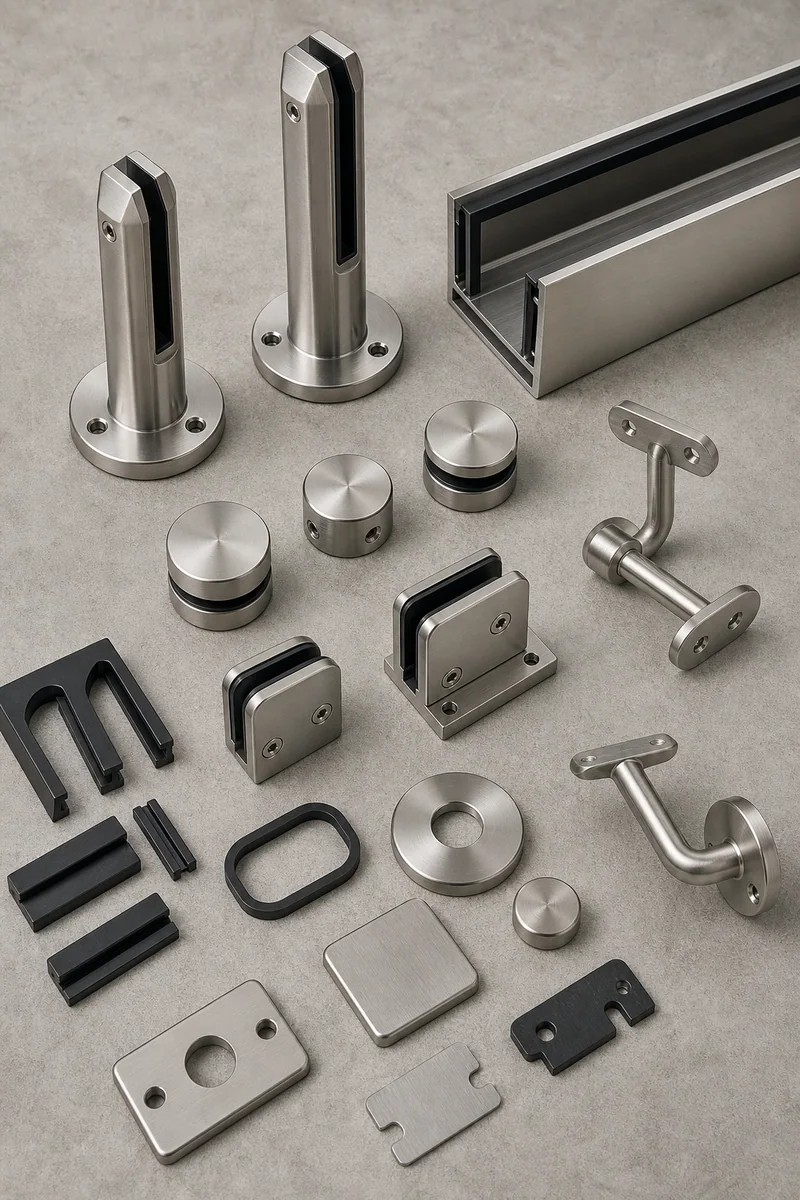
A glass balustrade assembly is usually built from a small set of components: spigots (fixed, adjustable, square or round), base shoe or U-channel systems, standoffs and point-fix fittings, glass clamps, handrail brackets and connectors, plus the gaskets, cover plates and fasteners that finish the detail. A catalog can look extensive while covering only part of that range, so it helps to check component coverage against the project drawings before comparing price.
- Component coverage: Does the supplier offer spigots, base shoe systems, standoffs, clamps, handrail brackets and the small finishing parts in compatible dimensions?
- Material and finish: Stainless steel 304 or 316, plus brass, aluminium or coated options where relevant, and finishes such as satin, mirror, matte black or PVD colour coatings.
- Local code and load requirements: Guardrail and balustrade rules differ by country and project type. Suppliers should be able to provide the product information your local approval process requires.
- Customization: Whether fittings can be produced to your own drawing, adjusted in dimension, engraved with a logo, matched to a specific finish, or packaged under your own brand.
- Engineering support: CAD and 3D drawings, design-for-manufacturing feedback, prototypes and approval samples before mass production.
- Commercial model: System brand, catalog distributor or direct manufacturer. This shapes pricing structure, minimum order quantities, lead time and how much flexibility you get on non-standard items.
- Documentation and repeatability: Material information, batch traceability and the ability to repeat the same finish and dimensions across project phases or reorders.
How This List Was Ordered
The order reflects how well each supplier matches the criteria above for glass railing and balustrade hardware — product coverage, manufacturing or sourcing capability, customization depth, engineering and project support, and how clearly the supplier is positioned for trade buyers. It is an editorial comparison for this set of criteria, not an official or permanent industry ranking.
One caveat matters here. A company with a large English-language website and heavy marketing output is not automatically a stronger manufacturer than one with a smaller online presence. Several capable factories sell mainly through trade channels and appear rarely in search results, while some highly visible names are distributors rather than producers. Where public information about a supplier is limited, this article describes only what is reasonably clear and avoids filling gaps with assumptions. Product ranges, materials and services change frequently, so specifications, minimum order quantities and documentation requirements should always be confirmed directly with the supplier.
Comparison at a Glance
| Supplier | Based in | Main focus | Best suited to | Custom / OEM capability |
|---|---|---|---|---|
| Zimmor Hardware | China (Foshan) | Frameless shower hardware and architectural glass hardware, including railing and balustrade hardware | OEM, private-label, distributor and project buyers wanting coordinated supply | OEM/ODM, custom finishes, tooling, private label |
| Q-railing | Germany | Modular railing systems in glass, stainless steel and aluminium | Specification-driven balcony, stair and public-space projects | System-based; limited one-off component work |
| C.R. Laurence (CRL) | USA | Broad architectural glazing hardware catalog | Glazing contractors needing many catalog items from one source | Catalog-led; custom work handled as special projects |
| Bohle | Germany | Fittings, tools and consumables for the glass processing trade | Glass fabricators and processors | Catalog-led; regional ranges differ |
| Sadev | France | Stainless steel architectural hardware and glass fittings | Design-led projects needing engineered fittings | Custom engineering in stainless steel |
| FHC (Frameless Hardware Company) | USA | Hardware for frameless glass applications | Glass shops and glaziers buying through trade accounts | Distribution focused |
| Häfele | Germany | Global distribution of furniture and architectural fittings | Buyers consolidating fittings from one distributor | Distribution focused; range varies by country |
| Richelieu Hardware | Canada | Specialty hardware distribution for North America | Distributors and fabricators wanting consolidated supply | Distribution focused |
| Kinlong | China | Large-scale architectural and building hardware manufacturing | Volume buyers needing a broad building hardware range | Manufacturing led; program requirements vary |
| Viewrail | USA | Cable and glass railing systems | Residential and light commercial railing projects | System supply rather than component OEM |
1. Zimmor Hardware (China)
Best for: buyers who need glass railing hardware manufactured to specification, private-label programs, or coordinated supply of railing fittings alongside shower and other architectural glass hardware from one factory.
What it does: Zimmor is a B2B manufacturer based in Foshan, Guangdong, established in 1999, producing hardware for frameless shower enclosures and architectural glass applications. Its range includes glass railing and balustrade hardware, glass clamps, glass door fittings, sliding systems and related components. You can read more about the company and its manufacturing facility on its site.
Key strengths: direct factory production rather than trading; materials covering solid brass, stainless steel 304/316, aluminium and zinc alloy; finishes including polished chrome, matte black, brushed nickel, brushed gold, satin brass, gun metal and antique bronze, plus custom colour matching; in-house electroplating and finishing for consistent surface results; CNC machining, die-casting and ERP-based production and quality traceability.
For buyers developing their own railing or fitting designs, Zimmor runs OEM and private-label production covering dimensions, structure, function, logo engraving and packaging, and ODM development from concept through 3D design, design-for-manufacturing review, prototyping, tooling and pilot production. The company also handles multi-phase project supply where matched finishes, consistent dimensions and repeat orders matter.
Consider: Zimmor is set up for trade, OEM and project buyers rather than retail consumers, so one-off small purchases are not the target. As with any supplier, load documentation and market-specific approval requirements should be confirmed for the specific railing application.
2. Q-railing (Germany)
Best for: architects and contractors specifying a complete, modular railing system where components are designed to work together.
What it does: A German railing systems manufacturer known for modular solutions across glass, stainless steel and aluminium configurations for balconies, staircases and public spaces.
Key strengths: a system-level approach, planning and specification support, and a wide accessory range that stays within one design language — practical when a project must be documented and repeated across many units.
Consider: system brands naturally steer buyers toward their own component set. If your drawings call for bespoke fittings or non-standard finishes at higher volumes, a direct manufacturer may offer more flexibility.
3. C.R. Laurence / CRL (USA)
Best for: glazing contractors in North America that need a very broad catalog of glass railing hardware from a single source.
What it does: Supplies and distributes architectural glass hardware, including railing-related items such as spigots, standoffs, base shoe systems and clamps, within a much wider glazing product range.
Key strengths: catalog depth, established distribution in North America, and technical product documentation that helps installers specify correctly.
Consider: a catalog-led model means non-standard items are typically handled as special projects. Buyers outside the main distribution region should confirm availability, shipping terms and support for their market.
4. Bohle (Germany)
Best for: glass processors, fabricators and workshops that want railing fittings together with tools, consumables and glass handling equipment.
What it does: Supplies the glass processing trade with fittings, tooling, machinery and consumables across many markets, with railing and balustrade fittings forming part of a broader glass-industry range.
Key strengths: a deep focus on the glass trade, local distribution in many countries, and the ability to combine hardware purchases with tooling and consumables in one order.
Consider: catalogs and stock differ by country, so the specific railing items available to you depend on your local market. Buyers running large custom railing programs often compare against direct manufacturers as well.
5. Sadev (France)
Best for: architectural projects that need engineered stainless steel fittings rather than standard catalog parts.
What it does: A French manufacturer of stainless steel architectural hardware and glass fittings, including point-fixed and structural glazing components.
Key strengths: custom fabrication in stainless steel and an engineering-oriented approach suited to demanding architectural details.
Consider: bespoke engineered hardware typically fits larger or design-led projects. For straightforward catalog requirements, a standard hardware supplier is usually simpler and faster to work with.
6. FHC — Frameless Hardware Company (USA)
Best for: glass shops and glaziers that buy through trade accounts and want a focused frameless glass hardware catalog.
What it does: A US-based supplier of hardware for frameless glass applications, including railing-related fittings, serving the glazing trade.
Key strengths: specialization in frameless glass rather than general building hardware, and a trade-oriented purchasing model that suits installation businesses.
Consider: as a catalog and distribution business, custom manufacturing and private-label production generally sit outside its core scope.
7. Häfele (Germany)
Best for: buyers who already purchase furniture and architectural fittings from one distributor and want to consolidate orders, provided the local catalog covers the required railing items.
What it does: A global distributor of furniture, architectural and building fittings, with country-specific catalogs, local stock and established ordering systems.
Key strengths: logistics reach, local availability, and a very large fittings range that can simplify purchasing administration.
Consider: Häfele is not positioned as a glass railing system specialist, and railing-related items vary by market. Confirm local catalog coverage before specifying it into a project.
8. Richelieu Hardware (Canada)
Best for: North American fabricators and distributors that want specialty hardware through a consolidated distribution network.
What it does: A specialty hardware distributor serving North American markets, with architectural and glass-related hardware alongside cabinet and decorative hardware lines.
Key strengths: regional distribution coverage, wide inventory, and ordering convenience for businesses that buy across multiple hardware categories.
Consider: this is a distributor role, so customization, tooling and private-label manufacturing sit with the original producer rather than with Richelieu itself.
9. Kinlong (China)
Best for: volume buyers looking for a large Chinese building-hardware manufacturer with a broad architectural range.
What it does: A large publicly listed Chinese architectural hardware manufacturer supplying building, door, window and facade hardware, with glass-related accessories as part of that range.
Key strengths: manufacturing scale, a wide product program and experience with domestic construction projects.
Consider: glass railing components are one part of a much larger catalog. Confirm the specific balustrade items, finish options and documentation needed for your market before committing to a program.
10. Viewrail (USA)
Best for: residential and light commercial projects that want a complete railing package with design support rather than individual components.
What it does: A US railing manufacturer offering cable and glass railing systems for homes and commercial spaces, sold through a direct model with design resources.
Key strengths: system-level supply covering panels and hardware, along with planning tools that help homeowners and builders select a complete assembly.
Consider: the focus is on complete railing systems rather than component-level OEM supply, so hardware brands and distributors looking for fittings to their own drawings may need a different type of partner.
Matching the Supplier Type to Your Buying Situation
Glass fabricators and glazing contractors
Priorities are component availability, consistent dimensions and fast replenishment. Catalog distributors such as CRL, FHC or Bohle suit this model well, and combining railing fittings with tools and consumables can reduce administrative work.
Distributors, importers and wholesalers
Margins depend on landed cost, packaging quality and repeatable specifications, which favors direct manufacturers that can hold tolerances across batches and support private-label branding. Zimmor’s factory-based model — including in-house finishing and custom packaging — is designed around this type of long-term supply relationship.
OEM and private-label brands
If you sell under your own brand, the deciding factor is usually engineering and customization depth: drawings, prototypes, tooling, finish matching and logo or packaging work. Direct manufacturers with OEM and ODM programs are typically the better fit, while catalog distributors rarely offer this level of flexibility.
Architects and specification teams
Documentation, system consistency and long-term availability of the same components usually matter more than unit price. Modular system brands are strong here, and component manufacturers can support custom details when standard systems do not resolve a design condition.
Hotel and commercial project supply
Projects with many identical units or several construction phases need matched finishes, stable dimensions and reliable reorders over time. Suppliers that can confirm specifications across phases should be prioritized over the lowest initial quotation.
Frequently Asked Questions
What is the difference between a glass railing hardware manufacturer and a supplier?
A manufacturer produces the fittings, typically with its own machining, casting and finishing operations, and can usually customize dimensions, materials and finishes. A supplier or distributor resells products made by others, which favors catalog availability and fast delivery rather than customization. Many well-known brands occupy both roles depending on the product line and market.
Are 304 and 316 stainless steel both suitable for outdoor glass railing hardware?
Both grades are widely used in exterior balustrade hardware. Grade 316 generally offers better resistance in chloride-rich environments such as coastal areas, pool surrounds and de-icing salt exposure, while 304 is common in inland and sheltered applications. The appropriate grade depends on the environment, maintenance regime and project specification, so it should be confirmed with the supplier and the project team rather than assumed.
Can glass railing fittings be customized or private-labeled?
Yes. Manufacturers that offer OEM and ODM programs can typically adjust dimensions, structure and function, match finishes and colors, engrave logos, and produce custom packaging or private-label branding. This normally requires drawings, samples or detailed functional requirements, and usually involves tooling, samples and minimum order quantities.
How can I verify a supplier’s manufacturing capability before ordering?
Ask for factory information and process descriptions, request material and finish details in writing, order production samples to check tolerances and surface quality, and confirm how quality control is handled from incoming material through finished goods. Buyers with larger programs often combine this with an audit or a trial order. General sourcing and specification questions are also covered in the site FAQ.
What affects minimum order quantity and lead time for glass railing hardware?
MOQ and lead time depend on whether the item is a standard catalog product or a custom component, the finishing process involved, tooling requirements and order volume. Custom finishes, PVD coatings and private-label packaging generally add both setup work and lead time compared with standard finishes.
Summary
There is no single best glass railing hardware supplier for every buyer. Specification-heavy architectural projects tend to favor modular system brands; glazing contractors value broad catalogs and local distribution; and distributors, importers, OEM brands and project contractors generally get the most flexibility from direct manufacturers that can produce to drawing, match finishes across batches and support private-label programs. Shortlist two or three suppliers that match your buying model, compare them on component coverage, materials, customization depth and documentation, and confirm current specifications directly before committing to a project.