
A sliding shower door system is a coordinated set of track, rollers, guides, stops, handles, and seals. This guide focuses on the system handoff and bill of materials, while model selection and glass fabrication inputs remain tied to their own drawings.

List every system component by function
Create a schedule for track, moving and fixed panel hardware, rollers, guides, stops, handle, seals, and end fittings. Identify the model and quantity for each enclosure. Mark optional items separately from parts required for the chosen layout. This makes missing interfaces visible before the package reaches purchasing or the installer.
Check the interfaces between parts
Use the supplier's system drawing to verify wheel-to-track, guide-to-panel, stop-to-rail, and seal-to-closing-edge relationships. Record the dimensions and revisions that control each interface. Do not combine parts from different systems based only on a similar appearance; request a written fit confirmation if a substitution is proposed.
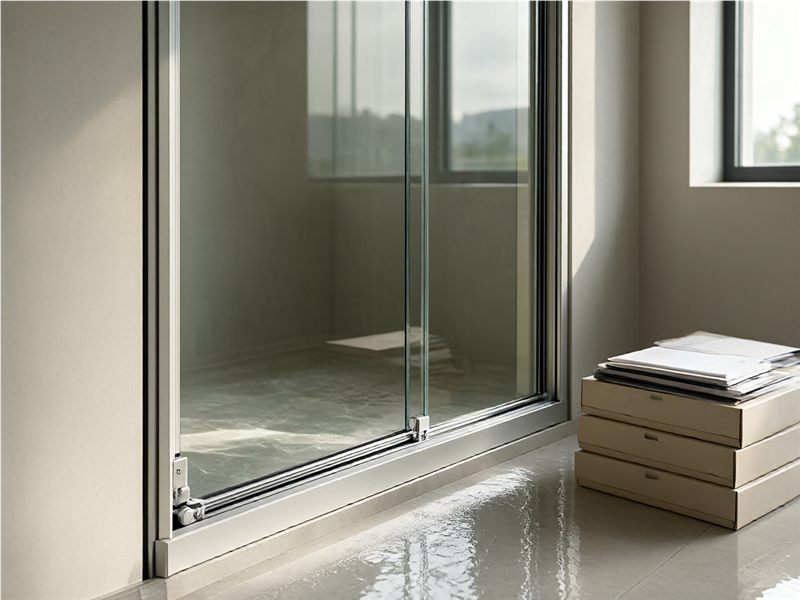
Coordinate the panel path and service route
Show the full panel travel, overlap, entry opening, and access for removing or adjusting the door. Check that stops and guides remain reachable after covers are fitted. Record the intended method for releasing a panel for service using the supplier instructions. This helps distinguish a complete system from a bundle that lacks replacement or adjustment details.
Release one controlled system package
Attach the bill of materials, panel schedule, finish list, installation instructions, and unresolved-item register to one revision. Have the glass fabricator and hardware supplier use the same layout. At sample approval, confirm all parts in the package and retain their model identifiers so a future replacement does not restart the system-selection process.
Sliding system coordination questions
Can rollers and tracks from separate systems be mixed?
Only after the suppliers confirm the interface and the complete moving panel arrangement.
What does the installer need in addition to a parts list?
A system drawing, panel schedule, movement direction, adjustment details, installation sequence, and service references.
Related resources: Zimmor glass hardware and fitting information; ANSI Z97.1-2026: Safety glazing materials used in buildings.
