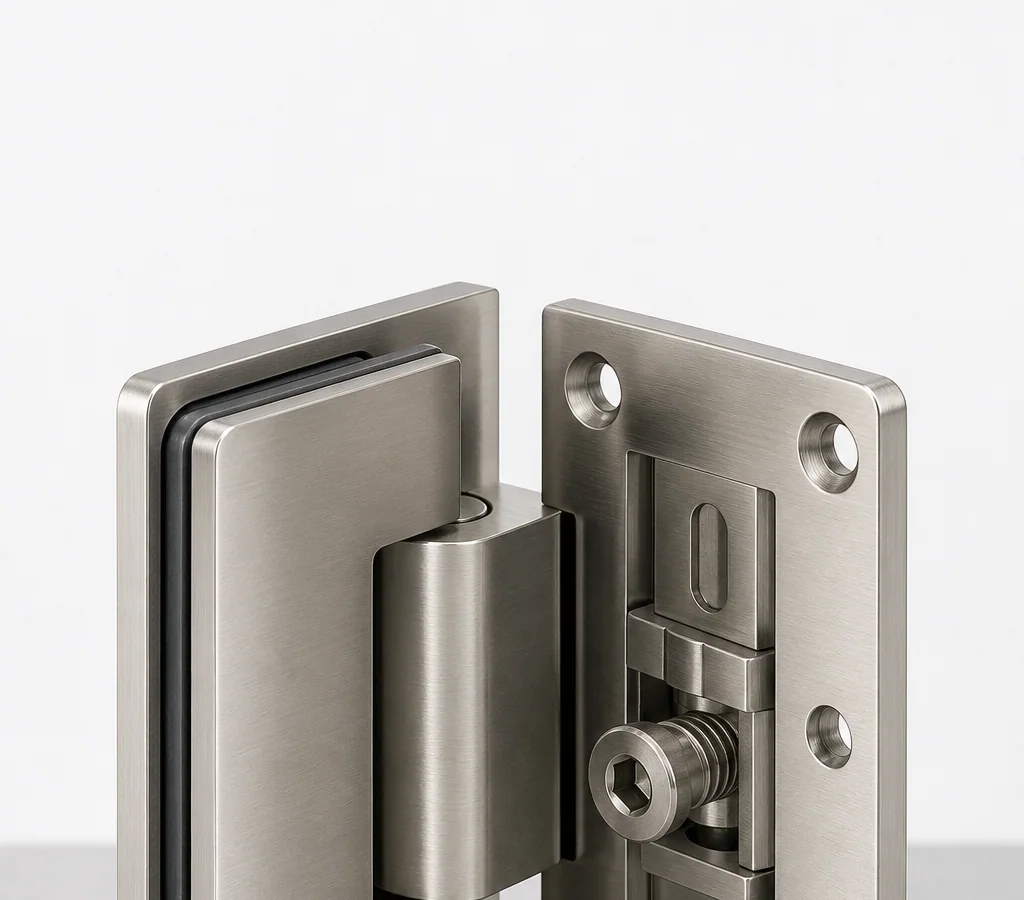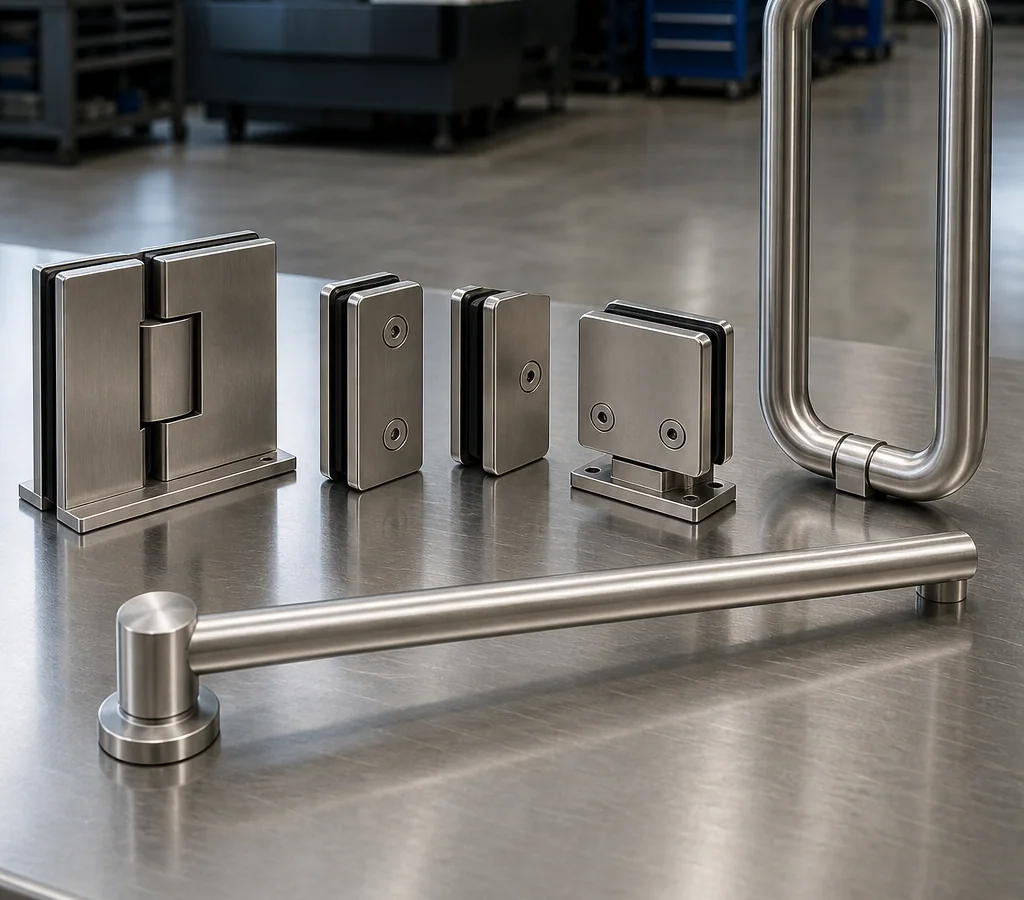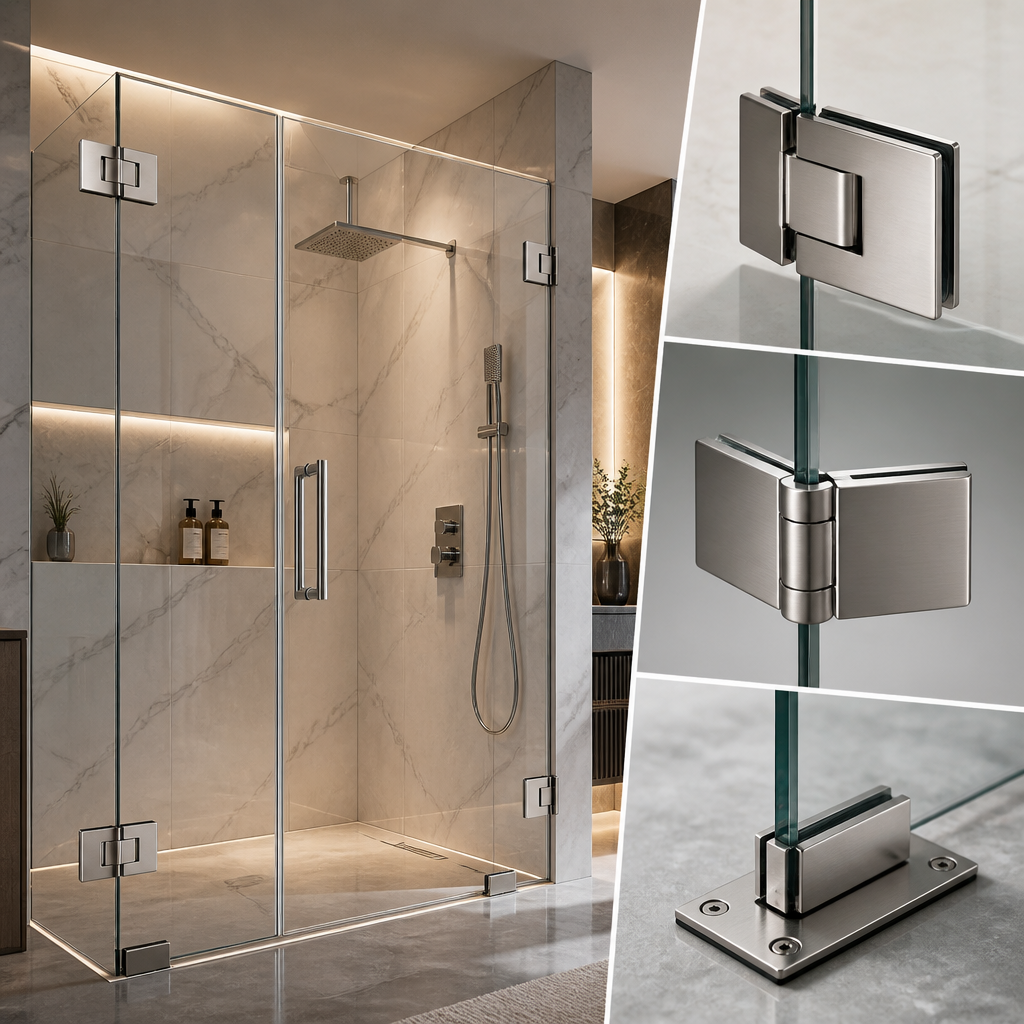
Los soportes de vidrio para ducha son los accesorios que sujetan un panel fijo de vidrio — el panel fijo, panel de retorno o panel lateral de un cerramiento sin marco — contra una pared o contra otro panel de vidrio. La elección del adecuado se reduce a una breve lista de variables: el grosor y el tamaño del ranura del vidrio, el ángulo de la unión, la carga que soporta el panel, la superficie a la que se fija el soporte, el material y el acabado del soporte, y cómo coincide el accesorio con el resto de la hardware del cerramiento.
Las secciones siguientes explican qué hace cada tipo de soporte, dónde se utiliza y cómo especificarlo sin crear problemas posteriores en la instalación.
Lo que hacen los soportes de vidrio para ducha en un cerramiento sin marco
En una ducha sin marco o semimarco, el propio vidrio forma parte de la estructura. Las bisagras soportan la puerta móvil, los soportes sujetan los paneles que no se mueven y las barras de soporte o estabilizadores rigidizan los paneles altos. Un soporte de vidrio para ducha transfiere el peso del vidrio y cualquier fuerza lateral que actúe sobre él a la pared o a un panel adyacente y también fija la posición del panel.
Como no hay un marco para ocultar las tolerancias, la alineación de los soportes tiene un efecto directo en la instalación terminada: la altura del panel, el tamaño de la junta entre paneles y cómo cierra la puerta de forma uniforme. Por eso los soportes suelen seleccionarse junto con las bisagras, las juntas y las barras de soporte, en lugar de como una compra aislada.
Soportes, pinzas, bisagras y barras de soporte: aclarando la terminología
“Soporte de vidrio para ducha” es una descripción de categoría y no el nombre de un producto individual. En los catálogos y en los planos, la misma familia de accesorios puede aparecer como pinzas de vidrio, accesorios de vidrio a pared, soportes de panel, soportes de fijación o soportes de esquina. No todos los proveedores usan estos términos de la misma manera, por lo que vale la pena confirmar a qué se refiere antes de realizar el pedido.
Como distinción práctica:
- Soportes y pinzas sujetan un panel fijo en su posición.
- Bisagras sujetan y pivotean la puerta móvil.
- Barras de soporte y estabilizadores span entre paneles, o entre un panel y una pared, para limitar el movimiento en ensamblajes altos o anchos.
- Canales en U y cabeceras soportan paneles fijos a lo largo de un borde en algunos sistemas, y pueden reemplazar soportes en ciertos diseños.
Tipos de soportes de vidrio para ducha
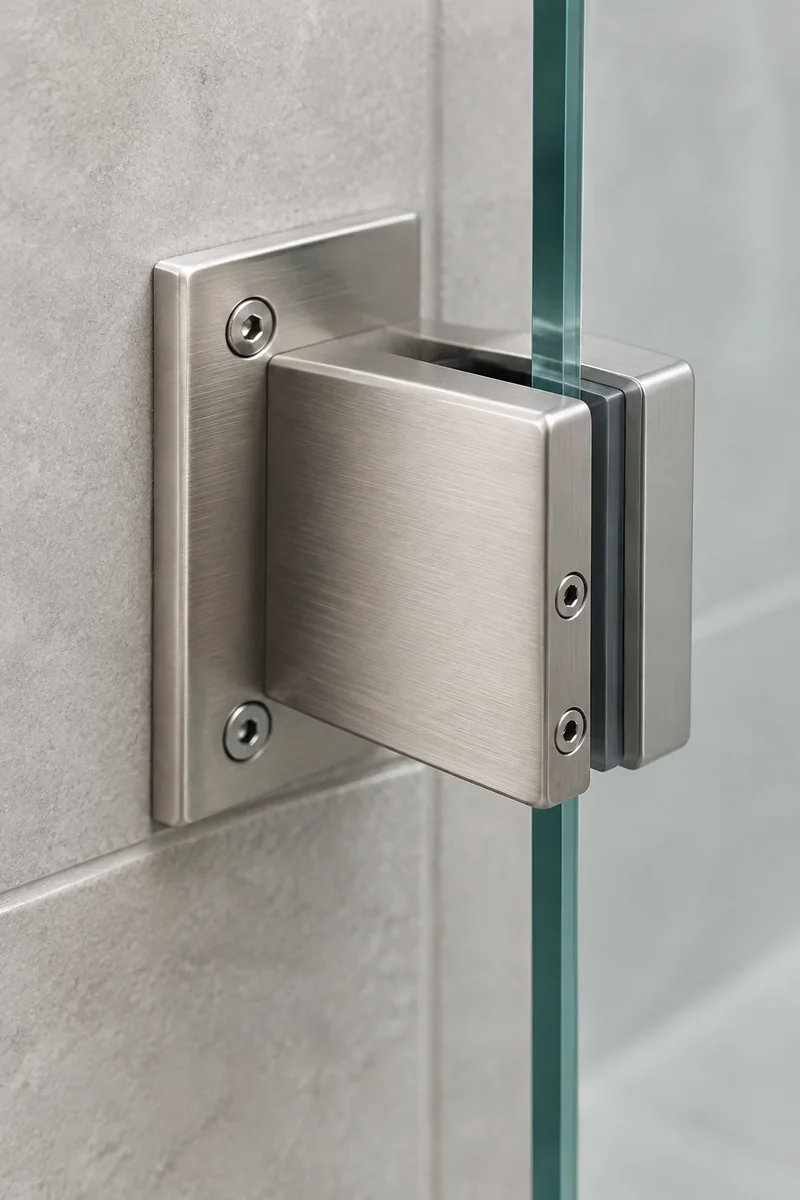
Soportes de pared a vidrio
Estos fijan un panel de vidrio a una pared. El lado de la pared se atornilla al sustrato — azulejos sobre un respaldo adecuado, mampostería o montante refuerzo — y el lado del vidrio sujeta el panel ya sea en una ranura con junta o a través de un orillo perforado. Se utilizan comúnmente donde un panel fijo se une a una pared al final de un cerramiento, en la esquina de una instalación de paso, y donde un panel de retorno se une a una pared.
Las configuraciones más comunes son de 90° (panel perpendicular a la pared) y de 180° (panel corriendo contra la cara de la pared). Los soportes de pared a vidrio también se ofrecen como accesorios de un lado o de dos lados; la elección depende de si la pinza está destinada a estar mayormente oculta detrás del panel o visible desde el lado de la ducha.
Soportes de vidrio a vidrio
Las bridas de cristal a cristal unen dos paneles en lugares donde no hay muro en la unión. Se utilizan para recintos de esquina formados por dos paneles fijos, para paneles de retorno que se encuentran con un panel fijo y para distribuciones en forma de L y escalonadas. Las dos versiones comunes son de 90° (los paneles se encuentran en un ángulo recto) y de 180° (los paneles se encuentran en línea).
Bridas de ángulo ajustable
No todos los recintos están en 90° o 180°. Las bridas ajustables o de múltiángulo permiten establecer el ángulo durante la instalación, lo cual es útil para habitaciones no cuadradas, muros angulares y distribuciones no estándar. Por lo general, contienen más componentes que las bridas de ángulo fijo, por lo que el alineamiento y el apriete requieren más cuidado en el lugar. Para uniones estándar de ángulo recto y en línea, una brida fija es más simple y generalmente más rígida.
Bridas de soporte y estabilización
Algunos accesorios existen principalmente para evitar que un borde libre se mueva: una pequeña brida del muro a la parte superior de un panel, o una brida que se usa junto con una barra de estabilizador a través de la parte superior del recinto. Estos son importantes cuando un panel es alto, cuando una puerta está bisagrada en un panel en lugar de en un muro, o cuando el recinto es ancho. Como con otras bridas, el número y la posición apropiados dependen de las dimensiones del panel y de los datos de carga del proveedor para ese accesorio específico.
Diseños de encaje en ranura y montaje con orificio
Hay dos formas amplias en que una brida sujeta el cristal:
- Encaje en ranura: el borde del cristal se coloca en una ranura en U con junta y se sostiene con tornillos de apriete. No se requiere orificio en el panel.
- Montaje con orificio: el panel se perfora o se entalla para que la placa del muro, el perno o el tornillo de fijación atraviese el cristal. Este enfoque se usa en muchas aplicaciones de muro a cristal donde la pinza necesita estar compacta o el borde del cristal está totalmente expuesto.
La consecuencia importante es el momento. El cristal laminado puede perforarse, pero el cristal templado no puede cortarse ni perforarse después del templado. Si la brida requiere un orificio, ese orificio debe mostrarse en el dibujo del fabricante del cristal y perforarse antes de que el panel sea templado. Confirme el requisito de orificio, el diámetro y la posición de la brida antes de enviar el cristal a producción.
Comparación de los tipos principales
| Tipo de brida | Lo que conecta | Aplicación típica | Verificación principal antes de pedir |
|---|---|---|---|
| Muro a cristal, 90° | Panel de cristal a un muro perpendicular | Recintos de esquina y de acceso libre | Fijación al muro y si el cristal necesita un orificio |
| Muro a cristal, 180° | Panel de cristal a la cara del muro | Paneles corriendo paralelos a un muro | Descentramiento del panel y espesor total de la pinza |
| Cristal a cristal, 90° | Dos paneles en un ángulo recto | Recintos de esquina sin muro en la unión | Tamaño de la ranura y conjunto de juntas para el grosor del cristal |
| Cristal a cristal, 180° | Two panels in line | Wide fixed panel runs | Alignment of the two panel edges |
| Adjustable angle | Two panels, or panel to wall, at a set angle | Out-of-square rooms and angled walls | Angle range and how the angle is locked |
| Support / stabilizing | Free edge of a panel to a wall or bar | Tall panels and door-hinged panels | Position and load data from the supplier |
Where shower glass brackets are used
The same bracket families appear across most frameless glass shower formats:
- Residential shower enclosures: corner and alcove layouts where a fixed panel meets a wall or a return panel.
- Walk-in showers and wet rooms: a single fixed panel stabilised at the wall and at the free edge.
- Bath screens over a bath: fixed panels combined with a hinged or pivoting section.
- Hotel and commercial bathrooms: standardised enclosures repeated across many rooms, where consistent dimensions and finishes matter as much as the individual fitting.
- Glass partitions in wet areas: where a shower panel line continues into a partition or fixed screen.
In projects with repeated rooms, brackets are usually specified once and then repeated across the building. That makes drawing accuracy and finish consistency the two most important supplier attributes, because spare panels and later orders need to match the original hardware. See how project-ready shower hardware supply for hotels and resorts is structured for this kind of repeat specification.
How to choose the right shower glass bracket
1. Confirm glass thickness and slot size
Shower glass brackets are made for specific glass thicknesses, most commonly 8 mm, 10 mm and 12 mm, and are usually supplied with gaskets to suit. Check the bracket’s stated slot range against the actual glass thickness: a clamp that is too wide will not grip reliably, and one that is too narrow will not close over the glass. If a project uses a mix of thicknesses, make sure each bracket is matched to the panel it holds.
2. Match the joint angle and the enclosure geometry
Measure the angle at the joint, not only the room. Tiled walls are frequently slightly out of plumb or out of square, and a 90° bracket fitted to an 88° corner can pull the panel out of position. Where the room is not true, an adjustable bracket or a site-measured glass panel usually works better than forcing a fixed fitting.
3. Check load and the number of brackets
The panel’s size, thickness and method of support determine how many brackets are needed and where they sit. A tall fixed panel with a door hanging off it carries different loads from a small return panel. Use the supplier’s load information for the specific bracket, and keep the configuration within the panel dimensions that the supplier states for that fitting. Undersupplying brackets is a common cause of glass movement and of doors that will not stay in alignment.
4. Check what the wall can accept
A bracket is only as strong as its fixing. Tiles over a solid substrate, concrete and reinforced stud walls behave differently, and some wall types need a backing plate or blocking behind the finish. Decide the fixing method before ordering, and check that the wall plate offers enough screw positions for the load and the substrate.
5. Decide slot-fit or hole-mounted early
This decision affects glass fabrication. If the design needs drilled panels, the hole positions and diameters belong on the glass order, and the drilling has to happen before tempering. Choosing the bracket after the glass is toughened leaves no room to change the design.
6. Choose material and finish
Shower hardware is exposed to humidity and cleaning products, so material matters as much as appearance:
- Stainless steel 304 and 316: common choices for shower and architectural glass hardware; 316 is often specified for more corrosive environments such as coastal or heavily chlorinated settings.
- Solid brass: used where a heavier, more substantial fitting is wanted and for certain plated finishes.
- Zinc alloy and aluminium: used in some components and in systems where weight and cost are the priority; suitability depends on the finish system applied over them.
Finishes commonly available include polished chrome, matte black, brushed nickel, satin brass, brushed gold, gun metal and antique bronze, with PVD and other coating options used to improve wear resistance. If brackets and hinges are visible in the same enclosure, it is usually worth ordering them in the same finish and from the same source so that colour and surface match across the set.
7. Coordinate with hinges, handles and support bars
Brackets, hinges, handles, seals and support bars form one assembly. Mixing hardware from different systems can create gaps, uneven glass reveals and unsupported edges. It is easier to specify the hardware package as a set — hinge type and capacity, bracket positions, handle length, seal profile — than to select each part separately. The same logic applies to door hardware, as explained in this guide to choosing shower door hinges for frameless glass doors.
8. Check documentation and sample quality
For projects, ask for the bracket drawing, material and finish specification, gasket details, and any test or inspection documentation the supplier can provide. A physical sample is the most reliable way to check surface finish, machining quality and how the clamp closes on the glass before committing to a full order. Our complete shower hardware specification guide lists the components and dimensions that usually belong in a project specification.
Installation and safety notes
- Use toughened safety glass for shower enclosures, and comply with the glazing and building requirements that apply to the project location.
- Do not drill, cut or grind tempered glass on site. All machining is completed by the glass fabricator before toughening.
- Fit the gaskets supplied with the bracket. Direct metal-to-glass contact should be avoided, and missing or incorrect gaskets are a common source of edge damage.
- Tighten set screws and wall fixings to the level the manufacturer specifies. Over-tightening can stress the glass, while under-tightening leaves the panel free to move.
- Confirm the wall is suitable for the fixing before installation. Where the substrate is unknown, check with the contractor.
- Glass panels are heavy and often need two people to position. Lifting and handling equipment should suit the panel size.
Sourcing and customising shower glass brackets
For distributors, shower enclosure brands and contractors, the practical questions when sourcing are usually about consistency and change control rather than about a single fitting. Useful points to settle with a supplier include: whether the bracket is a standard catalogue item or made to drawing, the material and finish grade, whether gaskets and fixings are supplied, packing and labelling for the destination market, and how repeat orders are kept to the same specification.
Zimmor Hardware is a B2B manufacturer of frameless shower hardware and architectural glass hardware, based in Foshan, Guangdong since 1999. The company produces glass clamps and brackets, shower hinges, handles, support bars, sliding systems, U-channels and seals, in materials including solid brass, stainless steel 304/316, aluminium and zinc alloy, with finishes such as polished chrome, matte black, brushed nickel, brushed gold, satin brass and gun metal. Because CNC machining, finishing and in-house electroplating are handled at the factory, finish consistency across a hardware set can be controlled at the source rather than across several suppliers.
For buyers working from an existing design, Zimmor can manufacture brackets to drawings, CAD files or physical samples, including dimension, structure, material, finish, colour, logo, packaging and private-label customisation. For buyers developing a new product, OEM and private-label shower hardware manufacturing covers sample matching and batch production, while ODM support can extend from concept and engineering through 3D design, DFM evaluation, prototyping, tooling and pilot production before volume manufacturing.
Preguntas frecuentes
Do shower glass brackets require holes in the glass?
It depends on the design. Slot-fit brackets grip the glass edge in a gasketed slot and need no hole, while hole-mounted wall-to-glass fittings require the panel to be drilled or notched. Because tempered glass cannot be drilled after toughening, confirm the requirement with the supplier before the glass is fabricated.
How many brackets are needed for one glass panel?
There is no single number. It depends on the panel’s size and thickness, whether a door is hinged off the panel, and the load data for the specific bracket. Follow the supplier’s configuration guidance for the panel dimensions you are using rather than copying a count from a different layout.
Can the same bracket be used on 8 mm and 10 mm glass?
Some brackets accept a range of thicknesses with different gaskets, and others are made for one thickness only. Check the stated slot range and gasket set for each bracket, and match every bracket to the panel it actually holds.
What material is best for shower glass brackets?
Stainless steel 304 and 316 are widely used for shower hardware, with 316 often specified where corrosion resistance matters more, such as coastal projects. Solid brass is chosen for a heavier feel and certain plated finishes. In all cases, the quality of the surface finish and the plating or coating system affects how the fitting performs in a humid bathroom.
Can shower glass brackets be used for glass railings or partitions?
Not interchangeably. Railing and balustrade hardware is engineered for different loads, spans and safety standards than shower enclosures. Shower brackets should be specified for shower applications, and railing projects should use railing-specific fittings.
Can brackets be customised in a specific finish or with a brand logo?
Many manufacturers offer this. Zimmor produces custom glass fittings from drawings, CAD files, samples or reference products, with customisation of dimensions, structure, finishes, colours, logo engraving, packaging and private-label branding for B2B customers.