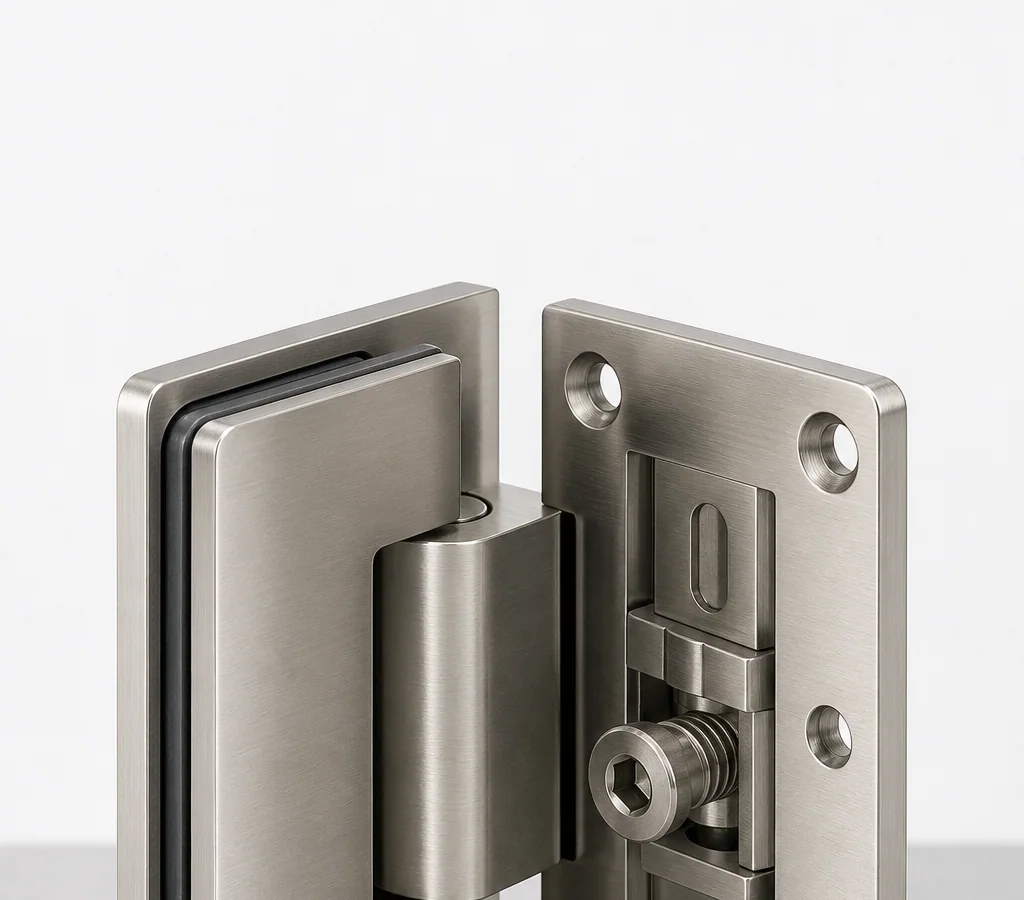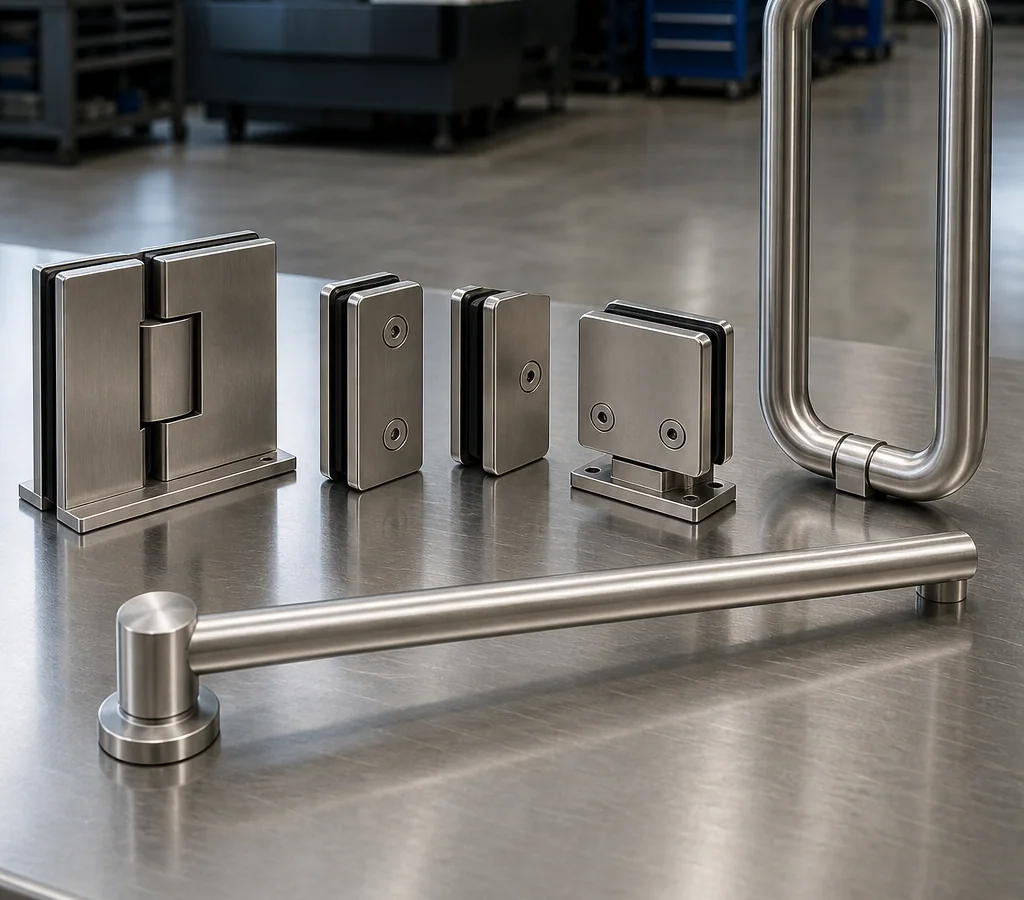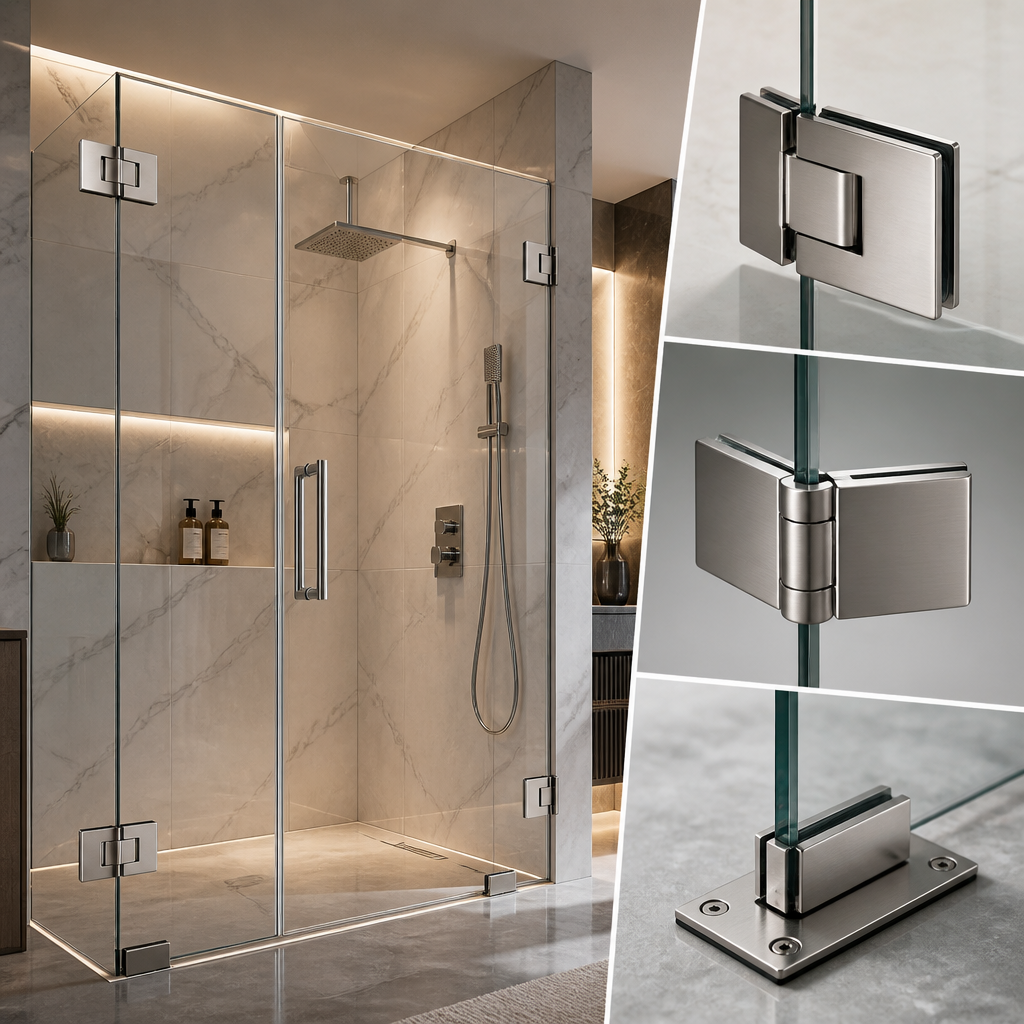
Кронштейны для душевого стекла — это крепёжные элементы, которые удерживают фиксированную стеклянную панель — неподвижную, обратную или боковую панель безрамной конструкции — на стене или на другой стеклянной панели. Выбор подходящего кронштейна зависит от небольшого набора факторов: толщины и размера паза стекла, угла соединения, нагрузки, которую выдерживает панель, поверхности, к которой крепится кронштейн, материала и покрытия кронштейна, а также того, насколько крепление соответствует остальным hardware-компонентам в конструкции.
В разделах ниже объясняется назначение каждого типа кронштейна, где он используется и как правильно специфицировать его, чтобы избежать проблем на этапе установки.
Роль кронштейнов для душевого стекла в безрамной конструкции
В безрамном или полурамном душевом коробе само стекло является частью конструкции. Петли держат подвижную дверь, кронштейны удерживают неподвижные панели, а опорные или стабилизаторные штанги придают жёсткость высоким панелям. Кронштейн для душевого стекла передаёт вес стекла и любое боковое воздействие на стену или на соседнюю панель — при этом он также определяет положение панели.
Поскольку нет рамы, которая могла бы скрыть допуски, выравнивание кронштейнов напрямую влияет на готовую установку: высоту панели, размер зазора между панелями и равномерность закрытия двери. Именно поэтому кронштейны обычно подбирают совместно с петлями, уплотнителями и опорными штангами, а не как отдельную покупку.
Кронштейны, зажимы, петли и опорные штанги: уточнение терминологии
“Кронштейн для душевого стекла” — это описание категории, а не название конкретного продукта. В каталогах и на чертежах одна и та же семья крепёжных элементов может называться стеклянными зажимами, фитингами «стекло-к-стене», кронштейнами для панелей, крепёжными кронштейнами или угловыми кронштейнами. Поставщики не всегда используют эти термины одинаково, поэтому перед заказом стоит уточнить, что именно подразумевается.
Как рабочая классификация:
- Кронштейны и зажимы удерживают фиксированную панель в заданном положении.
- Петли держат и обеспечивают поворот подвижной двери.
- Опорные и стабилизаторные штанги соединяют панели между собой или панель со стеной, чтобы ограничить перемещения в высоких или широких сборках.
- U-образные профили и верхние поперечины поддерживают фиксированные панели вдоль кромки в некоторых системах и могут заменять кронштейны в определённых конструкциях.
Типы кронштейнов для душевого стекла
Кронштейны «стена-стекло»
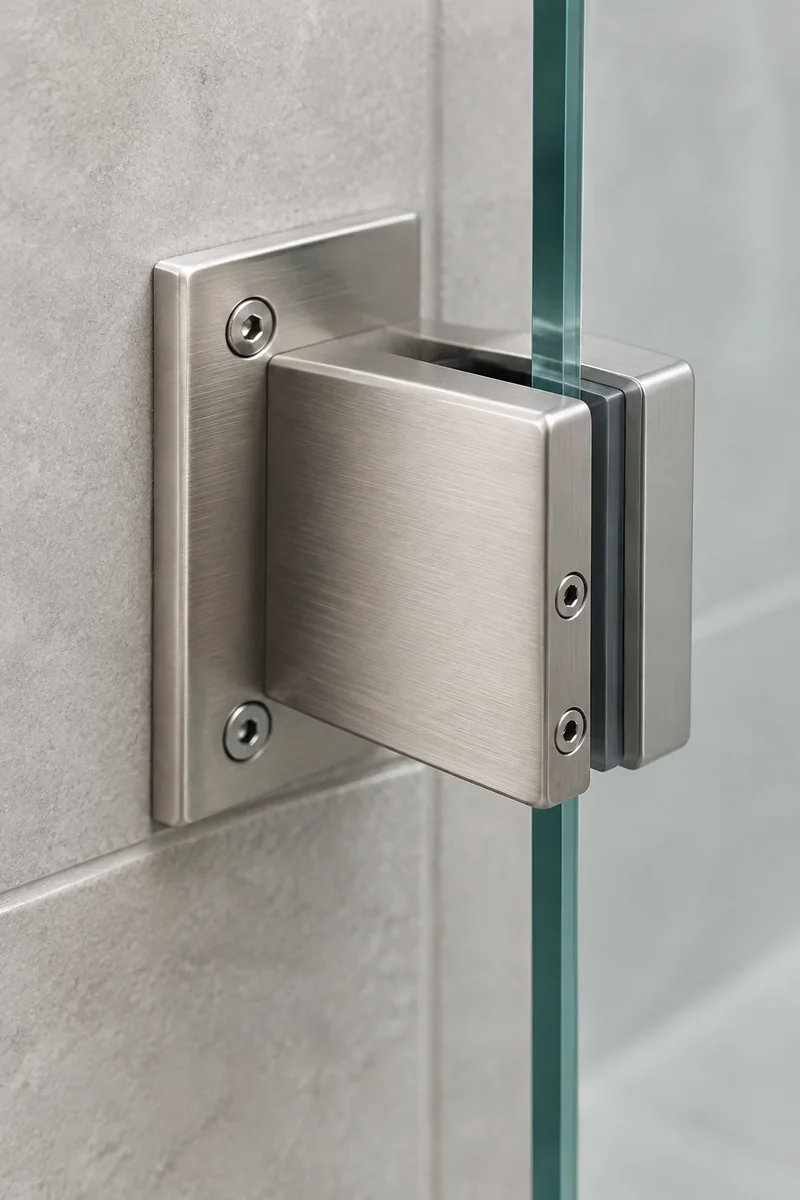
Эти кронштейны крепят стеклянную панель к стене. Стенная часть прикручивается к основанию — к плитке на подходящей подложке, кладке или усиленной стойке — а стеклянная часть удерживает панель либо в паза с уплотнителем, либо через просверленное отверстие. Они часто используются там, где фиксированная панель примыкает к стене в конце душевого короба, в углу проходной установки и там, где обратная панель возвращается к стене.
Наиболее распространённые конфигурации — 90° (перпендикулярное расположение панели к стене) и 180° (панель установлена плоскостью к поверхности стены). Кронштейны «стена-стекло» также выпускаются в одностороннем или двустороннем исполнении; выбор зависит от того, зажим должен быть преимущественно скрыт за панелью или быть видимым со стороны душа.
Кронштейны «стекло-стекло»
Кронштейны «стекло-стекло» соединяют две панели в месте, где нет стены. Они используются для угловых ограждений, образованных двумя фиксированными панелями, для возвращающихся панелей, которые соединяются с фиксированной панелью, а также для Г-образных и ступенчатых конфигураций. Две распространенные версии — 90° (панели встречаются под прямым углом) и 180° (панели расположены в линию).
Кронштейны с регулируемым углом
Не каждое ограждение расположено под углом 90° или 180°. Регулируемые кронштейны или кронштейны с многопозиционным углом позволяют устанавливать угол в процессе монтажа, что полезно для комнат с неровными углами, наклонных стен и нестандартных планировок. Как правило, они содержат больше компонентов, чем кронштейны с фиксированным углом, поэтому при монтаже требуется более тщательная выравнивание и затяжка. Для стандартных соединений под прямым углом и в линию фиксированный кронштейн проще и, как правило, более жесткий.
Опорные и стабилизирующие кронштейны
Некоторые крепёжные элементы существуют в первую очередь для предотвращения движения свободного края: небольшой кронштейн от стены к верхней части панели или кронштейн, используемый вместе с стабилизирующей планкой, пересекающей верхнюю часть ограждения. Это важно, когда панель высокая, когда дверь навешивается на петли, закреплённые на панели, а не на стене, или когда ограждение широкое. Как и в случае с другими кронштейнами, подходящее количество и расположение зависят от размеров панели и данных о нагрузках поставщика для конкретного крепёжного элемента.
Конструкции с пазом и с креплением через отверстие
Есть два основных способа, которым кронштейн зажимает стекло:
- Установка в паз: кромка стекла укладывается в U-образный паз с уплотнителем и удерживается фиксаторными винтами. В панели не требуется отверстие.
- Крепление через отверстие: в панели просверливается отверстие или вырезается проточка, чтобы стенная пластина, буртик или крепёжный винт проходили сквозь стекло. Этот подход используется во многих приложениях «стена-стекло», где зажим должен быть компактным или кромка стекла полностью открыта.
Важным следствием является сроки. Плавающее стекло можно просверливать, но закаленное стекло нельзя резать или сверлить после упрочнения. Если кронштейн требует отверстие, это отверстие должно быть указано на чертеже стеклообрабатывающего цеха и просверлено до закалки панели. Подтвердите требование кронштейна к отверстию, диаметр и расположение до отправки стекла в производство.
Сравнение основных типов
| Тип кронштейна | Что соединяет | Типичное применение | Основная проверка перед заказом |
|---|---|---|---|
| Стена-стекло, 90° | Стеклянная панель с перпендикулярной стеной | Угловые и проходные ограждения | Крепление к стене и необходимость отверстия в стекле |
| Стена-стекло, 180° | Стеклянная панель с лицевой поверхностью стены | Панели, расположенные параллельно стене | Смещение панели и общая толщина зажима |
| Стекло-стекло, 90° | Две панели под прямым углом | Угловые ограждения без стены в месте соединения | Размер паза и комплект уплотнителей для толщины стекла |
| Стекло-стекло, 180° | Two panels in line | Wide fixed panel runs | Alignment of the two panel edges |
| Adjustable angle | Two panels, or panel to wall, at a set angle | Out-of-square rooms and angled walls | Angle range and how the angle is locked |
| Support / stabilizing | Free edge of a panel to a wall or bar | Tall panels and door-hinged panels | Position and load data from the supplier |
Where shower glass brackets are used
The same bracket families appear across most frameless glass shower formats:
- Residential shower enclosures: corner and alcove layouts where a fixed panel meets a wall or a return panel.
- Walk-in showers and wet rooms: a single fixed panel stabilised at the wall and at the free edge.
- Bath screens over a bath: fixed panels combined with a hinged or pivoting section.
- Hotel and commercial bathrooms: standardised enclosures repeated across many rooms, where consistent dimensions and finishes matter as much as the individual fitting.
- Glass partitions in wet areas: where a shower panel line continues into a partition or fixed screen.
In projects with repeated rooms, brackets are usually specified once and then repeated across the building. That makes drawing accuracy and finish consistency the two most important supplier attributes, because spare panels and later orders need to match the original hardware. See how project-ready shower hardware supply for hotels and resorts is structured for this kind of repeat specification.
How to choose the right shower glass bracket
1. Confirm glass thickness and slot size
Shower glass brackets are made for specific glass thicknesses, most commonly 8 mm, 10 mm and 12 mm, and are usually supplied with gaskets to suit. Check the bracket’s stated slot range against the actual glass thickness: a clamp that is too wide will not grip reliably, and one that is too narrow will not close over the glass. If a project uses a mix of thicknesses, make sure each bracket is matched to the panel it holds.
2. Match the joint angle and the enclosure geometry
Measure the angle at the joint, not only the room. Tiled walls are frequently slightly out of plumb or out of square, and a 90° bracket fitted to an 88° corner can pull the panel out of position. Where the room is not true, an adjustable bracket or a site-measured glass panel usually works better than forcing a fixed fitting.
3. Check load and the number of brackets
The panel’s size, thickness and method of support determine how many brackets are needed and where they sit. A tall fixed panel with a door hanging off it carries different loads from a small return panel. Use the supplier’s load information for the specific bracket, and keep the configuration within the panel dimensions that the supplier states for that fitting. Undersupplying brackets is a common cause of glass movement and of doors that will not stay in alignment.
4. Check what the wall can accept
A bracket is only as strong as its fixing. Tiles over a solid substrate, concrete and reinforced stud walls behave differently, and some wall types need a backing plate or blocking behind the finish. Decide the fixing method before ordering, and check that the wall plate offers enough screw positions for the load and the substrate.
5. Decide slot-fit or hole-mounted early
This decision affects glass fabrication. If the design needs drilled panels, the hole positions and diameters belong on the glass order, and the drilling has to happen before tempering. Choosing the bracket after the glass is toughened leaves no room to change the design.
6. Choose material and finish
Shower hardware is exposed to humidity and cleaning products, so material matters as much as appearance:
- Stainless steel 304 and 316: common choices for shower and architectural glass hardware; 316 is often specified for more corrosive environments such as coastal or heavily chlorinated settings.
- Solid brass: used where a heavier, more substantial fitting is wanted and for certain plated finishes.
- Zinc alloy and aluminium: used in some components and in systems where weight and cost are the priority; suitability depends on the finish system applied over them.
Finishes commonly available include polished chrome, matte black, brushed nickel, satin brass, brushed gold, gun metal and antique bronze, with PVD and other coating options used to improve wear resistance. If brackets and hinges are visible in the same enclosure, it is usually worth ordering them in the same finish and from the same source so that colour and surface match across the set.
7. Coordinate with hinges, handles and support bars
Brackets, hinges, handles, seals and support bars form one assembly. Mixing hardware from different systems can create gaps, uneven glass reveals and unsupported edges. It is easier to specify the hardware package as a set — hinge type and capacity, bracket positions, handle length, seal profile — than to select each part separately. The same logic applies to door hardware, as explained in this guide to choosing shower door hinges for frameless glass doors.
8. Check documentation and sample quality
For projects, ask for the bracket drawing, material and finish specification, gasket details, and any test or inspection documentation the supplier can provide. A physical sample is the most reliable way to check surface finish, machining quality and how the clamp closes on the glass before committing to a full order. Our complete shower hardware specification guide lists the components and dimensions that usually belong in a project specification.
Installation and safety notes
- Use toughened safety glass for shower enclosures, and comply with the glazing and building requirements that apply to the project location.
- Do not drill, cut or grind tempered glass on site. All machining is completed by the glass fabricator before toughening.
- Fit the gaskets supplied with the bracket. Direct metal-to-glass contact should be avoided, and missing or incorrect gaskets are a common source of edge damage.
- Tighten set screws and wall fixings to the level the manufacturer specifies. Over-tightening can stress the glass, while under-tightening leaves the panel free to move.
- Confirm the wall is suitable for the fixing before installation. Where the substrate is unknown, check with the contractor.
- Glass panels are heavy and often need two people to position. Lifting and handling equipment should suit the panel size.
Sourcing and customising shower glass brackets
For distributors, shower enclosure brands and contractors, the practical questions when sourcing are usually about consistency and change control rather than about a single fitting. Useful points to settle with a supplier include: whether the bracket is a standard catalogue item or made to drawing, the material and finish grade, whether gaskets and fixings are supplied, packing and labelling for the destination market, and how repeat orders are kept to the same specification.
Zimmor Hardware is a B2B manufacturer of frameless shower hardware and architectural glass hardware, based in Foshan, Guangdong since 1999. The company produces glass clamps and brackets, shower hinges, handles, support bars, sliding systems, U-channels and seals, in materials including solid brass, stainless steel 304/316, aluminium and zinc alloy, with finishes such as polished chrome, matte black, brushed nickel, brushed gold, satin brass and gun metal. Because CNC machining, finishing and in-house electroplating are handled at the factory, finish consistency across a hardware set can be controlled at the source rather than across several suppliers.
For buyers working from an existing design, Zimmor can manufacture brackets to drawings, CAD files or physical samples, including dimension, structure, material, finish, colour, logo, packaging and private-label customisation. For buyers developing a new product, OEM and private-label shower hardware manufacturing covers sample matching and batch production, while ODM support can extend from concept and engineering through 3D design, DFM evaluation, prototyping, tooling and pilot production before volume manufacturing.
Часто задаваемые вопросы
Do shower glass brackets require holes in the glass?
It depends on the design. Slot-fit brackets grip the glass edge in a gasketed slot and need no hole, while hole-mounted wall-to-glass fittings require the panel to be drilled or notched. Because tempered glass cannot be drilled after toughening, confirm the requirement with the supplier before the glass is fabricated.
How many brackets are needed for one glass panel?
There is no single number. It depends on the panel’s size and thickness, whether a door is hinged off the panel, and the load data for the specific bracket. Follow the supplier’s configuration guidance for the panel dimensions you are using rather than copying a count from a different layout.
Can the same bracket be used on 8 mm and 10 mm glass?
Some brackets accept a range of thicknesses with different gaskets, and others are made for one thickness only. Check the stated slot range and gasket set for each bracket, and match every bracket to the panel it actually holds.
What material is best for shower glass brackets?
Stainless steel 304 and 316 are widely used for shower hardware, with 316 often specified where corrosion resistance matters more, such as coastal projects. Solid brass is chosen for a heavier feel and certain plated finishes. In all cases, the quality of the surface finish and the plating or coating system affects how the fitting performs in a humid bathroom.
Can shower glass brackets be used for glass railings or partitions?
Not interchangeably. Railing and balustrade hardware is engineered for different loads, spans and safety standards than shower enclosures. Shower brackets should be specified for shower applications, and railing projects should use railing-specific fittings.
Can brackets be customised in a specific finish or with a brand logo?
Many manufacturers offer this. Zimmor produces custom glass fittings from drawings, CAD files, samples or reference products, with customisation of dimensions, structure, finishes, colours, logo engraving, packaging and private-label branding for B2B customers.