

A shower glass bracket holds a fixed panel against a wall or another panel. Choose it from the approved enclosure drawing, exact glass preparation, panel geometry, mounting surface, matching hardware and product-specific instructions. Similar-looking brackets are not interchangeable unless their specifications support the same application.
For glass work, involve the glass fabricator and a qualified installer before the glass is ordered or processed. The NGA Frameless Shower Enclosure Manual provides industry guidance for enclosure design and installation.
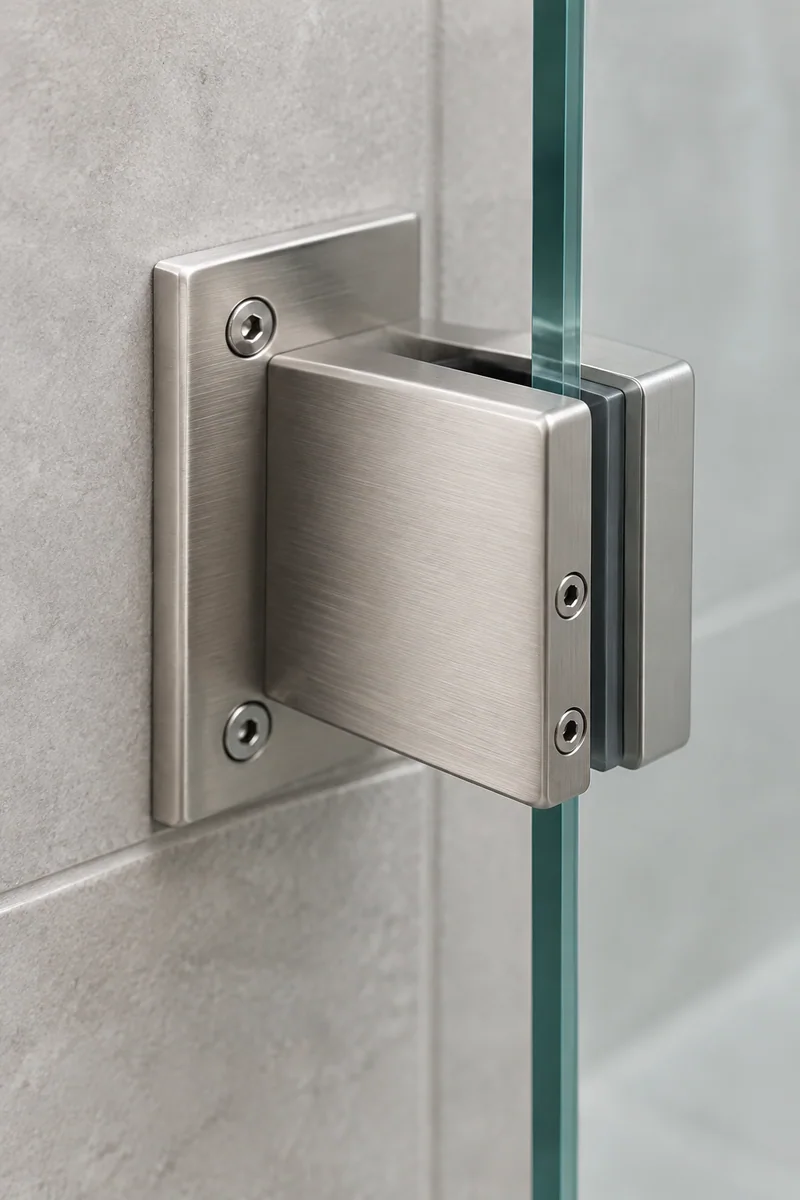
Identify the bracket configuration
- Wall-to-glass: connects a fixed panel to a prepared wall or backing assembly.
- Glass-to-glass: joins fixed panels at the layout angle shown on the approved drawing.
- Fixed-angle or adjustable-angle: the hardware must match the actual joint geometry and the product’s adjustment range.
- Slot-grip or hole-mounted: the glass interface and gasket arrangement must match the exact fitting and glass fabrication drawing.
- Stabilizing hardware: brackets, support bars or channels may have different roles; confirm the system design rather than substituting one for another.
Check the glass and panel details
Record the panel dimensions, glass type and thickness, edge condition, cutout or hole pattern, joint angle, panel-to-panel gap and mounting locations. Use the bracket manufacturer’s current drawing and gasket specification to confirm compatibility. Do not infer slot fit, hole position or panel support from a photograph or from another model.
If a design requires drilled or notched heat-treated glass, coordinate the required fabrication with the glass processor before tempering. Do not field-drill, cut, notch or grind tempered glass. Confirm all dimensions and tolerances against the approved glass and hardware drawings before fabrication.
Verify the mounting structure and complete assembly
Identify what is behind the finished wall and which fasteners and backing the specific assembly requires. Tile alone does not establish a suitable anchorage. Have the responsible designer or installer verify the substrate, backing, fasteners, installation method and any project-specific structural requirements. Check the bracket together with adjacent hinges, seals, channels and stabilizer bars so that the intended clearances and load path are documented.
Ask for the exact model’s approved glass range, installation instructions, applicable rating or test evidence and limitations. Do not transfer a load claim from one size, joint, mounting surface or component configuration to another without supporting documentation.
Specify material, finish and inspection reference
List the product code, base material, finish code, visible surfaces, accepted colour reference, gasket material and packaging. Ask which test reports apply to the exact model and finish, and how the supplier checks a production batch against the approved sample. The sample approval guide can help establish that reference. See the hinge selection guide when coordinating the bracket with a moving door.
Use a pre-order checklist
- Approved enclosure and glass-processing drawings identify the bracket locations and interface.
- Exact SKU, angle, glass preparation, gasket and finish are confirmed by current product documentation.
- Wall or panel support, fasteners and installation responsibilities are assigned.
- Required instructions, project evidence and finish reference match the ordered configuration.
- Any field measurement or change has written approval before glass fabrication or hardware release.
Frequently Asked Questions
Do shower glass brackets always require holes in the glass?
No. Some designs grip a panel in a gasketed slot; others use holes or another interface. Follow the exact model drawing and coordinate any glass processing before tempering.
How many brackets does a fixed glass panel need?
There is no universal number. The enclosure design, panel size, glass, bracket rating, support and substrate determine the layout. Use the approved drawing and the responsible designer or installer’s instructions.
Can the same bracket fit different glass thicknesses?
Only when the model’s documented slot and gasket range includes each glass specification. Confirm with the current product drawing rather than assuming similar brackets share a range.
Can I anchor a bracket into tile?
Tile finish alone does not confirm the backing or fastener capacity. Verify the actual wall construction and installation details with the responsible designer or qualified installer.
Can I use a shower bracket for a railing or another glass application?
Do not assume so. Use the bracket only for an application and configuration supported by its specific rating, instructions and project requirements.