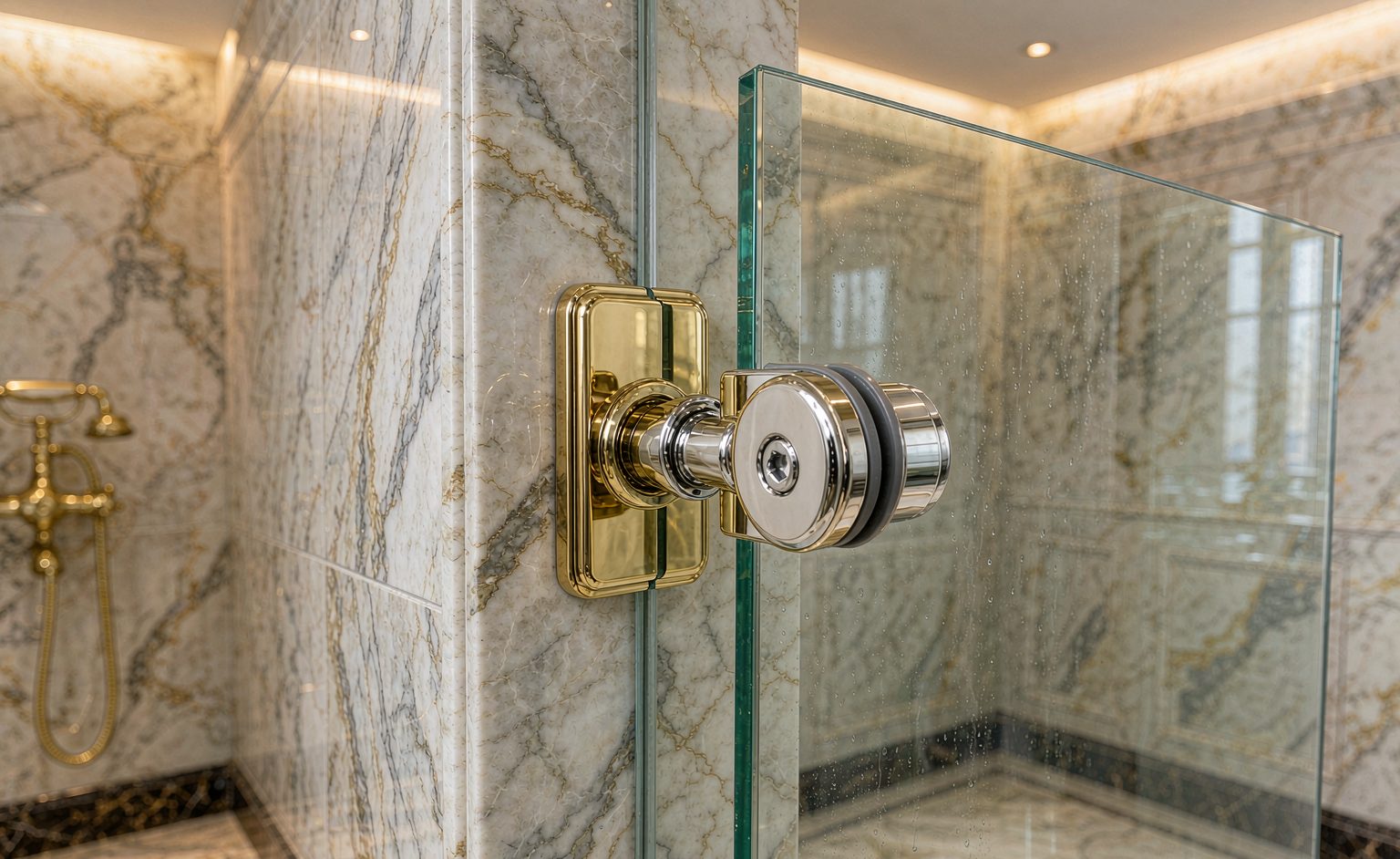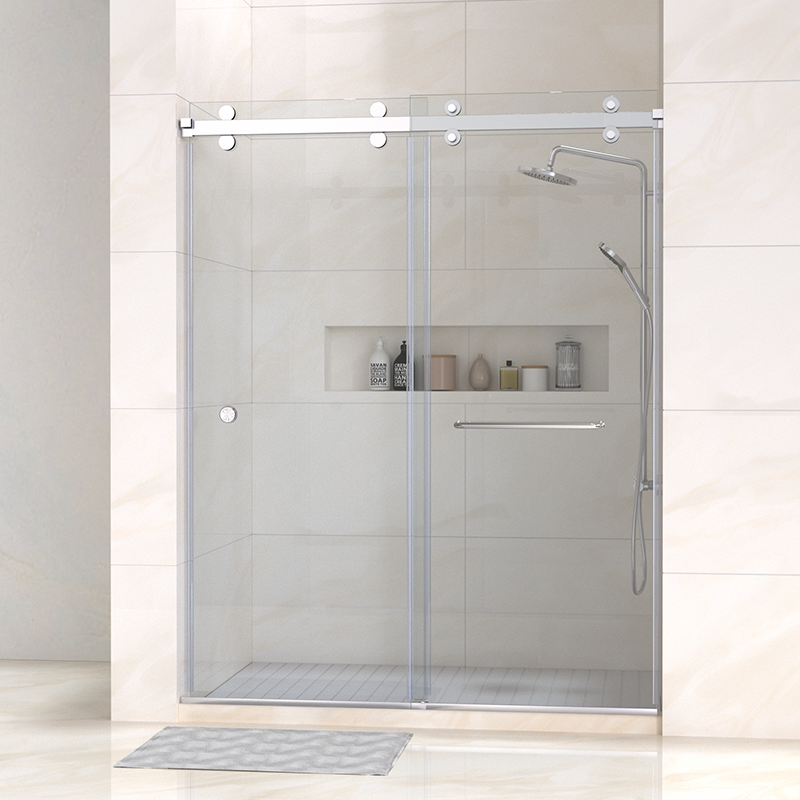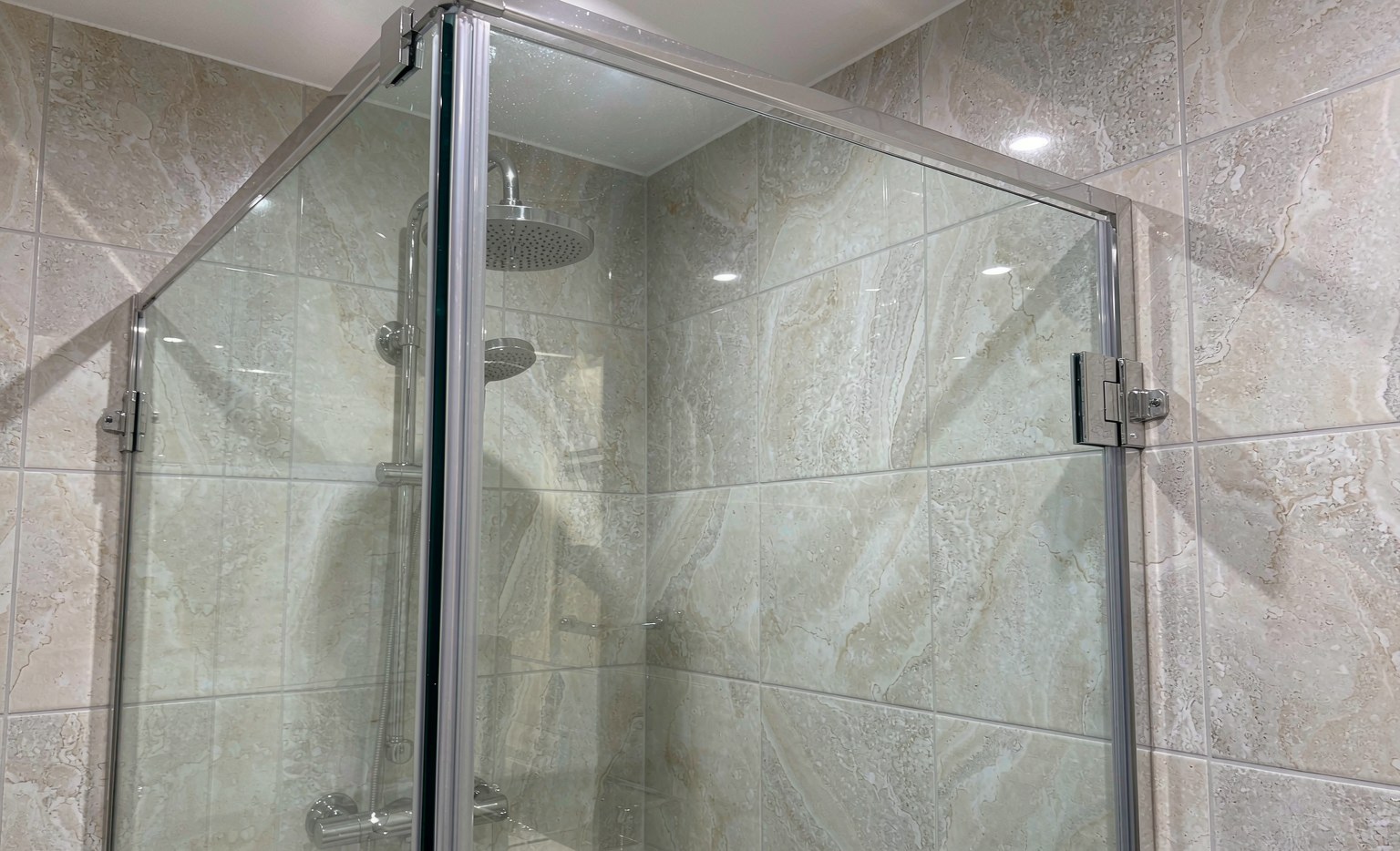

Frameless shower enclosures are sold on what they do not have: no frame, no bulky post, no visible aluminium channel around every panel. The price of that aesthetic is that water now has to be managed by a handful of small extrusions. When an enclosure leaks, squeaks, rattles or fails to latch, the hinge is almost never the culprit — the seal is.
Seals are also the least specified item on a shower hardware bill of materials. They get ordered as “the clear strip that fits 10mm glass”, and then someone on site discovers that the door closes onto a wall at 135° while the seal was moulded for 180°. This guide is written for fabricators, glaziers, bathroom brands and project buyers who want to get the seal right the first time. Every part number, material and dimension below is taken from Zimmor’s current seal product pages.
What a shower door seal actually has to do
A seal on a frameless door performs four separate jobs, and different profiles are optimised for different ones:
- Water containment. Stopping spray escaping through the gap between the moving door and the fixed panel, the wall, or the floor.
- Soft close. Cushioning the door as it swings shut so glass does not meet glass or glass does not meet aluminium.
- Latch and retention. On magnetic profiles, holding the door closed rather than letting it drift open.
- Clearance tolerance. Absorbing the few millimetres of error that every real bathroom has, because walls are rarely plumb and glass is rarely perfectly square.
When a seal fails in service, it is usually because one of those four jobs was assumed rather than specified. A profile that contains water beautifully may leave a door that drifts open; a magnetic strip that latches firmly may be too stiff for a light 6mm door.
Step one is geometry, not material
Before anyone talks about PVC or polycarbonate, the geometry has to be settled. Zimmor’s seal range is organised around exactly this question:
- Glass to glass, at an angle. The seal sits on the vertical edge of the door and closes against a fixed panel. Zimmor’s Z-5703 is specified for glass-to-glass at 135°, while Z-5706 is a glass-to-glass 180° profile with soft vinyl.
- Glass to floor. A bottom seal that sweeps the threshold. The Z-5708 uses a U-style body with a bulb attachment for exactly this position.
- H jamb. The seal that receives the door edge against a wall or return panel. Z-P380HJ is listed as an H jamb for 180° glass.
- H wipe. A multi-purpose wipe profile for the door edge, such as Z-P500HW.
- Magnetic closing. Two sealing strips carrying magnetic stripes that meet face to face, as on Z-5711, which is specified with magnetic stripe on both sides.
The angle is the number people forget. A 135° return and a 180° inline panel need different profiles, and the difference is not cosmetic — fitting a 180° seal into a 135° corner either leaves a gap or puts permanent stress on the extrusion, which is how a seal starts to lift after a few months.
PVC or polycarbonate? The material decision
Two polymers cover almost the whole category, and Zimmor states the material explicitly on each product page.
- PVC (polyvinyl chloride). Specified for Z-5703 and Z-5711. PVC is the flexible, forgiving, cost-effective option. It compresses easily, which makes it good for light doors and for profiles that need to drape around a curve. In clear formulations it is the standard choice for general-purpose shower sealing.
- PC (polycarbonate). Specified for Z-5706, Z-5708, Z-P500HW and Z-P380HJ, and described as “high clear”. Polycarbonate is the stiffer, optically clearer and more impact-resistant material. It holds its shape better on long runs and resists the yellowing and clouding that clear PVC can develop over years of exposure to bathroom chemicals and warm water.
The trade-off is straightforward. PVC is softer and cheaper and closes more gently; PC is clearer, harder-wearing and more dimensionally stable, which matters on a heavy 10mm or 12mm door where the seal has to resist being crushed out of position. For a premium frameless enclosure where the hardware is visible and the door is heavy, PC is usually the right call. For a light door, a secondary bathroom or a price-driven project, PVC does the job.
Glass thickness is the first number on the order
Every seal in the range is sized to the glass it clamps onto, and the sizes follow the standard frameless thickness steps. Zimmor’s published size tables make the mapping explicit — for example, the high-clear PC H jamb family and the clear PC seal family each run across four catalogue numbers:
| Glass thickness | Imperial | H jamb family (PC) | Clear PC seal family |
|---|---|---|---|
| 6 mm | 1/4″ | P140HJ | P914WS |
| 8 mm | 5/16″ | P516HJ | P956WS |
| 10 mm | 3/8″ | P380HJ | P990WS |
| 12 mm | 1/2″ | P120HJ | P912WS |
The Z-5706 high-clear PC seal follows the same logic in its own numbering — Z-5706-6mm, -8mm, -10mm and -12mm variants, one per glass thickness — and Z-5703 is listed as a clear PVC seal available for 10mm thickness.
Two practical warnings. First, measure the actual glass, including any coating or laminate interlayer, rather than trusting the nominal order. Second, do not assume a seal will “stretch” to the next size up: an undersized seal on thicker glass will split during installation or creep off the edge in service, and an oversized one will spin on the edge and never sit square.
Specification snapshot: the profiles in the current range
The table below summarises six real Zimmor seal SKUs with their published item numbers, materials and intended positions. Use it as a shortlisting tool, then confirm the exact glass thickness and angle before ordering.
| Item No. | Product | Material | Position / angle | Notes |
|---|---|---|---|---|
| Z-5703 | Clear PVC Seal | PVC | Glass to glass, 135° | Clear PVC, listed for 10 mm glass |
| Z-5706 | High Clear PC Seal | PC | Glass to glass, 180° | Soft vinyl; 4 thicknesses; standard length 2.4 m |
| Z-5708 | PC Seal with Bulb Attachment | PC | Glass to floor | U-style body with bulb attachment, high clear |
| Z-5711 | PVC Seal with Magnetic Stripe | PVC | Glass to glass, 180° | Magnetic stripe on both sides |
| Z-P500HW | High Clear PC Seal — H Wipe | PC | Glass to glass | Multi-purpose H wipe seal |
| Z-P380HJ | High Clear PC Seal — H Jamb | PC | Glass to glass, 180° | H jamb; 6/8/10/12 mm catalogue sizes |
Magnetic and bulb seals: closing the door quietly
The two specialty constructions deserve their own note, because they solve problems that a plain fin seal cannot.
Magnetic seals carry a flexible magnetic stripe inside the extrusion. Z-5711 is specified with the stripe on both sides, so the two faces meet and hold. This gives a positive close — the door stays shut instead of drifting — which is what customers actually notice. Magnetic profiles belong on the closing edge of a swing door, not on a fixed panel, and they need to be matched so the two strips meet squarely along their whole height.
Bulb seals use a hollow or semi-hollow bulb that compresses on contact. Z-5708 pairs a U-style body with a bulb attachment for the glass-to-floor position. The advantage is tolerance: a bulb absorbs an uneven threshold far better than a flat fin, which is why this construction is the standard answer to “the floor slopes slightly and water escapes at one corner”.
Length, cutting and installation practicalities
Z-5706 is published with a standard length of 2.4 metres, with length available from 1 metre to 2.4 metres as required. That range is not arbitrary — it covers a full-height door edge in a single uncut piece while still allowing shorter runs to be ordered without paying for waste.
On site, three habits prevent most seal complaints:
- Cut square, with a sharp blade. A ragged cut at the bottom of a vertical seal is where water tracks out and where the profile starts to peel.
- Dry-fit before you trim to length. Seals that are cut a millimetre short will shrink back from the edge over time.
- Check the hinge side and the latch side separately. The clearance on a hinged edge is set by the hinge, and the same seal will behave differently on the two edges of the same door.
For full enclosure assembly sequence and tolerances, Zimmor’s trade guide to installing a frameless shower door covers the wider process that the seal has to fit into.
Ordering, lead times and branding
Seals are consumable hardware, and the ordering pattern is different from hinges. Zimmor’s published FAQ states that regular products are held in material inventory with a lead time of five weeks, while a full 40 HQ container can be produced in around two weeks. Custom glass and custom hardware accessories are both supported, so a non-standard enclosure size does not force a standard seal.
For brands and distributors, the relevant extras are packaging and marking: Zimmor offers laser logos, colour box design, printing and environmental labels, and supports sea freight, air freight, rail and intermodal transport. Because seals are light but bulky, they are an ideal consolidation item — add them to a hinge and clamp container rather than shipping them separately, and the freight per unit drops sharply.
Frequently asked questions
How do I know whether I need a 135° or a 180° seal?
Measure the angle between the door and the panel or wall it closes against when the door is shut. An inline door closing onto a straight panel is 180°; a door closing into a corner return is typically 135°. Zimmor lists the angle explicitly — Z-5703 is a 135° glass-to-glass profile, while Z-5706 and Z-5711 are 180° glass-to-glass.
Which glass thicknesses are covered?
The published size tables run across 6 mm (1/4″), 8 mm (5/16″), 10 mm (3/8″) and 12 mm (1/2″). The H jamb family uses catalogue numbers P140HJ, P516HJ, P380HJ and P120HJ respectively, and the Z-5706 seal has dedicated -6mm, -8mm, -10mm and -12mm variants.
PVC or PC — which lasts longer?
Polycarbonate is the stiffer and more impact-resistant material and holds optical clarity better over time, which is why Zimmor specifies “high clear” PC for the Z-5706, Z-5708, Z-P500HW and Z-P380HJ profiles. PVC remains the right choice where softness, flexibility and cost matter most. Match the material to the door weight and the visible quality level of the project.
Can seals be supplied in custom lengths?
Yes for the profiles where length is a variable — Z-5706 is published as available from 1 metre to 2.4 metres, with 2.4 metres as the standard length. Zimmor also confirms that glass and hardware accessories can be customised to size and requirement.
What about non-standard enclosures?
Custom glass can be produced to size and requirement, and Zimmor operates its own hardware factory for matching accessories. Send the enclosure dimensions, glass thickness, closing angles and target quantity, and the seal set can be specified as a package rather than part by part.
Conclusion
The seal is the cheapest component on a frameless enclosure and the one that generates the most callbacks. Specifying it properly takes four numbers: the closing angle, the glass thickness, the position on the door, and the material. Once those are fixed, the part number follows directly — 135° or 180°, 6 through 12 mm, glass-to-glass or glass-to-floor, PVC or high-clear PC.
Start from the geometry, confirm the measured glass thickness rather than the nominal one, and choose polycarbonate wherever clarity and long-term shape retention matter. Then consolidate the seals into the same shipment as the hinges, clamps and handles, because that is where the real saving on a seal line is found.
To review the full range by position, browse Zimmor’s product solutions, or send the enclosure drawing, glass thickness and quantity for a matched seal specification and quotation.