The single most consequential decision when specifying frameless shower hardware is material choice — and for shower door hinges, the debate almost always comes down to stainless steel vs brass. Get this wrong, and you are looking at pitting, discoloration, or a door that sags within a year of installation.
As a frameless shower hardware manufacturer since 1999 exporting to 136 countries, Zimmor Hardware has supplied both forged brass and 304/316 stainless steel hinges to hotel, residential, and commercial projects worldwide. In this guide we break down the two materials across the metrics that actually matter on the jobsite: corrosion resistance, load rating, cost, and finish durability.
Bottom line up front: Choose brass for premium aesthetics and maximum corrosion resistance in most indoor residential and hotel applications. Choose stainless steel (316) for coastal, high-humidity, or heavy-duty commercial environments where strength and salt resistance outweigh finish options. (We detail the trade-offs below.)
1. The Fundamental Trade-Off
| Dimension | Solid Brass | Stainless Steel (304/316) |
|---|---|---|
| Corrosion resistance | Excellent (naturally rust-proof) | 304 good / 316 excellent |
| Strength (load) | Moderate-to-high | Higher |
| Finish range | Wide (chrome, PVD black, gold, brushed) | Narrower (brushed, polished, PVD) |
| Weight / feel | Dense, premium | Lighter, industrial |
| Cost (typical) | Higher | Moderate |
| Best for | Luxury residential, hotels | Coastal, commercial, heavy doors |
Brass is an alloy of copper and zinc. Its corrosion resistance is intrinsic — a brass hinge does not need a coating to survive a humid bathroom; it resists rust on its own (Source: industry material data, copper alloy corrosion behavior). This is why forged brass remains the default choice in our hinge selection guide for high-end hardware.
Stainless steel resists corrosion through a passive chromium-oxide layer that self-heals when scratched. The critical distinction is grade: 304 stainless contains ~18% chromium and 8% nickel, while 316 adds 2–3% molybdenum, which dramatically improves resistance to salt and chlorides (Source: ASTM material specifications).
2. Stainless Steel Grades: 304 vs 316
When a spec sheet says “stainless steel shower door hinges,” it almost always means one of two grades — and they are not interchangeable.
- 304 stainless steel — the industry workhorse. More than adequate for inland residential and most commercial bathrooms. Resists standard humidity and cleaning chemicals.
- 316 stainless steel — marine-grade. The molybdenum content makes it the definitive choice for coastal properties, outdoor-adjacent showers, and anywhere salt spray or chlorinated cleaning is routine. It typically carries a 20–40% price premium over 304.
User experience tip: If the project is within 10 km of salt water, or the client uses harsh chlorinated cleaners daily, specify 316. Otherwise 304 is sufficient and more cost-effective.
3. Corrosion Resistance: Salt Spray Testing Explained
The most reliable way to compare materials is the neutral salt spray test (NSS), standardized as ASTM B117. It subjects a sample to a continuous salt-mist environment and measures how long before corrosion appears.
- Forged brass: passes 96–200+ hours with minimal degradation, depending on finish
- 304 stainless steel: typically 100–200 hours before pitting
- 316 stainless steel: 200–500+ hours, the top performer
- PVD-coated finishes (on either base metal): can extend resistance further by adding a hard, inert surface layer
When comparing suppliers, always ask for the actual salt-spray test report rather than a marketing claim. Zimmor Hardware conducts 48H+ salt spray testing as a standard QC gate on all finishes, backed by our quality certifications and test reports (Source: Zimmor Hardware quality documentation).
4. Load Rating and Structural Strength
Hinge load capacity depends on both material and geometry. For doors utilizing frameless shower door hinges, the governing number is the door weight divided by the number of hinges.
- A standard 3/8″ (10mm) tempered glass door with hardware weighs roughly 35–45 kg.
- Two stainless steel hinges can typically carry this comfortably; stainless steel’s higher tensile strength allows slimmer hinge bodies for the same rating.
- Brass hinges achieve comparable ratings through a denser, forged body — often heavier, but with a more premium feel.
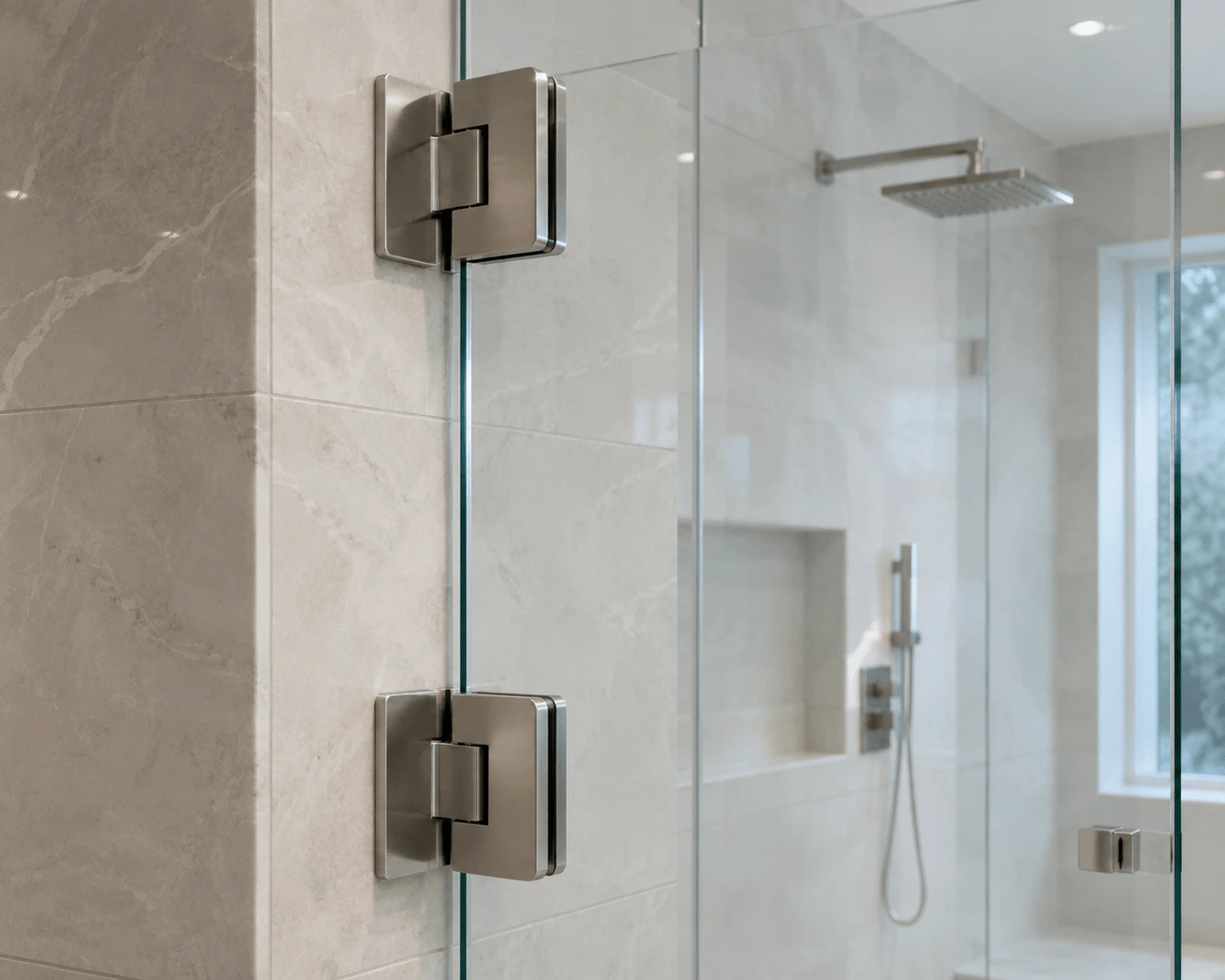
Zimmor Hardware’s hinge series carries explicit ratings — for example, two hinges rated for 80 lbs (36 kg) on 3/8″ glass, and three hinges for 120 lbs (54 kg) on wider doors. Always confirm the manufacturer’s published weight rating before specifying (Source: Zimmor Hardware product specification sheets).
5. Finish Options and Aesthetic Matching
This is where brass typically wins. Brass accepts a far wider range of finishes, including the 2026 trend finishes that dominate bathroom design:
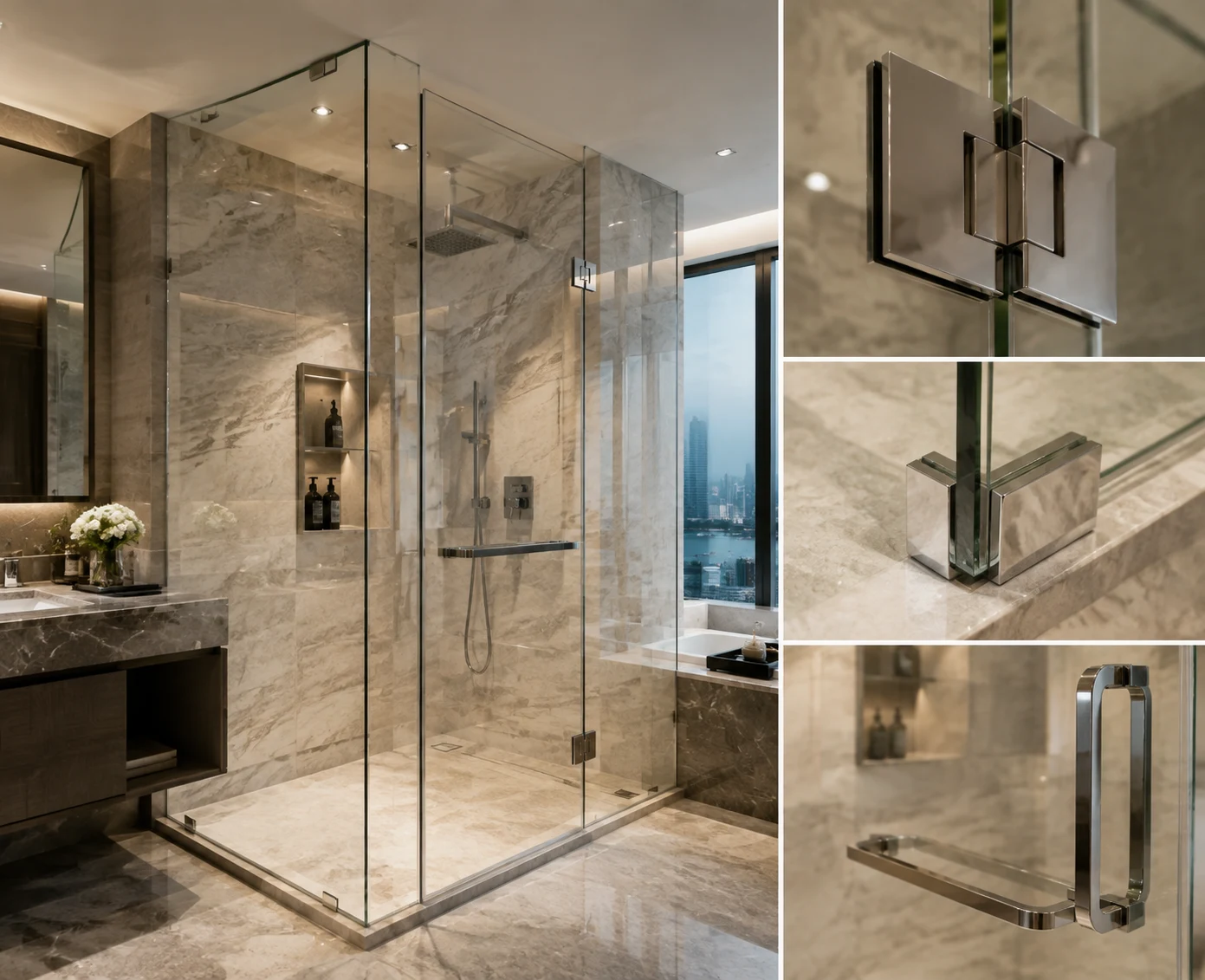
- Polished Chrome — timeless, both materials support it
- Matte Black (PVD) — the current market leader; PVD on brass offers the deepest, most durable black
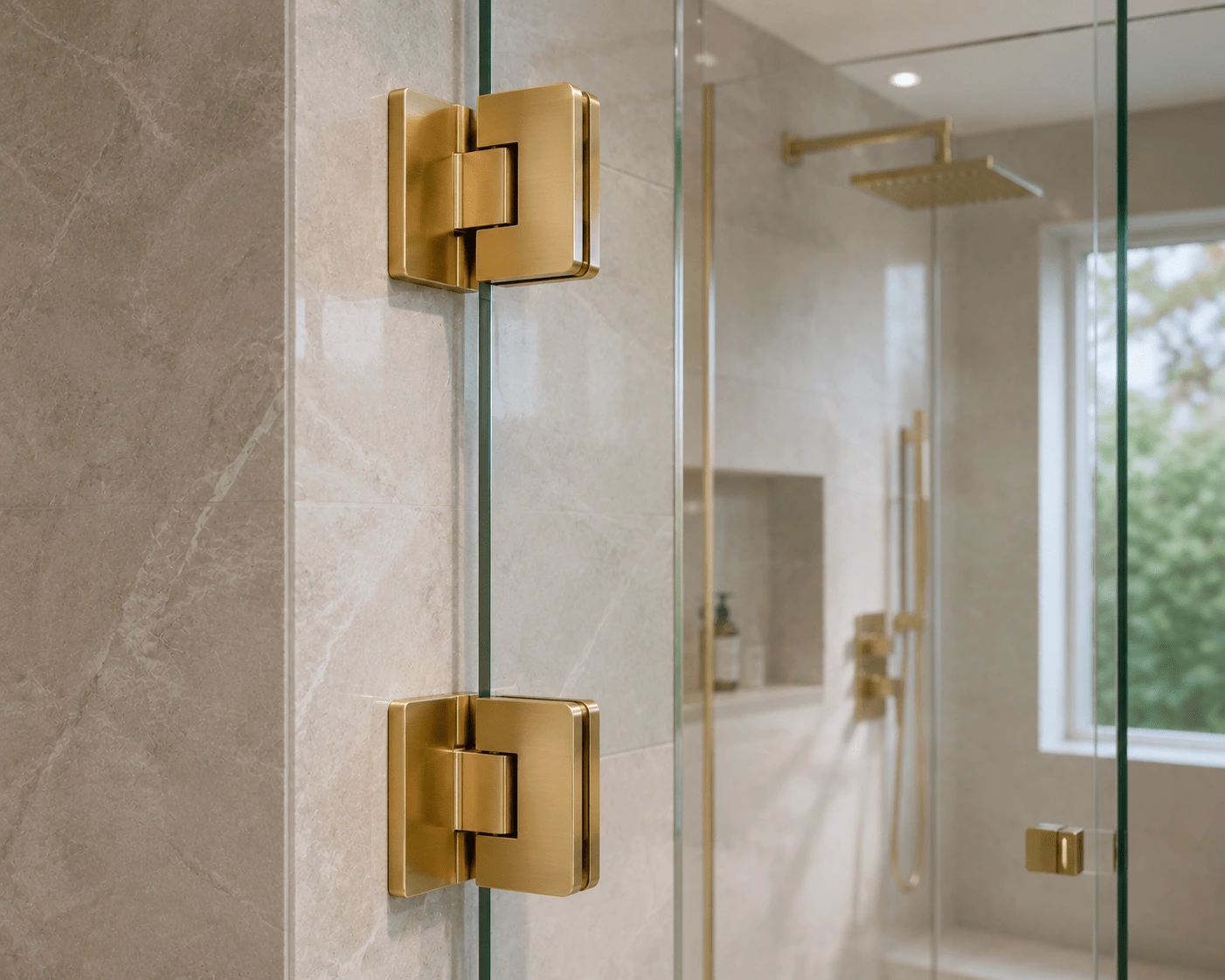
- Brushed Gold / Brushed Brass — rising fast in 2026; brass base gives the richest tone
- Brushed Nickel — the fingerprint-resistant middle ground
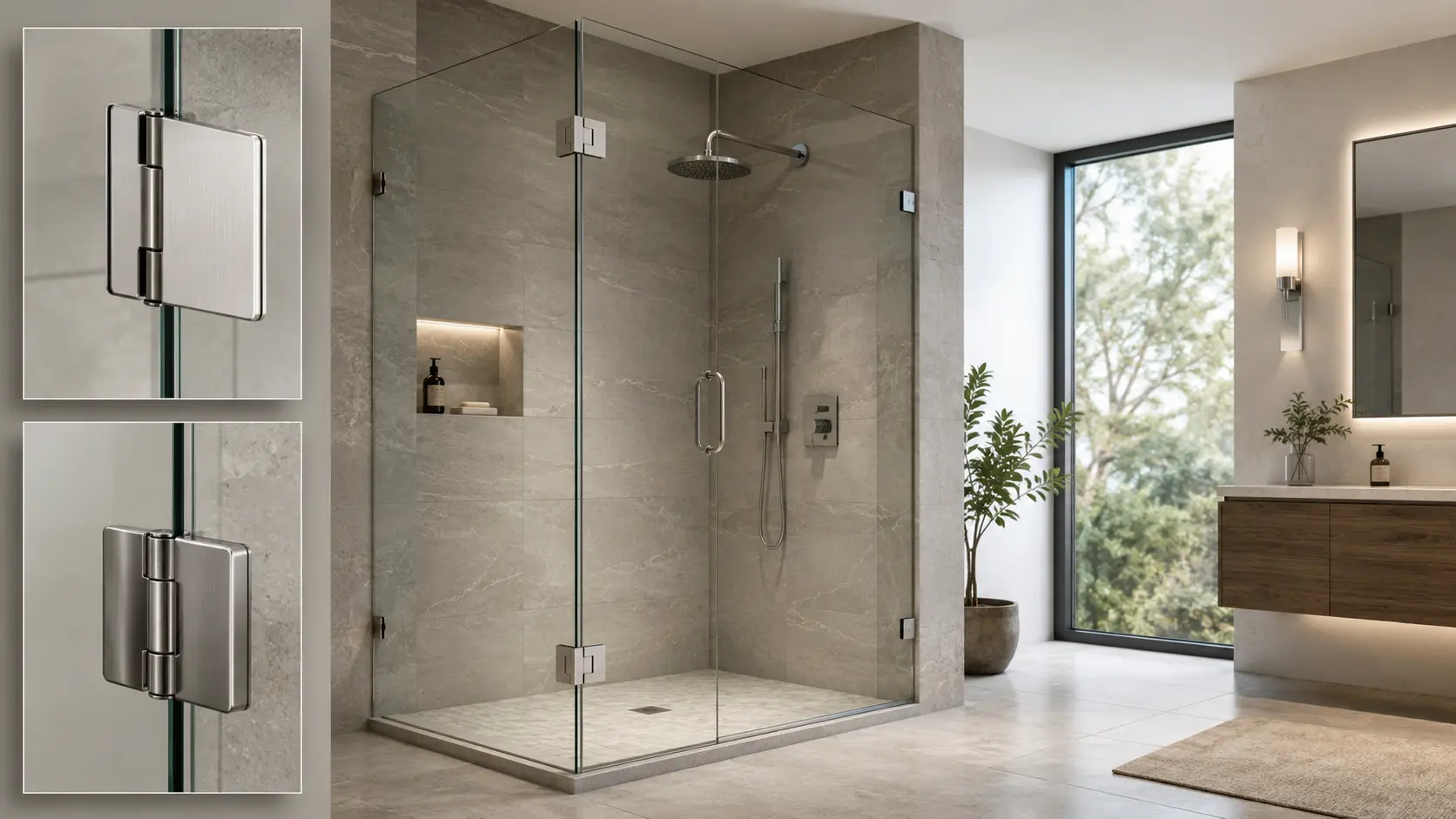
Stainless steel is generally limited to polished, brushed/satin, and PVD black/gold. If the project requires a warm gold or unlacquered-brass aesthetic, a brass base is effectively mandatory.
Design note: In mixed-metal bathrooms (another 2026 trend), the hinge finish should match or deliberately contrast with the handle, clamp, and support bar. Specifying all components from one manufacturer avoids finish color variance — a common complaint when hardware is sourced from multiple vendors. For a complete overview of component matching, consult our full hardware specification guide.
6. Cost and Procurement Considerations
| Factor | Brass | Stainless Steel |
|---|---|---|
| Raw material cost | Higher (copper-based) | Lower (for 304) |
| Finish cost | PVD/gold adds premium | Standard finishes cheaper |
| Typical price range | $8–$30 per hinge | $5–$25 per hinge |
| 316 premium | — | +20–40% over 304 |
| Supply stability | Stable | Stable |
For budget-sensitive residential work, 304 stainless steel offers the best value. For luxury hospitality and coastal commercial projects, forged brass or 316 stainless steel are the defensible specifications.
7. Making the Final Call: A Decision Framework
Use this sequence to specify with confidence:
- Environment first — coastal or harsh-chemical? → 316 stainless steel.
- Aesthetic second — need warm gold / unlacquered brass? → brass.
- Load third — very heavy doors? → stainless steel for slimmer profiles.
- Budget last — standard residential, inland? → 304 stainless steel.
When in doubt, request samples of both materials in the target finish and run a side-by-side inspection. A reputable manufacturer will provide finish chains and material certificates without hesitation.
Frequently Asked Questions
Is stainless steel or brass better for shower door hinges?
Both are excellent; the choice depends on environment and finish needs. Brass offers a wider finish range and natural corrosion resistance; 316 stainless steel is stronger and better for coastal or heavy-duty commercial use.
Do stainless steel shower door hinges rust?
304 stainless can develop light surface rust in salt-heavy environments; 316 stainless resists it much better. Standard indoor bathrooms rarely cause rust on either grade.
What is the best grade of stainless steel for shower hinges?
316 is the best for coastal or high-chloride environments. 304 is sufficient and more cost-effective for most inland residential and commercial bathrooms.
Why are brass shower hinges more expensive?
Brass is a copper-based alloy with a higher raw material cost, and premium finishes like PVD black or gold add further cost. It is the traditional choice for high-end hardware.
Can I get stainless steel hinges in a matte black finish?
Yes — matte black PVD coating is applied over stainless steel and offers good durability, though the richest black tones are typically achieved on a brass base.
Conclusion
Stainless steel and brass are both first-rate materials for shower door hinges — the right choice is a function of environment, finish requirements, and budget. For most inland residential work, 304 stainless steel delivers the best value; for coastal or heavy-duty projects, 316 stainless steel is the safe specification; and for premium aesthetics with the widest finish range, forged brass remains the benchmark.
Ready to Specify Hardware for Your Next Project?
Contact Zimmor Hardware for material samples, salt-spray test reports, and custom OEM/ODM support — or download our full catalog to compare hinge series across both materials.