

Specifying frameless shower hardware for large-scale commercial developments, hospitality projects, or high-end residential builds requires a rigorous technical approach. Unlike consumer product selection based solely on bathroom styling, B2B hardware procurement must satisfy structural load capacity, cycle durability, material grade standards, and tight installation tolerances. Since 1999, working closely with global glass fabricators, glaziers, and general contractors across 136 countries, Zimmor Hardware has identified key specification oversights that lead to premature component failure, glass slippage, and costly jobsite callbacks.
This comprehensive specification guide outlines the five core technical dimensions every project manager, contractor, and procurement officer must evaluate when selecting commercial shower door fittings. Whether you are executing custom cut-to-size orders or coordinating multi-unit hotel developments, this framework provides the engineering clarity needed to eliminate field risks and optimize procurement efficiency.
Who This Specification Guide Is For
This is a trade-level framework designed for industry professionals who evaluate hardware suppliers and establish project standards. The guidance below assumes you are one of the following:
- Glass fabricators and shower enclosure brands requiring precise CAD cutout compatibility and verified load ratings.
- Glazing contractors and project managers responsible for defect-free installation and long-term durability across commercial sites.
- Architectural hardware specifiers and importers seeking consistent finish quality and ERP-backed production standards.
- Procurement leads evaluating direct-factory OEM/ODM capabilities to streamline supply chain costs.
1. Structural Hardware: Hinges, Clamps & Support Systems
The structural integrity of a frameless glass enclosure relies entirely on the mechanical engineering of its primary mounting hardware. Selecting hinges, clamps, and support bars without calculating dynamic glass loads is the primary cause of system failure in high-use commercial environments.
Understanding Shower Door Hinge Weight Ratings & Load Capacities
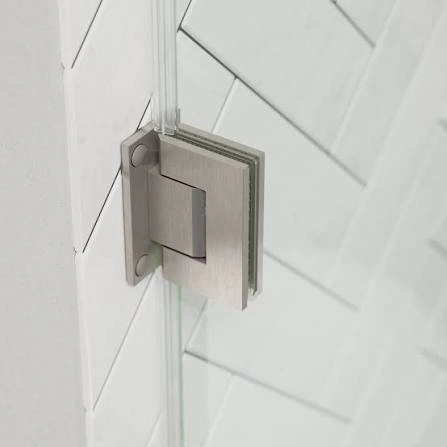
Shower hinges must support heavy tempered safety glass under both static gravitational loads and dynamic cyclic forces. Heavy glass (typically 10mm / 3/8″ to 12mm / 1/2″) exerts significant cantilever torque on hinge pins and mounting plates. Specifiers must ensure the base material—preferably forged solid brass or high-tensile 304/316 stainless steel—is rated specifically for the intended glass weight and door width.
| Glass Thickness | Hinge Configuration | Max Door Width | Max Door Weight | Recommended Base Material |
|---|---|---|---|---|
| 8mm (5/16 in) | 2 Standard Hinges | 750mm (30 in) | 35 kg (77 lbs) | Forged Brass / SS304 |
| 10mm (3/8 in) | 2 Heavy-Duty Hinges | 800mm (32 in) | 45 kg (100 lbs) | Solid Forged Brass |
| 10mm – 12mm | 3 Heavy-Duty Hinges | 900mm (36 in) | 55 kg (121 lbs) | Solid Forged Brass / Heavy SS304 |
| 12mm (1/2 in) | Pivot Hinge System | 1000mm (40 in) | 65+ kg (143+ lbs) | Stainless Steel SS304 / SS316 |
Glass Clamp Spacing & Structural Installation Standards
Wall-to-glass and glass-to-glass shower glass clamps replace bulky perimeter frames to create a clean, modern aesthetic. Over-tightening clamps on uneven tile surfaces can cause stress concentration and panel breakage, while under-specifying clamp counts causes panel deflection.
- Edge Clearance: Position clamps at a minimum distance of 150mm (6 in) from the panel corners to prevent localized stress propagation during structural shift.
- Maximum Spacing: Maintain a maximum distance of 600mm to 800mm between adjacent clamps along vertical or horizontal glass edges.
- Gasket Quality: Ensure all clamps are supplied with non-aging, high-density EPDM or clear PVC gaskets to prevent direct metal-to-glass contact and shock transmission.
When to Specify Stabilizer Support Bars
Header-free configurations using fixed glass panels over 900mm wide or 2000mm high require architectural stabilizer bars. A 45-degree corner support bar or 90-degree wall-to-glass support rod prevents lateral panel flex, maintaining seal integrity and overall enclosure rigidity.
Engineering Note on Heavy Glass Doors: For oversized glass doors exceeding 50 kg (110 lbs) or 900mm (36 in) in width, standard side-mount wall hinges create high rotational torque on wall fasteners. Specify a top-and-bottom heavy-duty floor pivot hinge system engineered in SS304/SS316 to transfer the door’s full gravitational mass directly into the floor structure. For deeper technical load tables, review our dedicated frameless shower door hinge selection guide.
2. Door Systems: Sliding, Pivot & Hinged Configurations
Selecting between sliding systems, side-hinged doors, and pivot configurations depends on square footage constraints, traffic volume, structural wall backing, and water-containment requirements.
Space-Constrained Projects: Why Sliding Systems Win
Commercial hospitality projects (hotels, multi-family developments) increasingly specify sliding shower door systems to maximize usable floor area. Eliminating outward door swings allows architects to optimize vanity placement and fixture clearance.
- Roller Mechanics: High-precision stainless steel ball bearings encased in wear-resistant POM (Polyoxymethylene) wheels guarantee quiet, smooth gliding for 50,000+ opening cycles.
- Track Loading: Extruded high-grade 304 stainless steel or heavy-wall aluminum header tracks engineered to prevent rail sagging over wide spans (>1500mm).
- Soft-Close Dampeners: Integrated dual-directional soft-close hydraulic buffers prevent high-impact glass collisions at track ends.
| System Configuration | Space Efficiency | Load Capacity | Water Containment | Best Project Application |
|---|---|---|---|---|
| Sliding System (Barn/Roller Style) | Maximum (Zero door swing) | High (Supported by top rail) | Moderate to High (Requires bottom guide & seals) | Hotels, Urban Apartments, Compact Layouts |
| Side-Hinged (Wall Mount) | Requires swing clearance | Moderate (Dependent on wall framing) | High (Tight vertical magnetic seal fit) | Custom Residential, Luxury Suites |
| Pivot System (Floor/Header Mount) | Requires partial clearance | Very High (Vertical load into floor slab) | Moderate (Requires bottom sweep setup) | Heavy Glass, Extra-Wide / High-Traffic Entrances |
3. Surface Finishes: Durability, Testing Standards & Matching
Shower hardware operates in high-humidity environments exposed to soap scum, hard water minerals, and aggressive cleaning solvents. Specifying the correct surface finish treatment prevents corrosion, flaking, and tarnishing over years of daily commercial use.
Finish Durability Comparison & Salt Spray Testing Standards
Hardware specifiers should evaluate finish quality using standardized testing methods such as ASTM B117 (Neutral Salt Spray / NSS Test). Commercial specification standards typically require components to withstand a minimum 48-hour to 96-hour salt spray exposure without surface pitting or micro-cracking.
| Finish Style | Manufacturing Process | Corrosion Resistance | Scratch Resistance | Recommended Environment |
|---|---|---|---|---|
| Chrome (Polished) | Multi-layer electroplating (Copper + Nickel + Chrome) | Excellent (96h+ Salt Spray) | High | High-Traffic Hospitality & Commercial |
| PVD Finishes (Brushed Brass / Gold) | Physical Vapor Deposition (Vacuum Titanium coating) | Superior (200h+ Salt Spray) | Exceptional (Harder than steel) | Luxury Hospitality & Premium Residential |
| Matte Black | Electrophoretic Deposition (ED) or Powder Coating | Good to High (48h–72h Salt Spray) | Moderate (Requires care during install) | Modern Residential & Boutique Hotels |
| Brushed Nickel / Stainless | Mechanical brushing + protective clear passivation | Excellent | High (Hides fingerprints) | Commercial & High-End Residential |
Multi-Hardware Category Finish Consistency
A common quality issue in commercial procurement is color variation across hardware categories—such as matte black hinges exhibiting a different tone compared to glass clamps or U-channels. Working with an integrated manufacturer capable of executing consistent surface treatments across hinges, handles, clamps, and aluminum profiles ensures complete visual uniformity across the enclosure package.
4. Glass Compatibility & Accessory Integration
Shower hardware must integrate seamlessly with glass cutout templates, handle ergonomics, and waterproofing vinyl seals to deliver a reliable, leak-free installation.
Glass Cutout Templates and Fabrication Precision
Tempered glass cannot be cut, drilled, or altered post-heat treatment. Hardware suppliers must provide precise CNC glass cutout CAD templates (DXF/DWG format) with tight manufacturing tolerances (±0.5mm). Incorrect hole placement or notch radius will result in glass cracking during tempering or binding during hardware installation.
Architectural Handles, Towel Bars, and Accessories
Handles and pull knobs serve as the main physical touchpoint for end users. Key specification criteria include:
- Back-to-Back Mounting: Heavy-duty through-glass pulls require clear polymer washers and protective internal sleeves to prevent metal-to-glass contact under high pulling forces.
- Combination Handle/Towel Bars: Ideal for compact hotel bathrooms, combining outer towel hanging space with an inner grab pull without requiring extra glass cutouts. For installation step-by-steps, refer to our towel bar and handle combo installation guide.
- Material Integrity: Ensure interior fixings, washers, and set screws are constructed from 304-grade stainless steel to eliminate interior rust staining.
Seals, Gaskets & Sweeps: Industrial Waterproofing Standards
Water leakage control relies on high-quality clear vinyl (PVC) or magnetic profile seals. Specify UV-stabilized clear PVC compounds to prevent yellowing, stiffness, and cracking under thermal cycling and light exposure. Magnetic profiles are recommended for 90-degree and 180-degree door closure junctions to ensure positive, watertight latching.
5. Supplier Evaluation: Certifications & Quality Assurance
For glass fabricators, importers, and project buyers, selecting the right manufacturing partner is as critical as selecting the hardware specifications. Low-cost hardware sourced from uncertified suppliers often conceals internal casting flaws, inferior zinc alloys, or thin plating that leads to structural failure post-installation.
Essential Quality Management & Testing Certifications
Verify that your shower hardware manufacturer maintains internationally recognized quality systems and third-party test reports:
- ISO 9001:2015: Guarantees consistent manufacturing process control and traceability from raw material ingot to final packaging.
- EN 14428 / CE Certification: European standards governing durability, cleanability, and structural integrity for shower enclosures.
- Cycle Testing Reports: Independent lab confirmation that hinge mechanisms endure 50,000 to 100,000 opening/closing cycles without spring displacement or hinge pin wear exceeding 0.5mm.
10-Point Hardware Procurement Checklist
- Is the primary hinge body forged from solid brass or investment-cast 304/316 stainless steel (rather than die-cast zinc alloy)?
- Does the supplier provide downloadable CAD / DXF cutout templates for automated CNC glass machinery?
- Are neutral salt spray test reports (ASTM B117) available for all supplied finishes?
- Does the manufacturer offer ERP-backed batch traceability for raw material heat numbers?
- Are internal hinge springs made from high-tensile 304 stainless steel wire to resist corrosion fatigue?
- Are mounting gaskets made from durable, non-aging PVC or silicone rubber?
- Can the supplier guarantee finish color consistency across mixed product lines (hinges, clamps, handles, profiles)?
- Does the factory utilize in-house CNC machining centers to ensure tight machining tolerances?
- Are sliding hardware systems equipped with hydraulic soft-close mechanisms tested for high cycles?
- Does the factory provide OEM/ODM customization capabilities for specific project architectural drawings?
Sourcing Hardware & OEM Considerations for Brands/Contractors
Successful frameless shower enclosure projects demand a balanced specification strategy that harmonizes structural load capabilities, door configuration efficiency, corrosion-resistant surface finishing, precise glass integration, and rigorous supplier quality audits. Evaluating hardware against these five engineering dimensions eliminates field failures, protects jobsite safety, and guarantees long-term commercial performance.
Since 1999, Zimmor Hardware has supplied fabricators, contractors, and brands in 136 countries with load-rated hinges, handles, glass clamps, and full shower hardware systems. If you are specifying a production run or a custom enclosure program, explore our product lines or contact our engineering team directly:
- Browse our full catalog of heavy-duty shower door hinges and glass hardware.
- For step-by-step installation methodologies, refer to our frameless shower door installation guide.
- Download our direct-factory PDF Product Catalog for full dimensions and cutouts.
- Contact our technical team for custom OEM/ODM project quotes and sample evaluations.
Frequently Asked Questions
What is the recommended material for commercial shower door hinges?
Solid forged brass and investment-cast 304/316 stainless steel are the gold standards for commercial applications. Unlike die-cast zinc alloys, forged brass and stainless steel possess high tensile strength, resisting fatigue and deformation under heavy glass loads (10mm to 12mm) in high-traffic environments.
How does PVD coating compare to traditional electroplating for shower hardware?
Physical Vapor Deposition (PVD) produces a thin, extremely hard ceramic layer bonded at the atomic level. PVD finishes (such as Brushed Brass or Brushed Gold) offer superior corrosion resistance (withstanding 200+ hours in salt spray testing) and scratch resistance compared to standard electroplating, making PVD ideal for luxury hospitality projects.
Why is 10mm glass preferred over 8mm glass in frameless specifications?
10mm (3/8″) glass provides the optimal balance of structural rigidity and weight for true frameless designs. While 8mm glass requires additional framing or header bars to prevent panel flexing, 10mm glass allows for self-supporting, high-end frameless aesthetics while maintaining compliance with ANSI Z97.1 safety standards.
How do you prevent color variance across mixed hardware lines?
Color variance is prevented by procuring all enclosure components (hinges, clamps, handles, and aluminum channels) from a single integrated manufacturer using automated batch electroplating or ED coating. Sourcing components from multiple suppliers inevitably leads to tone and sheen mismatches on site.
What testing certifications should buyers request from hardware manufacturers?
Importers and project managers should request ISO 9001:2015 quality management compliance, EN 14428 / CE durability reports, ASTM B117 salt spray corrosion test results, and independent 50,000+ opening cycle test reports to ensure long-term hardware reliability.
See the complete article index for every guide on this site.