

Key takeaways
- A frameless shower door is replaceable, but only with a hinge that matches the existing glass holes: tempered glass cannot be drilled after manufacture, so a wrong hinge means a new glass panel.
- Compressed clamping gaskets produce exactly the same sag as a worn hinge body. Lift the free edge by hand; any vertical movement means the clamp has lost grip, not that the hinge has failed.
- Take six measurements from the old hinge before ordering: glass thickness, hole centre spacing, hole diameter, hole-to-edge setback, cutout geometry, and opening angle.
- Check the load while you are there. Glass weighs about 2.5 kg per m² per mm of thickness, so a 700×2000 mm door in 10 mm glass is roughly 35 kg on the hinge pair.
- Over-tightening does not hold the glass better. It crushes the gasket, removes the friction, and loads the hole edge until it cracks.
Short answer: a frameless shower door hinge is replaceable, but only with a hinge whose glass hole pattern, thickness, and opening angle match the existing holes. Tempered glass cannot be re-drilled, so a mismatched replacement means a new glass panel. Measure the old hinge before you order anything.
When a shower door hinge actually needs replacing
Frameless doors hang entirely on their hinges. There is no frame to share the load, which is why a worn hinge shows up as a door that sags, catches on the curb, or refuses to self-close. But a door that swings badly is not automatically a door with a dead hinge. Frameless hardware fails in a few distinct ways, and only some of them are solved by buying a new part.
The most common mistake is replacing the hinge when the clamping gaskets have compressed. The gaskets sit between the hinge body and the glass and generate the friction that holds the door at the correct height. When they flatten, the door slides down a few millimetres inside the hinge, and the symptom is identical to a worn hinge body: sag, drag, misalignment. If you replace the hinge first, you spend money and keep the problem.
The ten-minute diagnostic before you buy anything
Run this sequence with the door still fitted. It separates a worn hinge body from a compressed gasket, a loose fixing, or a seal that is fouling the swing.
- Look at the gasket line. Open the door and sight along the edge where the hinge clamps the glass. A healthy gasket shows a continuous resilient strip. A compressed one looks flattened, shiny, or has a visible gap between hinge plate and glass.
- Lift the door vertically. With the door closed, place both hands under the free edge and lift gently. Any vertical movement of the glass inside the hinge means the clamp has lost grip — gaskets, not the hinge body, are the likely cause.
- Check the wall or glass-panel fixings. Wall-mounted hinges bolt into a wall plate; glass-to-glass hinges clamp a fixed panel. Loose screws at either end move the whole assembly, and a hinge that has shifted sideways reads as a sagging door.
- Listen while swinging. A dry creak is usually friction in the pivot. A sharp click or a grinding feel under hand pressure is metal-to-metal contact or a slipped gasket, and repeated clicking after re-tightening is the signal that the hinge body itself is done.
- Test the self-close with the seals clear. Many self-closing hinges begin to pull the door home from a fixed angle. If the door returns when you hold the seal strip clear but not when it is fitted, the seal is fighting the hinge, not the hinge failing.
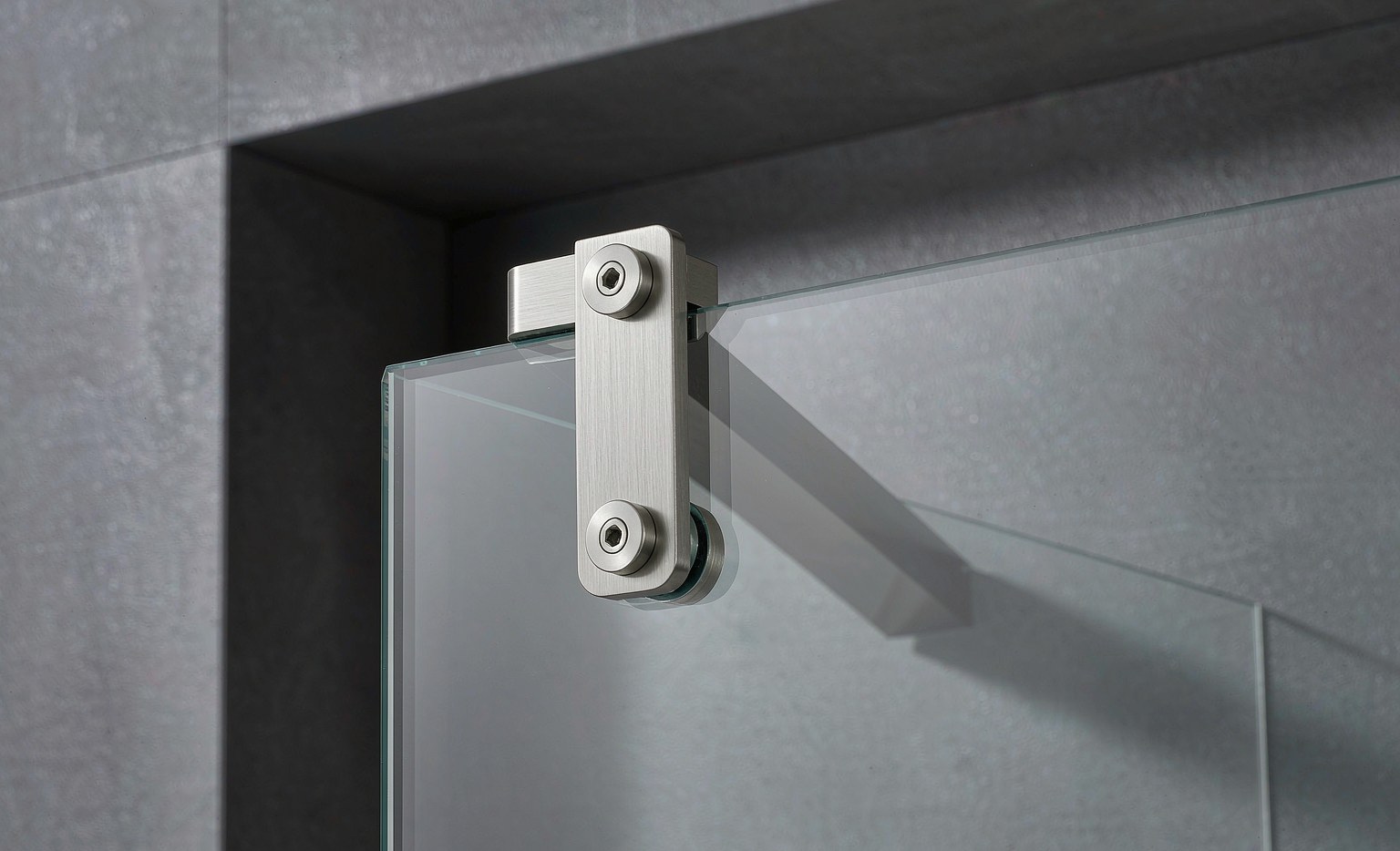
If steps one to three identify a loose clamp or a movement problem, the repair is re-seating and re-torquing, which is a different job from replacement and is covered in our guide to adjusting a sagging frameless shower door. Replacement is the right call only when the hinge body itself has failed.
The measurement worksheet: six numbers to take off the old hinge
This is the part that goes wrong in the field. A replacement hinge is not a like-for-like part across manufacturers. Hole patterns, notch geometry and glass clearances differ between brands and between production generations of the same brand, so two hinges that look identical on the outside can be incompatible on the bench. Because tempered glass is made by heating and quenching the panel and cannot be cut, drilled or re-shaped afterwards, there is no fallback: if the holes do not line up, the glass does not change, and the hinge becomes scrap.
Take these six measurements from the old hinge while it is still on the door.
| Measurement | How to take it | What goes wrong if you get it wrong |
|---|---|---|
| Glass thickness | Measure the glass at the drilled edge with a calliper, not at the middle of the panel. Record the actual reading, for example 9.8 mm for nominal 10 mm glass. | A hinge rated for 8 mm will not clamp a 10 mm panel; the gasket cannot compress enough and the door slides. |
| Hole centre spacing | Centre-to-centre distance between the two drilled holes in the same panel, measured along the glass edge. | Off by a couple of millimetres and the bolts will not pass through both holes at once. |
| Hole diameter | Diameter of the drilled hole, taking the average of two readings at 90°. | Too small and the bolt sleeve will not enter; too large and the bolt has play, which cracks the hole under load. |
| Hole-to-edge setback | From the centre of the hole to the polished glass edge. | Wrong setback changes where the hinge sits, which shifts the door in or out of the reveal and starts a leak at the hinge side. |
| Cutout or notch geometry | Photograph the hole area square-on. Note whether the glass is notched square, rounded, or cut as a mouse-ear pattern around the hole. | A hinge body designed for a square notch will not seat in a mouse-ear cutout. This is the single most common incompatible pairing. |
| Opening angle and type | Confirm 90°, 135° or 180°, and whether the hinge is wall-to-glass or glass-to-glass. | A 90° hinge cannot close a 135° corner layout; the door will foul the fixed panel or fail to meet the seal. |
Photograph the old hinge, face-on and from the side, next to a ruler in frame, before you remove it. If the original has no visible part number — which is common on unbranded assemblies — those photographs plus the six numbers above are the entire specification any supplier has to work from. When you approach a supplier for a match, ask them to confirm the hole spacing and notch geometry against your measurements in writing before the order is confirmed.
Checking the load: does the replacement hinge carry the door?
Replacement is also the moment to check that the door was correctly hung in the first place. Doors that fail early in their life are usually under-hinged rather than badly made. The relationship between glass thickness and mass is fixed: glass weighs roughly 2.5 kg per square metre for every millimetre of thickness.
Worked example for a typical residential door of 700 × 2000 mm in 10 mm glass:
- Area = 0.70 m × 2.00 m = 1.40 m²
- Mass = 1.40 m² × 10 mm × 2.5 kg/m²/mm = 35 kg
That 35 kg is dead weight carried entirely by the hinge pair, plus the dynamic load of every swing. A door of this size on two hinges is a conventional arrangement for residential work, but the hinges fitted to it must be rated for a 35 kg panel, not for a lightweight 6 mm door. Push the same door to 900 mm wide and the mass rises to 45 kg, which is where a three-hinge layout or a heavy-duty body becomes the sensible choice. The calculation is a check on your replacement choice, not a substitute for the manufacturer’s stated capacity — use the figure your supplier publishes, and treat these numbers as a filter for obvious mismatches.
Repair, replace the hinge, or replace the glass
Once you have the diagnostic result and the measurements, the decision is usually unambiguous.
| Symptom | Likely cause | Right action |
|---|---|---|
| Door sits low, lifts freely by hand, no noise | Compressed clamping gaskets | Re-seat and re-torque; replace gaskets, not the hinge |
| Dry creak on swing, door otherwise aligned | Pivot friction | Adjust and lubricate; no parts needed |
| Sharp click or grind, persists after re-tightening | Worn hinge body or slipped gasket contact | Replace the hinge — match all six measurements |
| Chipped or star-cracked glass at the hole | Over-tightened clamp or impact | Glass must be replaced; a new hinge will not fix a cracked hole |
| Replacement hinge will not seat in the existing holes | Incompatible cutout or spacing | Source a matching hinge; the glass cannot be modified |
| Hinge correct but door still leaks at the hinge side | Seal contact or alignment | Address the seal and alignment, covered in our frameless leak guide |
If the table points to a worn body, the replacement should be a direct match on all six measurements. Adjustable bodies are worth considering for the replacement itself, because the adjustment range absorbs small tolerance differences between the old and new hinge and lets you dial the door back onto the seal without re-drilling anything. Our range of adjustable shower door hinges is built around that tolerance, and the wider shower door hinge range covers wall-to-glass and glass-to-glass configurations across the common angles.
Re-hanging the door without damaging the glass
Fitting a new hinge is a controlled sequence. The glass is heavy, and most damage happens during handling rather than during bolting.
- Support the door before you loosen anything. Two people, or a panel lifter rated for the load. Never let the free edge hang while one hinge is off.
- Remove the cover plates and back the bolts out evenly. Alternating a quarter turn per bolt keeps the body square and avoids loading one corner of the hole.
- Inspect the hole edges before fitting the new hinge. Any chip or star crack at the hole is a failure point and means the panel is compromised. Clean the hole of mineral scale so the sleeve seats flat.
- Fit the gaskets to the new hinge, not to the glass. A dry hinge on bare glass is how holes crack.
- Tighten evenly until the gasket just compresses. Firm, not brutal. The clamp holds by friction across the gasket face, and over-torque crushes the gasket and defeats it.
- Set the door height and square before final torque. Check the reveal against the fixed panel and the seal contact along the full height, then torque the bolts in alternating passes.
If the door no longer meets the seal after re-hanging, the hinge is usually sitting a millimetre proud or the door has moved out of plumb. That presents as a leak, and our guide to stopping frameless shower door leaks walks through the seal-side checks in order.
Choosing the replacement so it lasts longer than the first one
Most hygiene on a shower hinge is about what you do not do to it. Chlorinated cleaners and abrasive pads remove the passivation layer on stainless steel, and once that layer is gone the surface corrodes in a permanently wet environment. Rinsing and drying the hardware is worth more than any polish.
Material matters for lifespan. Stainless steel relies on a chromium-rich passive layer to resist corrosion, and the 316 grade is the one specified for wet, salt-bearing or chemically cleaned environments, while brass holds its finish but depends on the plating and lacquer quality for durability. Finish selection is usually the deciding factor for how the hinge will look after five years, and if you are going to specify a finish for a replacement, the surrounding panels and any new door hardware should match it at the same time. Glass thickness is worth confirming at the same moment: a replacement is the point at which it is safe to check whether the panels are 8, 10 or 12 mm, and our guide to frameless shower glass thickness explains what each thickness carries.
If the replacement is for a hotel, gym or serviced apartment rather than a single home, the hinge is working many times a day and the load calculation matters more, not less. In that case confirm the hinge type against the layout before ordering, using the selection guidance in our article on choosing frameless shower door hinges.
Frequently asked questions
Can I replace a shower door hinge without replacing the glass?
Yes, provided the new hinge matches the existing glass on hole spacing, hole diameter, hole-to-edge setback, cutout geometry, glass thickness and opening angle. Tempered glass cannot be drilled after manufacture, so there is no way to adapt the panel to a hinge. If the old hinge has no part number, measure it and photograph it before removing it.
Why did my new hinge not fit the existing holes?
Hole patterns are not standardised across manufacturers or even across generations of the same brand. A hinge designed for a square notch will not seat in a mouse-ear cutout, and a few millimetres of difference in centre spacing is enough to stop the bolts passing through both holes. Compatibility has to be confirmed from measurements, not from the outside shape of the hinge.
How long should shower door hinges last?
There is no single service life, because it depends on door mass, how many hinges carry it, how often it is used and how aggressive the cleaning regime is. Residential doors that are correctly hinged and cleaned without abrasives typically outlast heavily used communal showers by a wide margin. What shortens life reliably is an under-hinged door, a crushed gasket, and over-tightened bolts that crack the glass hole.
My door sags but the hinge looks fine — what else could it be?
Compressed clamping gaskets are the usual answer. The gaskets generate the friction that holds the door at height, and when they flatten the door slides down inside an otherwise sound hinge, producing exactly the sag you would expect from a worn body. Lifting the free edge by hand will show any vertical movement in the hinge, which points to the gasket rather than the hinge.
Is it cheaper to replace the hinge or the whole door?
Replacing a hinge is the smaller job whenever the glass is intact and a matching hinge can be sourced, because the glass is the expensive part. Replacing the glass is only forced when the hole area is chipped or star-cracked, or when no hinge on the market matches the existing hole pattern. Diagnose first: many sagging doors need a gasket or an adjustment and no new parts at all.
Can I use a hinge rated for 8 mm glass on a 10 mm door?
No. The clamp has a fixed gasket gap and a rated glass thickness range. An 8 mm hinge will not develop enough compression on a 10 mm panel, so the door slips under its own weight even when the bolts are tight. Always match the hinge’s rated range to the measured thickness of your glass, and confirm the door mass against the hinge capacity while you are at it.
How tight should the hinge bolts be?
Firm enough to compress the gasket, not enough to crush it. Tighten in alternating quarter turns and stop when the gasket is uniformly compressed with no visible gap at the plate edge. Over-torque does not hold the glass better; it crushes the gasket, removes the friction you rely on, and loads the hole edge until it cracks.
Do I need two hinges or three?
It depends on door mass rather than door width alone. Calculate the mass as area in square metres times thickness in millimetres times 2.5, then check it against the capacity your supplier publishes. A 700 by 2000 mm door in 10 mm glass is about 35 kg; wider panels approach 45 kg and are the point where a third hinge or a heavy-duty body is normally specified.
Sources
The working constraints in this guide are general engineering facts about glass and hardware rather than product specifications, and are referenced here so you can check them independently:
- Tempered glass — how toughened glass is made and why it cannot be cut or drilled after tempering.
- Hinge — the mechanics of pivot and load-bearing hinges.
- Stainless steel — chromium-based passivation and why grades differ in wet environments.
If you are specifying replacements across a project rather than a single door, send the measurements and a photograph of the existing hinge and we will confirm the compatible body and angle before anything is manufactured.