
Glass door fittings need a coordinated interface schedule because hinges, clamps, handles, and connectors can all affect the same glass panel. Capture the holes, edges, and finished clearances on one controlled drawing.

Build the panel-by-panel fitting schedule
Assign each glass panel an ID and list every fitting attached to it. Mark the fitting model, position, orientation, and the drawing that controls its glass preparation. This makes it easier to see when two parts claim the same space or require incompatible cut-outs. Keep fixed-panel connections separate from moving-door hardware.
Resolve holes, edges and attachment details
For each fitting, record the supplier's required hole, notch, edge distance, glass thickness, and interface parts. Compare those inputs with the fabricator's current panel drawing. If multiple components share a panel, review their combined locations and edge clearances instead of approving each one in isolation.
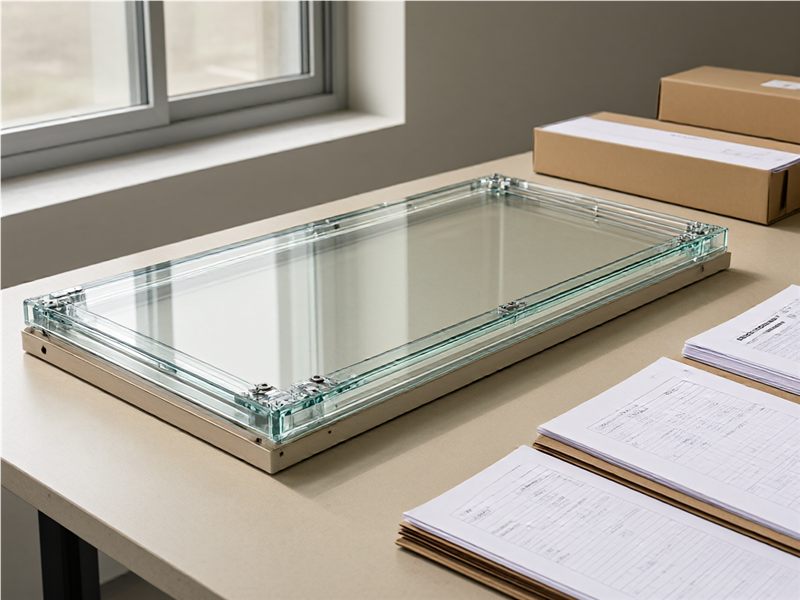
Review the load path and support points
Show how the panel is supported and where each fitting connects to a wall, floor, ceiling, or neighboring panel. Ask the supplier and project engineer to identify any configuration-specific assumptions. Do not add an unverified load rating to a product schedule; retain the source document and approval for the complete arrangement.
Close the package with a sample and revision record
Use a sample or mock-up to review orientation, visible covers, finish, access to fasteners, and panel movement. Note the model number and revision on the approved drawing. Any proposed substitution should be compared against the full fitting schedule so a part does not fit one dimension while conflicting with another interface.
Glass fitting coordination questions
Can each fitting be approved independently?
Each model needs its own check, but the combined positions and glass preparation should also be reviewed on the same panel drawing.
What should stop fabrication release?
Unconfirmed model numbers, hole locations, edge distances, glass details, or a change that has not been acknowledged by the affected suppliers.
Related resources: Zimmor glass hardware and fitting information; ANSI Z97.1-2026: Safety glazing materials used in buildings.
