

A frameless pivot door swings; a sliding system glides — and that single difference changes the whole specification. Sliding shower doors need no swing clearance, work in tight bathrooms where a hinged leaf would hit a vanity or toilet, and carry a distinctly European, all-glass aesthetic that architects keep asking for. But a sliding system is also a mechanism: a track, rollers and guides working under the full weight of a tempered panel, hundreds of cycles a year, in a wet and soap-scummed environment.
For distributors and installers, that means the track system deserves the same specification discipline as hinges. Choose the wrong rail material for the finish environment, the wrong roller class for the glass weight, or the wrong configuration for the opening, and the door will still work on day one — then bind, sag or rattle by month six. This guide walks through the anatomy of a frameless sliding system, the real trade-offs between aluminum and stainless track kits, how glass thickness and weight cap the design, and how to match the configuration to the opening. All figures below are taken from the current Zimmor sliding system range.
Anatomy of a frameless sliding system
Every top-run sliding shower system shares four functional parts:
- Header / guide rail. The structural beam fixed across the top of the opening. It carries the weight of the moving panel and defines the maximum installable width. Quality kits ship the header slightly oversize so installers can cut it down to the exact opening.
- Rollers / carriages. The wheels that grip the track and lift the glass. Their bearing quality decides how the door feels after a year of daily use. Better systems use sealed roller bearings; premium systems place rollers above and below the header so the panel is captured rather than merely hung.
- Guides and stops. Bottom guides and end stops keep the panel true in the opening and absorb the last few millimetres of travel.
- Seals and sweeps. Vertical seals between panels and a bottom sweep close the gap the track cannot. Sliding doors seal differently from pivot doors — see the dedicated shower door seals guide for profile selection.
One design detail separates good systems from cheap ones: where the rollers sit. Systems with rollers hidden inside the guide rail look cleanest; systems with rollers above and below the header bar hold the panel captive, which improves stability and gives the door that “floating”, all-glass appearance.
Aluminum vs stainless steel track systems
Zimmor’s sliding range offers two track material families, and the choice is not cosmetic — it changes the glass, the look and the maintenance profile.
| System | Track material | Roller position | Glass thickness | Header / kit width |
|---|---|---|---|---|
| 865 | Anodized aluminum rail, plated or lacquered stainless fittings | Inside the guide rail | 1/4″ (6 mm) | Various width specifications |
| 858 | Anodized aluminum rail, plated or lacquered stainless fittings | Inside the guide rail | 3/8″ (10 mm) | Various width specifications |
| 855 | Anodized aluminum rail, plated or lacquered stainless fittings | Inside the guide rail | 3/8″ (10 mm) | Various width specifications |
| 889 | 304 stainless steel | Above and below the header bar | 5/16″ or 3/8″ (8/10 mm) | Header kit up to 63″ (1600 mm), cuttable to size |
| 809 | 304 stainless steel | Above the header bar | 5/16″ or 3/8″ (8/10 mm) | Kit width 72″ (1830 mm), cuttable to size |
| 808 | 304 stainless steel | Above and below the header bar | 5/16″ or 3/8″ (8/10 mm) | Header kit 72″ (1830 mm), cuttable to size |
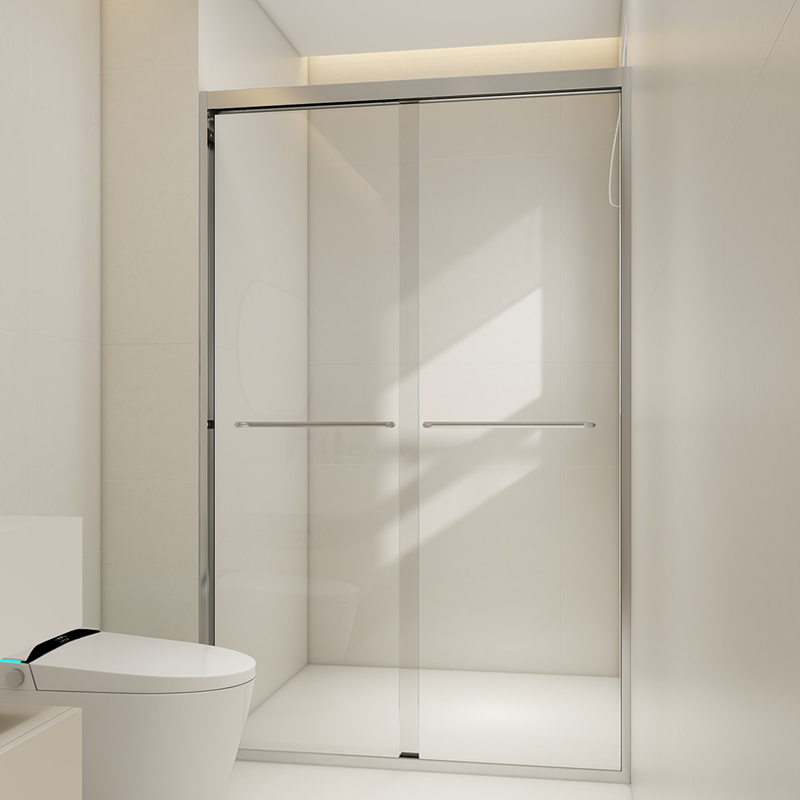
Choose anodized aluminum (865 / 858 / 855) when the project wants a defined rail profile and a tighter budget. The anodized layer protects the aluminum in wet environments, and the stainless fittings carry the visible hardware. Note the glass pairing: the 865 runs a lighter 6 mm panel, while the 858 and 855 take full 10 mm frameless glass — confirm which panel the elevation calls for before quoting.
Choose 304 stainless steel (889 / 809 / 808) when the spec calls for the European “all-glass” look and a premium glide. With stainless the hardware recedes visually and the glass dominates; the 889 and 808 add rollers below the header as well as above, so the panel is captured top and bottom. For finish-coordinated projects, match the stainless grade against the rest of the hardware as described in the stainless steel vs brass material guide, and if the bathroom has a plated or PVD finish scheme, check finish compatibility with the PVD coating buyer’s guide.
Glass thickness and the 40 kg rule
Sliding systems do not fail because glass breaks — they fail because a panel too heavy for the rollers chews through the track. Tempered glass weighs roughly 2.5 kg per square metre per millimetre of thickness, so panel weight climbs fast with size: a 900 × 2000 mm door leaf in 10 mm glass already carries about 45 kg.
The current Zimmor stainless systems therefore publish a hard limit: the sliding door glass must weigh less than 88 pounds (40 kg) — height is otherwise optional on the 889, 809 and 808. In practice that means:
- 8 mm panels give more height headroom inside the 40 kg envelope — the safe default for tall door leaves.
- 10 mm panels deliver the heavy, premium feel but cap the leaf size sooner; check the weight before promising a 2-metre-tall door in 10 mm.
- Fixed panels carry no roller limit, but their thickness should still match the slider for a coherent elevation — the thickness trade-offs are covered in the frameless shower glass thickness guide.
Always leave margin between the calculated panel weight and the system limit. A door specified at 38 kg against a 40 kg cap has no room for water film, soap residue or the extra friction of an aging roller — and sliding systems are judged by how they feel in year three, not day one.
Matching the configuration to the opening
The second big decision is what the system does around the sliding leaf:
| Configuration | Systems | Best for |
|---|---|---|
| One sliding door + one fixed panel | 809 | Standard alcove showers; the classic two-panel layout with minimal hardware and an almost floating appearance |
| Double sliding, fixed panels at either end (180°) | 865, 858, 855, 889 | Full standing showers and above-bathtub installs, wall-to-wall layouts where both ends are glass |
| Double sliding, fixed panels at either end or both sides (90°/180°) | 808 | Corner and L-shaped showers where the return wall needs glass on two sides |
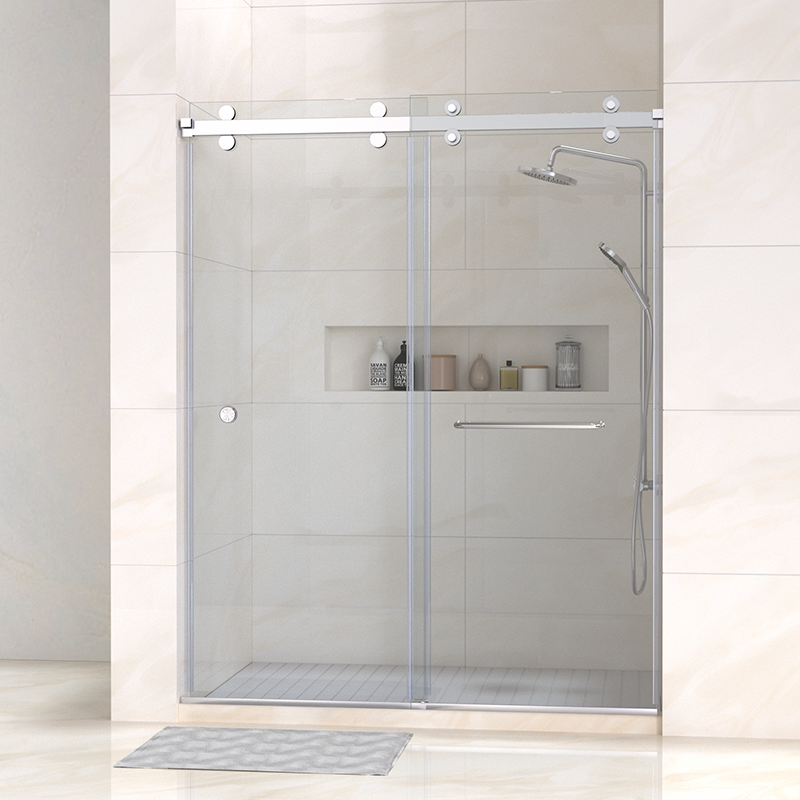
Two details make installation predictable. First, headers ship oversize on purpose: the 889’s longest header kit is 63″ (1600 mm) and the 809/808 kits are 72″ (1830 mm), each cuttable on site to the exact opening — measure the finished opening, not the stud-to-stud dimension, before cutting. Second, the 889’s 180-degree wall-to-wall installation needs only the 180° standard kit; there is no separate corner package to quote for straight-run layouts.
Installation sequence matters too: the header must be dead level or the door will self-drift to one end. The full survey-to-commissioning workflow is covered in the professional frameless installation guide, and the sliding-specific hardware choices slot into the wider framework of the frameless shower door hardware guide.
Keeping the glide: roller and track maintenance
- Rinse the track. Grit in the track is the main roller killer. A monthly rinse and wipe of the header channel removes the abrasive paste that soap and skin cells otherwise create.
- Check roller play. Lift each door leaf gently at the handle; any knocking or lateral play points to a worn carriage before the user ever complains.
- Keep the weight honest. If a heavier glass ever replaces the original panel, re-check the 40 kg limit — rollers are rated as a system, not per wheel.
- Lubricate sparingly. Sealed roller bearings need no oil; silicone spray on the track edges is the most that should ever be applied, and nothing greasy that traps grit.
Frequently asked questions
How heavy can a sliding shower door be?
The moving panel must weigh less than 88 pounds (40 kg) on Zimmor’s current 304 stainless systems (889, 809, 808). Since tempered glass weighs about 2.5 kg per square metre per millimetre of thickness, a 10 mm leaf reaches that limit at roughly 1.6 m² — calculate the panel before finalising the height, or step down to 8 mm glass for taller doors.
Should I choose aluminum or stainless steel track?
Both families are built for wet environments. Anodized aluminum kits (865/858/855) offer a defined rail profile with concealed in-rail rollers and suit budget-conscious projects — but confirm the glass pairing, because the 865 takes 6 mm while the 858/855 take 10 mm. Stainless systems (889/809/808) give the all-glass European look, take 8–10 mm glass, and on the 889/808 capture the panel with rollers above and below the header. For coastal or heavy-scale commercial work, stainless is the conservative choice.
Can a sliding system work in a corner shower?
Yes — the deciding spec is the fixed-glass configuration. Systems 865, 858, 855 and 889 take fixed panels at either end or both sides at 180° for straight wall-to-wall runs, while system 808 also supports fixed panels at 90°, which is what an L-shaped or corner enclosure needs. Pick the configuration first, then set the header width from the finished opening.
Summary
A sliding shower door system is specified in four moves: pick the track material (anodized aluminum or 304 stainless), match the glass to the system (6 mm on the 865; 10 mm on the 858/855; 8–10 mm on the stainless kits), keep the moving leaf under the 40 kg limit, and choose the configuration — one slider plus a fixed panel on the 809, 180° double sliding on the 889, or 90°/180° corner layouts on the 808. For an all-glass feature door start with the Double Sliding Door System 889; for a standard alcove build, the System 809 pairs one sliding leaf with a fixed panel; and for a 6 mm bath-screen budget, the System 865 keeps the mechanism fully concealed in the rail.