

Short answer: a frameless shower door that sags, drags, swings unexpectedly or leaks may have an alignment, fixing, gasket, threshold or hardware issue. Those symptoms do not prove that a hinge simply needs tightening. Because the glass panel is heavy and the hardware supports it, use the exact hinge documentation and a qualified installer before disturbing a loaded assembly.
This guide is a diagnosis checklist for installers and facilities teams. It does not provide a universal torque, tension setting or hinge-adjustment procedure: those values and methods depend on the exact hinge, glass, mounting surface and installation.
Record the symptom before changing the hardware
Note where the door stops, which edge moves out of position, whether the panel contacts the curb or fixed glass, and where water appears. Photograph the hinge model, gasket arrangement and visible clearances. Compare the installation with the approved enclosure drawing and the hinge manufacturer’s instructions.
| Observed symptom | Possible areas to check | Safe next step |
|---|---|---|
| Door edge drags or sits unevenly | Panel alignment, hinge seating, mounting surface, fixing condition and glass geometry | Keep the door supported and have a qualified installer assess the full assembly. |
| Door swings or does not close as expected | Hinge design, adjustment range, enclosure geometry and installation instructions | Identify the exact hinge model before any adjustment. |
| Water escapes at a corner or edge | Seal profile and contact, panel alignment, opening direction and threshold water management | Locate the escape path; do not assume a hinge adjustment will correct it. |
| Glass moves in a fitting, or hardware is loose | Gaskets, fixing components, substrate and possible glass or fitting damage | Stop using the door and arrange an installer inspection. |
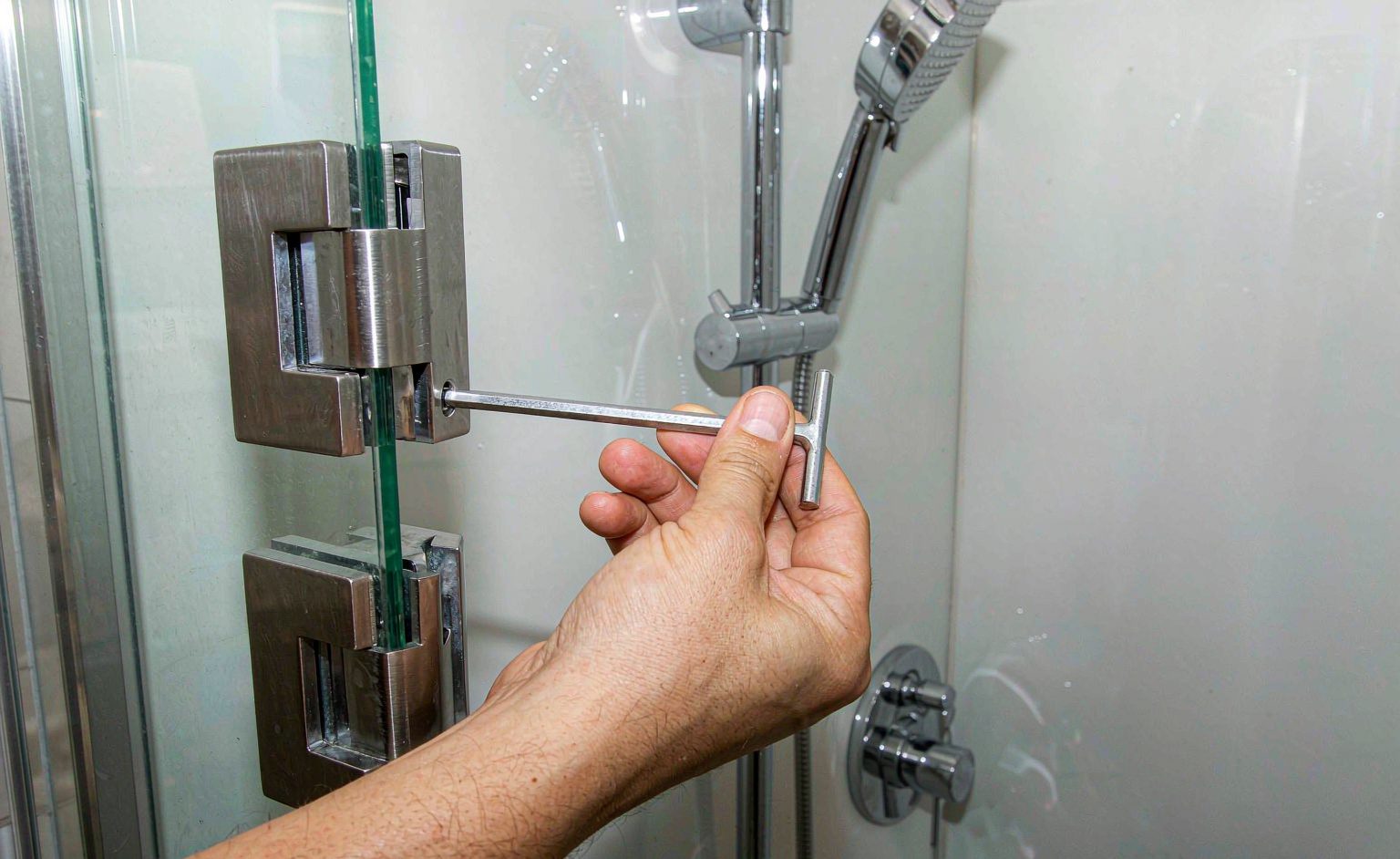
Why a generic torque or tension value is not enough
Hinge models can use different clamping arrangements, gasket stacks, fasteners and adjustment mechanisms. A torque value or pivot setting from another model may not apply, even when the hinges look similar. Use the model-specific drawing and instructions; if those documents do not give a value or procedure, request written guidance from the supplier or manufacturer.
Do not loosen a hinge on a suspended glass panel to “see if it moves,” and do not use an impact driver to compensate for uncertain torque. If a fixing appears loose, support the panel and have the installation assessed before operation resumes.
Separate hinge issues from seal and drainage issues
A leak can come from a worn or incompatible seal, a changed door position, a gap at the threshold, or the way water is directed to the drain. Inspect the meeting edge, jamb, hinge-side gap and bottom sweep as separate locations. See the frameless shower-door leak guide and seal specification guide before ordering parts.
When to stop using the enclosure
Stop use and restrict access if the glass is cracked, chipped at an edge, visibly shifting in a fitting, striking another surface, or supported by loose or damaged hardware. Do not attempt to realign or remove the glass while it is unsupported. Arrange inspection by a qualified glass or shower-door installer.
For a replacement or adjustment plan, identify the exact hinge and provide the enclosure drawing, panel dimensions, glass specification, mounting details and observed symptom. Zimmor’s hinge selection guide and installation checklist cover the broader specification and installation review.
Frequently asked questions
Can I adjust a frameless shower door without removing the glass?
Some models allow specified adjustments in place, while other repairs require the panel to be supported or removed. Follow the exact manufacturer instructions and use a qualified installer; do not loosen a loaded hinge based on a general guide.
Why does a frameless shower door sag?
Possible causes include panel alignment, hinge seating, fixings, the mounting surface, gaskets or glass geometry. Sagging alone does not identify a loose bolt. Have the complete assembly checked against its drawing and model instructions.
Do all shower hinges have an adjustable tension screw?
No. Adjustment mechanisms vary by model, and some hinges do not provide the same pivot-tension feature. Confirm the exact product documentation before attempting any change.
When should I stop using a shower door?
Stop use if glass is damaged or shifting, hardware is loose, or the panel contacts another surface. Keep people away from the door and arrange an inspection by a qualified installer.
Summary
Diagnose the door, hinge, seals, mounting surface and threshold together. Do not apply generic torque or pivot settings to an unidentified model. Record the hinge and glass details, follow current product instructions, and have a qualified installer handle work on a loaded glass panel.