
For hotels and large-scale projects, the key things to look for in frameless shower door handles are: a mounting method that matches the glass fabrication plan, durable materials such as stainless steel or solid brass, a finish that can be reordered consistently across phases, and a supplier who can document and repeat the same specification over multiple orders. Style matters, but in a project with dozens or hundreds of identical bathrooms, handle selection is really a specification and supply-chain decision.
Why handle selection is different for hotels and large projects
In a single residential bathroom, a handle is often chosen by look and feel. In a hotel or multi-unit project, the same handle may need to be repeated across guest rooms, public washrooms, and back-of-house areas, installed by different teams, and reordered years later for renovations.
That changes the buying question from “which handle looks best?” to “which handle can be specified, approved, installed, and replaced consistently?” Common project conditions that affect the choice include:
- High daily open-and-close cycles compared with residential use.
- Multiple glass thicknesses across different bathroom layouts.
- A need for matched finishes across hinges, handles, clamps, and support bars.
- Procurement through contractors, distributors, or private-label brands rather than direct consumer purchase.
- Repeat orders for phased handover, refurbishment, or expansion.
Because of these conditions, project buyers usually evaluate handles alongside the rest of the enclosure hardware rather than in isolation. A coordinated hardware package helps avoid mismatched finishes and dimensional surprises on site.
The core comparison criteria for project buyers
The criteria below are the ones that most often determine whether a handle works in a large-scale setting. They are not ranked in a single fixed order, because the priority shifts with project type.
1. Mounting method: hole-mounted vs. slot-fit vs. glass-bonded
Mounting method is one of the first decisions because it affects glass fabrication, installation labor, and future replacement.
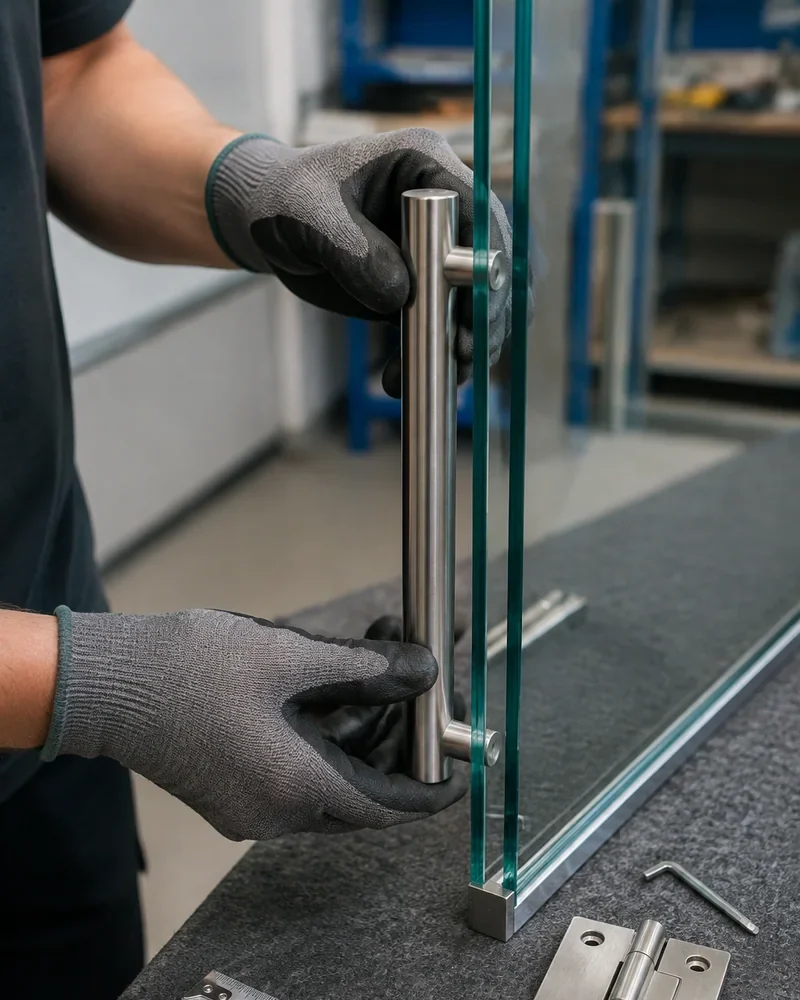
- Hole-mounted handles use drilled holes in the glass. This is a well-established approach in frameless shower construction, but it requires the glass to be drilled before tempering, since post-tempering drilling is generally not possible.
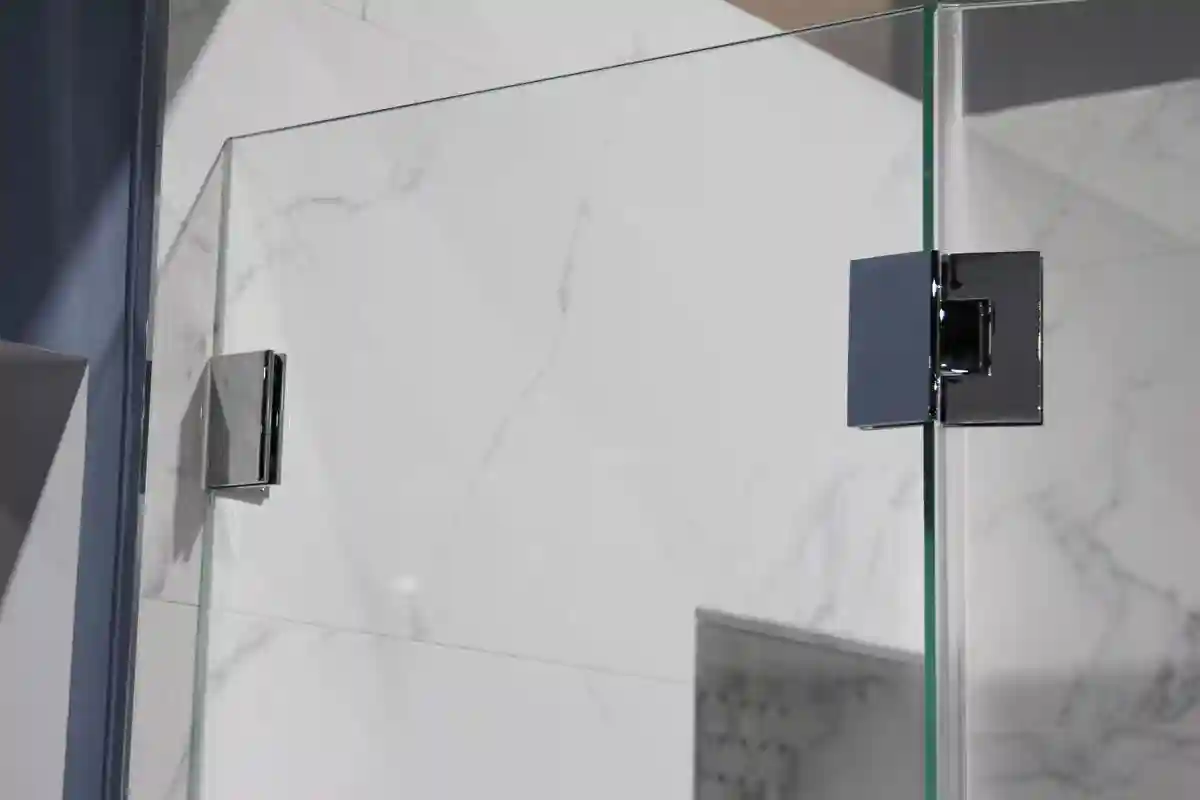
- Slot-fit or clamp-based hardware does not depend on drilled handle holes in the same way, and can suit projects that want to standardize glass panels or reduce drilling steps.
- Bonded or adhesive-mounted hardware is used in some applications, but load capacity and long-term performance depend heavily on surface preparation, adhesive system, and the specific product’s stated limits.
For a hotel, the practical question is whether the glass fabricator, the installer, and the hardware supplier are all working from the same glass drawing. A mismatch here is one of the more common causes of site delays.
2. Material and finish durability
Handles sit in a wet, warm, and often chemically cleaned environment. Material choice should be based on the expected service conditions rather than appearance alone.
- Stainless steel 304 is a common choice for interior bathroom hardware. Stainless steel 316 is often selected where higher corrosion resistance is wanted, such as coastal or more aggressive environments.
- Solid brass is used for a heavier feel and for certain finish aesthetics, though it is generally a higher-cost material.
- Zinc alloy and aluminum appear in some hardware categories, with the appropriate choice depending on the component and its structural role.
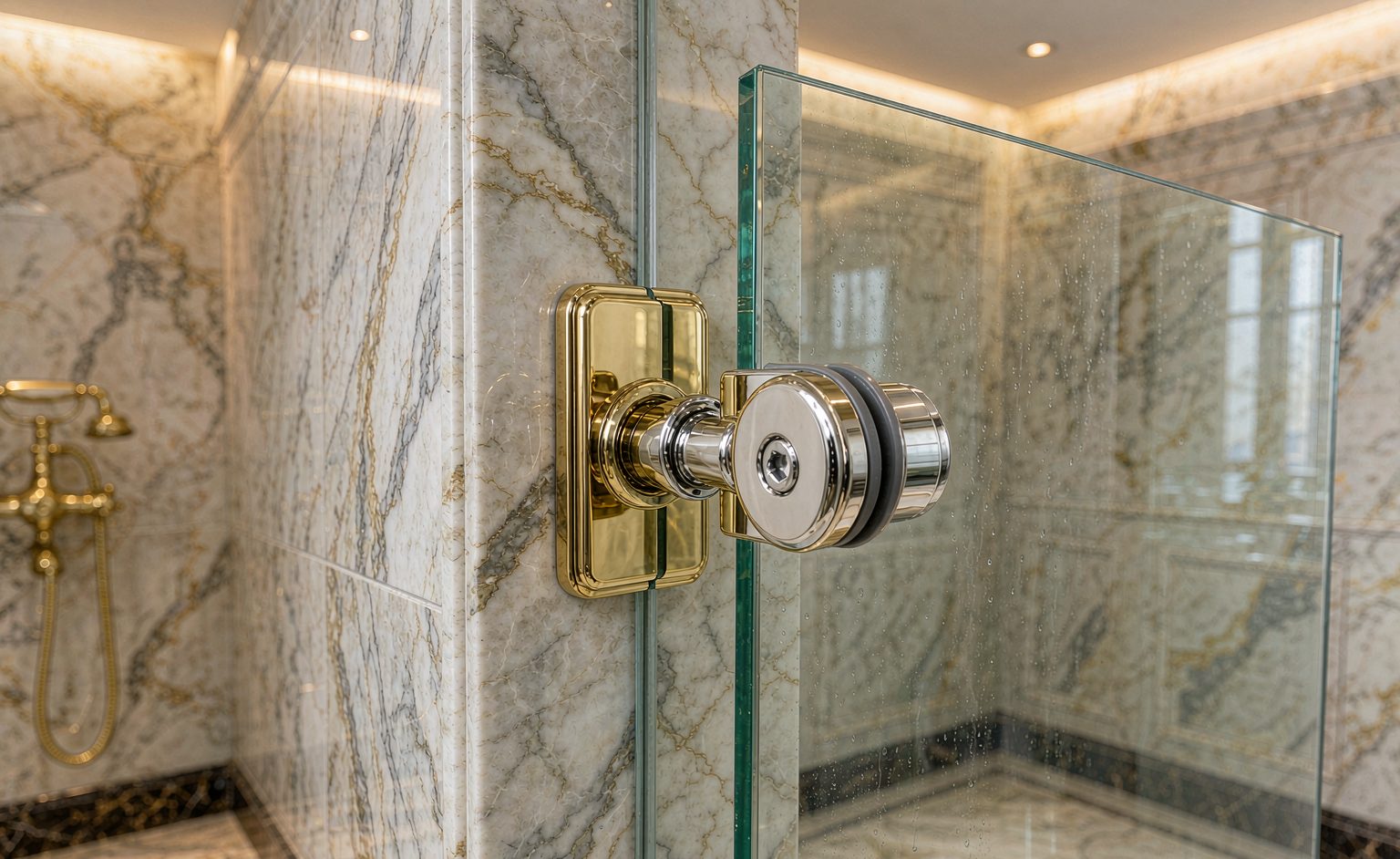
Finish is a separate decision from base material. Polished chrome, matte black, brushed nickel, brushed gold, satin brass, gun metal, and antique bronze are among the finishes commonly specified for hotel bathrooms. Finish consistency across a batch matters as much as the finish name, because two orders of “matte black” from different processes or suppliers may not visually match.
3. Batch consistency and color matching
In a project with hundreds of bathrooms, minor finish variation becomes visible when handles, hinges, and clamps are installed side by side. Buyers typically want to know:
- Can the same finish be repeated across production runs?
- Is the finish applied in-house or outsourced, and how is it controlled?
- Can a sample be approved and retained as a reference for later orders?
Processes such as in-house electroplating and PVD coating can support more controlled color matching, but the appropriate finish system depends on the base material and the target appearance.
4. Dimensions and compatibility with the door
Handle dimensions need to be checked against the glass thickness, the clearance available, and the door size. A handle that is comfortable on a 900 mm door may feel differently on a wider pivot door. Relevant checks include:
- Glass thickness range the handle is designed for.
- Distance from the door edge and from any hinge or latch position.
- Whether the handle doubles as a towel bar or is a pure pull.
- Clearance to adjacent walls, glass panels, or fixtures.
Because these depend on the specific enclosure geometry, they should be confirmed against the bathroom layout rather than assumed from a catalog photo.
5. Safety and code considerations
Relevant building, accessibility, and safety requirements vary by region and by project classification, and they should be confirmed with the project’s code consultant or specifier. In general terms, hotel bathrooms may need to consider:
- Reach and grip requirements for accessible guest rooms.
- Whether handles are within the door’s safe operating clearances.
- Appropriate glass type and thickness for the enclosure, which is a glass specification question rather than a handle question.
Handle selection does not replace the glass and enclosure specification. It should be coordinated with it.
How frameless shower door handles for hotels compare by project type
The right handle depends on the enclosure design and the guest experience target. The table below summarizes typical considerations rather than prescribing a single answer.
| Project context | Often preferred handle characteristics | Main trade-off to check |
|---|---|---|
| Standard hotel guest bathrooms | Simple, easy-to-clean profile with consistent finish across rooms | Cleaning access and finish durability under repeated cleaning |
| Luxury or boutique hotels | Coordinated finish with hinges and clamps; heavier feel | Cost and longer lead time for custom finishes |
| Large multi-phase developments | Repeatable specification, retained approval sample, documented reorder process | Supplier’s ability to hold the same finish and dimensions over time |
| Accessibility-focused rooms | Shape and mounting that supports grip and reach | Must be checked against applicable accessibility requirements |
| Coastal or high-humidity locations | Higher corrosion-resistance material and finish choices | Confirmation of the material grade and finish system |
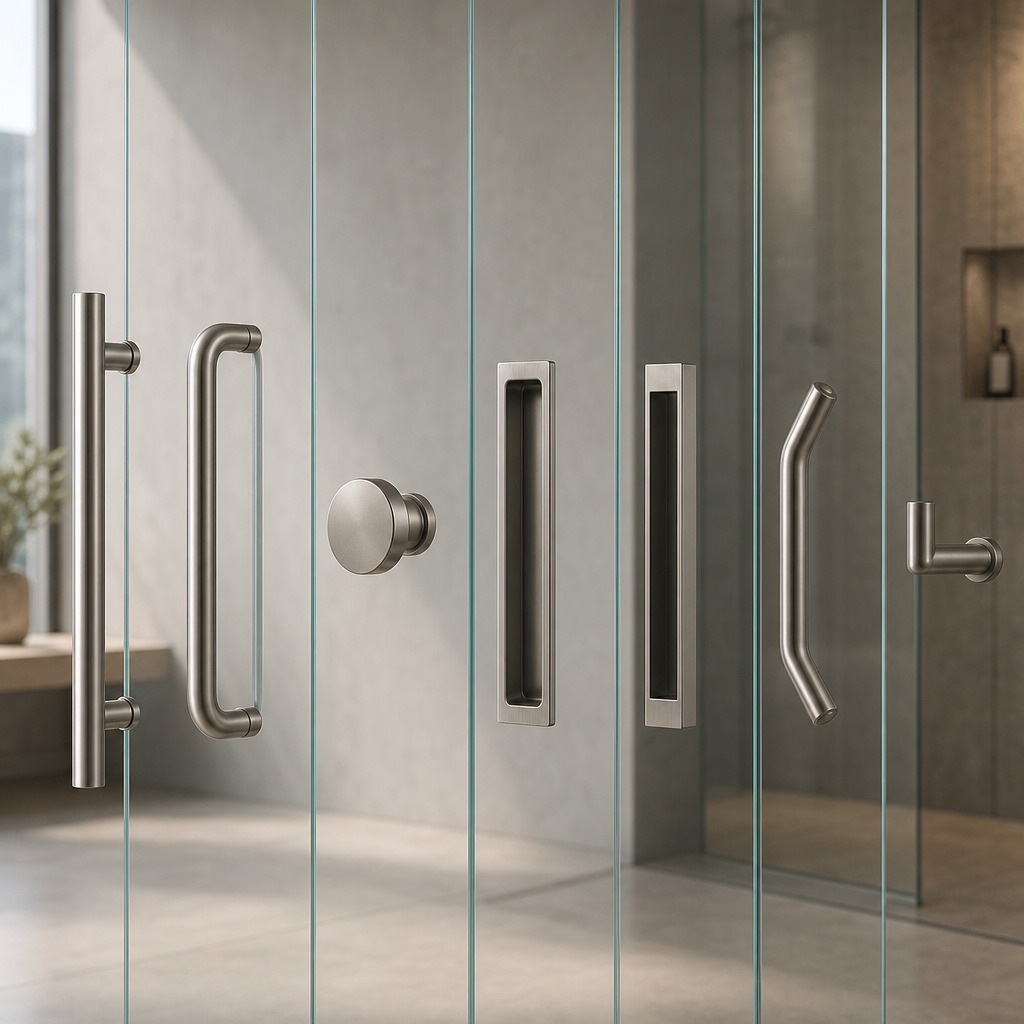
Different handle profiles are also available, such as straight tubular bars, U-shaped pulls, round knobs, recessed C- or D-shape pulls, square tube profiles, angled pulls, and L-shaped pulls. The profile affects grip, cleaning, and visual weight, so it should be matched to the guest-facing design intent.
Documentation and supply factors that reduce project risk
For procurement teams, the supplier side is often where projects succeed or fail. Useful things to request and verify include:
- Material grade stated for each component, not only a finish name.
- Drawings or dimensional data sufficient for the glass fabricator to prepare shop drawings.
- An approved sample that can be retained as a production reference.
- A stated reorder process for later phases or refurbishment.
- Packaging and labeling that suit site distribution, especially for private-label or multi-site delivery.
- Quality inspection points covering incoming material, semi-finished components, and finished goods.
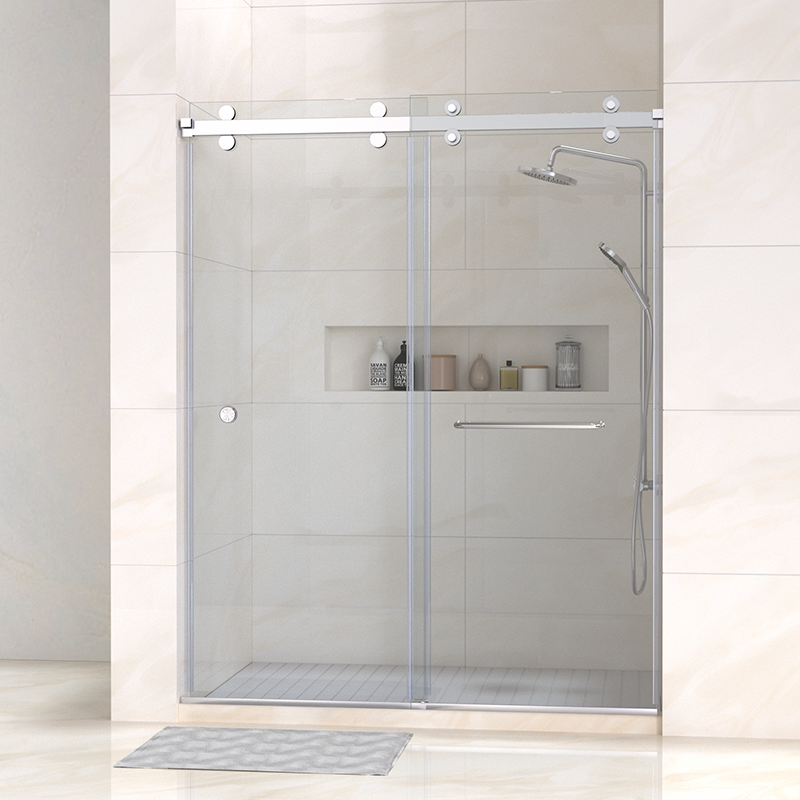
Where a project requires coordinated supply across hinges, handles, clamps, support bars, and sliding-system parts, sourcing them from one manufacturing source can simplify finish matching and dimensional compatibility. It can also reduce the number of separate approvals a contractor has to manage.
OEM, ODM and private-label options for hotel projects
Hotel groups and bathroom brands sometimes want hardware that carries their own branding or fits a particular design language. In those cases, custom manufacturing becomes part of the handle decision.
Typical customization areas include dimensions, structure, materials, finishes, colors, logo engraving, packaging, and labeling. Buyers can approach this in two ways:
- OEM — manufacture based on an existing customer design, drawing, or sample.
- ODM — develop a product from concept through design, prototyping, tooling, and production.
Zimmor Hardware is a B2B frameless shower hardware manufacturer based in Foshan, Guangdong, producing hinges, glass clamps, handles and knobs, support bars, U-channels, and sliding shower systems. Its OEM and ODM programs cover custom dimensions, structures, finishes, materials, logo engraving and private-label packaging, which is relevant when a hotel project needs a consistent, repeatable hardware specification rather than a one-off purchase. For hotel and resort projects specifically, the company supports coordinated supply so that hinges, handles, clamps, and bars can be specified with matching finishes and dimensions.
Specification checklist for a hotel or large-scale project
Before confirming a handle order, it helps to have the following settled:
- Confirmed glass thickness and mounting method for each bathroom type.
- Agreed material grade for the handle body and fixings.
- Approved finish sample, with a note on how it will be repeated.
- Dimensions verified against the enclosure drawing.
- Coordination confirmed with hinges, clamps, and support bars.
- Accessibility and safety requirements reviewed with the project specifier.
- Reorder and warranty terms clarified with the supplier.
- Packaging and labeling plan agreed for site delivery.
Frequently asked questions
Are frameless shower door handles different from standard door handles?
Yes. Frameless shower door handles are designed to mount on glass, so their fixings and load paths differ from handles used on timber or metal doors. The mounting method, glass preparation, and material choice all follow glass enclosure practice.
What material is best for hotel shower door handles?
There is no single best material for every project. Stainless steel 304 is a common choice for interior hotel bathrooms, stainless steel 316 is often selected for higher corrosion resistance, and solid brass is used where a heavier feel or a specific finish is wanted. The right choice depends on environment, budget, and design intent.
Can frameless shower door handles be supplied with matching finishes across a project?
Finish matching is achievable when the supplier controls the finishing process and retains an approved reference sample. It is worth confirming how finish variation is managed across batches before a multi-phase order is placed.
Do hotel shower door handles need to meet accessibility requirements?
Accessibility requirements vary by country, region, and project classification. In many projects, accessible guest rooms have specific grip, reach, and clearance expectations, so the handle should be confirmed with the project’s code consultant or specifier rather than selected solely on appearance.
Can handles be customized for a hotel brand?
Customization can include dimensions, materials, finishes, colors, logo engraving, and private-label packaging. For OEM, the supplier works from an existing design, drawing, or sample; for ODM, the supplier supports development from concept through production. Which route fits depends on how complete the buyer’s own design already is.
How should handle quantity be planned for a hotel project?
Quantity planning depends on the number of bathroom types, the number of rooms using each type, and the allowance for spares and future refurbishment. It is usually coordinated with the full hardware schedule for hinges, clamps, and bars rather than estimated from handle counts alone.
What to do next
Start by confirming the glass specification and mounting method, then select material and finish, then verify batch repeatability and documentation with the supplier. If the project involves multiple bathroom types or phased delivery, it is worth aligning the handle specification with the rest of the frameless shower hardware from the same source to keep finishes and dimensions consistent. For projects that need a repeatable, project-ready hardware package, a brief that includes glass thickness, enclosure drawings, finish reference, and expected volumes will make the supplier conversation more concrete.